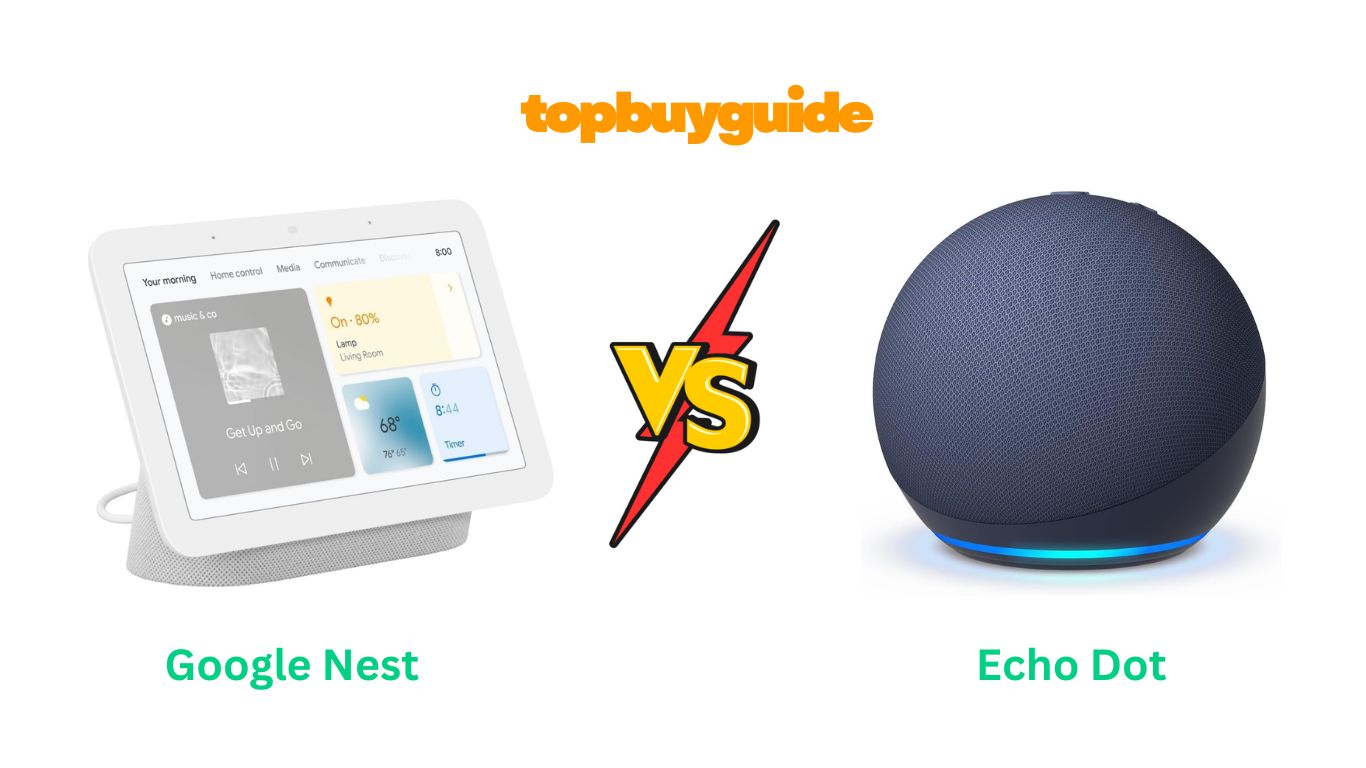
Choosing between Google Nest Hub and Echo Dot defines your smart home ecosystem. I recommend the Google Nest Hub for comprehensive functionality. Its 7-inch touchscreen displays recipes, videos, and photo slideshows beautifully. Google Assistant provides superior search accuracy and contextual understanding. The visual interface transforms how you interact with smart technology daily.
Why Do I Recommend The Google Nest Hub?
The Google Nest Hub delivers multi-sensory experiences that audio-only speakers cannot match effectively.
- Visual Display Advantage – The Google Nest Hub features a 7-inch touchscreen displaying 1024 x 600 resolution content. You can watch recipe videos, view security camera feeds, and control smart home devices visually. Conversely, the Echo Dot relies entirely on audio feedback with only LED lights. Visual interfaces prove dramatically more intuitive for complex tasks.
- Superior Video Streaming – With the Nest Hub, you can stream YouTube, Netflix, Hulu, and other services directly on the built-in screen. The visual experience enhances entertainment consumption significantly. Meanwhile, the Echo Dot offers only audio content without any video playback capability. The display transforms the device into a complete multimedia center.
- Google Search Integration – Google Assistant leverages the world’s most powerful search engine for answering questions. The accuracy and depth of responses consistently exceed competitors. While Alexa performs well, Google’s search integration provides more comprehensive and contextually relevant information. The knowledge base difference proves substantial for curious users.
- Digital Photo Frame Function – The Nest Hub seamlessly integrates with Google Photos displaying your memories as rotating slideshows. The feature transforms idle time into nostalgic experiences. The Echo Dot cannot display photos at all, limiting its decorative and sentimental value. This ambient functionality adds meaningful value beyond utilitarian purposes.
- Better Kitchen Companion – The touchscreen displays recipe instructions step-by-step with photos and videos. You can advance through cooking steps with voice commands while your hands are messy. The Echo Dot requires memorizing audio instructions without visual reference. The difference dramatically impacts cooking success and convenience.
- Sleep Sensing Technology – The Nest Hub’s 2nd generation includes Soli radar for contactless sleep tracking. It monitors breathing patterns, movement, and sleep disturbances without wearables. The Echo Dot offers no sleep tracking whatsoever. The health insights prove valuable for understanding and improving sleep quality.
- Gesture Controls – The Nest Hub recognizes hand gestures allowing you to pause music or snooze alarms without touching or speaking. Simply wave your hand near the device. While the Echo Dot 5th gen added tap controls, gesture recognition feels more futuristic. The hands-free control proves especially convenient during cooking or illness.
- YouTube Integration – Native YouTube support on the Nest Hub provides unlimited entertainment, tutorials, and educational content. The visual format suits YouTube’s content perfectly. The Echo Dot cannot display YouTube videos, only playing audio. For YouTube enthusiasts, the Nest Hub proves indispensable.
Side By Side Comparison Chart Google Nest vs Echo Dot
| Feature | Google Nest Hub | Echo Dot |
| Display | 7″ touchscreen (1024×600) | No display (LED ring only) |
| Voice Assistant | Google Assistant | Amazon Alexa |
| Video Streaming | YouTube, Netflix, Hulu | No video capability |
| Photo Display | Yes (Google Photos) | No |
| Sleep Tracking | Yes (Soli radar sensor) | No |
| Gesture Control | Yes (hand wave detection) | Tap gestures only |
| Speaker Size | Full-range speaker | 1.73″ front-firing driver |
| Camera | No camera | No camera |
| Smart Home Hub | Thread support | Zigbee, Matter, Thread |
| WiFi Extender | No | Yes (eero built-in) |
| Temperature Sensor | No | Yes (built-in) |
| Motion Sensor | No | Yes (built-in) |
| Display Size | 7 inches diagonal | N/A |
| Dimensions | 7.02″ x 4.65″ x 2.65″ | 3.9″ x 3.9″ x 3.5″ |
| Weight | 16.9 oz (480g) | 10.7 oz (304g) |
| Bluetooth | Bluetooth 5.0 | Bluetooth (version unspecified) |
| Audio Output | 3.5mm jack | No audio output jack |
| Colors | Chalk, Charcoal, Mist, Sand | Charcoal, Glacier White, Deep Sea Blue |
| Price | $99.99 | $49.99 |
| Ideal Use | Kitchen, living room, bedroom | Bedroom, bathroom, small rooms |
| Clock Display | Always-on customizable | LED clock (with Clock version only) |
What Common Google Nest vs Echo Dot Can Do?
Both smart speakers share fundamental voice assistant capabilities transforming homes into responsive, intelligent environments.
Voice-Activated Music Streaming – Both the Google Nest Hub and Echo Dot stream music from popular services hands-free. The Nest Hub supports YouTube Music, Spotify, Pandora, and other platforms seamlessly. The Echo Dot streams Amazon Music, Spotify, Apple Music, and Pandora with equal ease. Both devices deliver room-filling sound suitable for casual listening. Voice commands like “play relaxing music” or “play top hits” work intuitively on both platforms. The streaming quality depends on your subscription tier and internet connection speed.
Smart Home Device Control – Both speakers function as central smart home controllers connecting compatible devices throughout your house. The Nest Hub controls Google Nest thermostats, cameras, doorbells, and third-party devices supporting Google Home integration. The Echo Dot controls Ring doorbells, Amazon Smart plugs, Philips Hue lights, and countless Alexa-compatible devices. Both support voice commands like “turn off bedroom lights” or “set thermostat to 70 degrees.” The ecosystems differ but both offer comprehensive smart home management capabilities.
Alarm and Timer Functionality – Both devices excel as bedside alarm clocks with voice-controlled alarm setting. You can say “set alarm for 7 AM” or “wake me up at 6:30” without touching anything. Multiple alarms accommodate different weekday and weekend schedules. Timer functions prove invaluable in kitchens for cooking. Both allow you to set, check, and cancel multiple simultaneous timers. The reliability matches traditional alarm clocks while adding voice convenience.
Weather and News Updates – Both smart speakers provide current weather forecasts and news briefings on demand. The Nest Hub displays weather visually with graphics and multi-day forecasts. The Echo Dot delivers weather information through audio descriptions. Both can integrate weather into morning routines. News briefings come from customizable sources matching your preferences. Both update information in real-time reflecting current conditions accurately.
Hands-Free Calling and Messaging – Both devices enable voice calling and messaging within their respective ecosystems. The Nest Hub supports Google Duo video calls (though without camera) and voice calls. The Echo Dot facilitates calls to other Alexa devices and phone numbers. Both support Drop In features for household intercom functionality. Messaging works through voice commands dictating messages to contacts. The communication features connect distributed households effectively.
Podcast and Audiobook Playback – Both smart speakers access extensive podcast libraries through various platforms. The Nest Hub plays podcasts from Google Podcasts, Spotify, and other services. The Echo Dot streams podcasts through Amazon Music, Spotify, and Audible. Audiobooks play through their respective services seamlessly. Voice commands control playback speed, skipping, and bookmarking. Both remember your position for continued listening across sessions.
Question Answering and Knowledge Queries – Both voice assistants answer factual questions leveraging massive knowledge databases. Google Assistant taps Google’s search engine for comprehensive answers. Alexa uses Bing search and curated knowledge sources. Both handle conversions, calculations, definitions, and general knowledge questions. The accuracy depends on question complexity and phrasing. Both improve continuously through machine learning updates.
Routine Automation – Both platforms support routine creation automating multiple actions with single triggers. Morning routines might include weather reports, news briefings, light adjustments, and thermostat changes. The Nest Hub creates routines through the Google Home app. The Echo Dot uses the Alexa app for routine configuration. Both support time-based triggers and voice command triggers. The automation capabilities transform daily repetitive tasks significantly.
Common Features of Google Nest vs Echo Dot
| Feature | Google Nest Hub | Echo Dot |
| Voice Control | Yes (Google Assistant) | Yes (Alexa) |
| Music Streaming | Yes | Yes |
| Smart Home Control | Yes | Yes |
| Alarm Clock | Yes | Yes |
| Timers | Yes | Yes |
| Weather Updates | Yes | Yes |
| News Briefings | Yes | Yes |
| Voice Calling | Yes | Yes |
| Intercom/Drop In | Yes | Yes |
| Podcasts | Yes | Yes |
| Audiobooks | Yes | Yes |
| Question Answering | Yes | Yes |
| Bluetooth Connectivity | Yes | Yes |
| WiFi Connectivity | Yes (2.4/5GHz) | Yes (2.4/5GHz) |
| Multi-Room Audio | Yes | Yes |
| Routine Automation | Yes | Yes |
| Third-Party Skills | Yes | Yes |
| Volume Control | Yes (voice + touch) | Yes (voice + buttons) |
| Microphone Mute | Yes (physical switch) | Yes (physical button) |
| Spotify Integration | Yes | Yes |
| Pandora Support | Yes | Yes |
| Calendar Integration | Yes | Yes |
| Shopping Lists | Yes | Yes |
| Reminders | Yes | Yes |
A Detailed Comparison Of the Google Nest vs Echo Dot
Display and Visual Interface
The Google Nest Hub’s 7-inch LCD touchscreen fundamentally transforms user interaction beyond audio-only smart speakers. The 1024 x 600 resolution displays crisp text, vibrant photos, and smooth video playback. Ambient light sensors automatically adjust brightness preventing eye strain in dark rooms. The visual feedback makes confirming commands, viewing security cameras, and following recipes dramatically easier.
The Echo Dot lacks any display except LED light indicators communicating device status. The 5th generation added an LED clock option showing time, temperature, and timers. While the minimalist approach reduces distractions, it severely limits functionality. Visual learners and tasks requiring reference materials suffer without screen support.
Voice Assistant Intelligence
Google Assistant leverages Google’s search engine dominance delivering exceptionally accurate answers to complex questions. Contextual understanding allows follow-up questions without repeating context. Natural language processing handles conversational queries intuitively. Google’s knowledge graph provides comprehensive information spanning virtually any topic. The assistant excels at local business searches, directions, and general knowledge.
Amazon Alexa pioneered voice assistant technology and maintains impressive capabilities across diverse skills. The skill library exceeds 100,000 third-party integrations enabling vast functionality expansion. Alexa handles shopping, orders, and Amazon ecosystem integration seamlessly. While search accuracy lags Google slightly, Alexa’s smart home device compatibility remains industry-leading. The assistant feels more retail-focused than knowledge-focused.
Audio Quality and Performance
The Google Nest Hub includes a full-range speaker delivering balanced audio suitable for casual music listening. The sound emphasizes clarity over bass impact. Maximum volume fills small-to-medium rooms adequately. The speaker placement under the display projects sound forward. While not audiophile-grade, the audio quality exceeds expectations for its compact form.
The Echo Dot 5th generation features a 1.73-inch front-firing driver producing surprisingly robust sound for its tiny size. Amazon improved bass response and vocal clarity compared to previous generations. The spherical design projects sound omnidirectionally. Maximum volume impressively fills rooms without severe distortion. However, the single small driver cannot match larger speakers’ depth and richness.
Smart Home Ecosystem Integration
The Google Nest Hub integrates seamlessly with Google Nest products including thermostats, cameras, doorbells, and smoke detectors. Thread support enables low-power mesh networking for compatible devices. Matter protocol support promises future cross-platform compatibility. The Google Home app provides unified control across devices. However, the ecosystem remains smaller than Amazon’s with fewer third-party integrations.
The Echo Dot supports Zigbee, Matter, and Thread protocols creating a comprehensive smart home hub. Compatible device variety exceeds competitors significantly. Amazon’s ecosystem includes Ring doorbells, Blink cameras, eero routers, and countless third-party brands. The Alexa app unifies device management elegantly. Built-in eero WiFi extending adds valuable network functionality. The mature ecosystem offers unparalleled device compatibility.
Kitchen Functionality
The Google Nest Hub excels as a kitchen companion displaying recipe videos from YouTube step-by-step. Visual ingredient lists and instructions remain visible while cooking. Voice commands navigate recipe steps hands-free when hands are messy. Timers display visually making multiple timer management intuitive. Video tutorials guide techniques visually. The touchscreen controls music playback without speaking unnecessarily.
The Echo Dot functions adequately in kitchens through audio-only interactions. Voice-activated timers work reliably though managing multiple timers requires remembering names. Recipe instructions require memorization or repeated questioning. The compact size fits cramped counter spaces better. The tap-to-snooze timer feature proves convenient. However, the audio-only experience feels limiting compared to visual recipe displays.
Entertainment Capabilities
The Google Nest Hub streams YouTube, Netflix, Hulu, and other video services natively. The 7-inch screen suits casual video watching during meals or cooking. YouTube integration provides unlimited entertainment and tutorial content. The display functions as a digital photo frame showing Google Photos collections. Music playback includes album art and lyrics displays. The multimedia capabilities far exceed audio-only speakers.
The Echo Dot provides only audio entertainment without any video playback capability. Music streaming includes all major services but without visual elements. Podcasts and audiobooks play excellently through the improved speakers. Bluetooth connectivity allows phone audio streaming. The entertainment focus remains purely auditory. For video enthusiasts, the limitation proves significant and frustrating.
Sleep and Bedroom Features
The Google Nest Hub 2nd generation includes innovative sleep tracking using Soli radar technology. Contactless monitoring detects breathing patterns, movement, and sleep disturbances without wearables. Morning sleep summaries provide actionable insights improving sleep quality. Sunrise alarm simulations mimic natural dawn. The display dims completely at night preventing light pollution. However, sleep tracking requires Nest Aware subscription after trial period.
The Echo Dot functions as an excellent bedside alarm clock with customizable alarm sounds. Multiple alarms accommodate varying schedules easily. The LED clock version displays time at a glance. Temperature sensors enable bedroom climate automation. The compact 3.9-inch footprint fits small nightstands perfectly. Tap-to-snooze functionality proves convenient when groggy. However, no sleep tracking capabilities exist whatsoever.
Size and Portability
The Google Nest Hub measures 7.02 x 4.65 x 2.65 inches requiring substantial counter or shelf space. The 16.9-ounce weight feels substantial and stable. The fabric base prevents sliding on smooth surfaces. The larger footprint suits kitchens and living rooms better than cramped spaces. Placement flexibility exists but the size demands consideration. Moving between rooms requires reconfiguration.
The Echo Dot’s compact 3.9 x 3.5-inch sphere fits virtually anywhere. The 10.7-ounce weight makes relocation effortless. The small footprint suits bedside tables, bathrooms, and tight spaces perfectly. The spherical design looks attractive from all angles. Multiple Dots throughout homes remain affordable at $49.99 each. Portability enables seasonal room changes easily.
Gesture and Physical Controls
The Google Nest Hub recognizes hand gestures for controlling playback and alarms contactlessly. Waving near the device pauses music or snoozes alarms. The touchscreen provides direct interaction for complex tasks. Volume sliders adjust audio precisely. Physical switches disable microphones for privacy. The combination of gesture, touch, and voice controls offers versatile interaction methods.
The Echo Dot 5th generation added tap gesture recognition to its button controls. Tapping the top pauses music, snoozes alarms, or ends calls. Four physical buttons control volume, microphone muting, and Alexa activation. The tactile controls work reliably without looking. However, menu navigation requires voice commands exclusively. The minimal physical interface emphasizes voice-first interaction philosophy.
Price and Value Proposition
The Google Nest Hub retails for $99.99 offering substantial value for its feature set. The touchscreen display, superior voice assistant, and visual capabilities justify the premium over audio-only speakers. Sales frequently reduce pricing below $80 making it exceptionally affordable. For kitchen use, recipe display, and multimedia consumption, the investment pays dividends. The versatility exceeds single-purpose devices.
The Echo Dot costs just $49.99 making it Amazon’s most affordable Alexa device. The low price enables multiple units throughout homes economically. Frequent sales drop pricing below $30 during promotional periods. For basic voice assistant needs, smart home control, and bedroom alarms, the value proves unbeatable. The budget-friendly entry point welcomes smart home beginners.
Conclusion
The Google Nest Hub delivers superior functionality for most households. Its 7-inch touchscreen transforms interaction beyond voice-only limitations. Google Assistant’s search integration provides unmatched answer accuracy. Visual recipe displays, YouTube streaming, and photo frame capabilities add daily value. At $99.99, it costs just $50 more than the Echo Dot while offering dramatically expanded functionality. Choose the Nest Hub for comprehensive smart home experiences. [Check availability on Amazon]
FAQs
Q: Can the Echo Dot display photos like the Nest Hub?
A: No, the Echo Dot has no display screen for showing photos. Only LED light indicators communicate device status. The Echo Dot with Clock variant displays time, temperature, and timers only. For digital photo frame functionality, the Google Nest Hub’s 7-inch screen displays Google Photos slideshows beautifully.
Q: Which device has better sound quality?
A: The Google Nest Hub generally produces slightly better overall audio due to its larger full-range speaker. However, the Echo Dot 5th generation’s improved 1.73-inch driver delivers surprisingly robust sound for its tiny size with impressive bass. Neither device satisfies audiophiles, but both handle casual music listening adequately.
Q: Does the Google Nest Hub work with Alexa devices?
A: No, the Google Nest Hub uses Google Assistant exclusively and cannot communicate with Alexa devices. They operate in separate ecosystems. However, many smart home devices support both platforms simultaneously. You can control the same smart lights or thermostats from either ecosystem if devices offer dual compatibility.
Q: Can I use the Echo Dot for video calls?
A: No, the Echo Dot lacks a display and camera, preventing video calls entirely. It supports voice-only calls to other Alexa devices and phone numbers. For video calling, consider the Echo Show series with built-in screens and cameras. The Google Nest Hub also lacks a camera limiting video capabilities.
Q: Which device is better for cooking in the kitchen?
A: The Google Nest Hub excels as a kitchen companion with its touchscreen displaying recipe videos, ingredient lists, and step-by-step instructions visually. Voice commands navigate recipes hands-free while cooking. The Echo Dot requires memorizing audio instructions without visual reference, making complex recipes challenging to follow successfully.
Q: Does the Echo Dot have sleep tracking like the Nest Hub?
A: No, the Echo Dot offers no sleep tracking functionality whatsoever. The Google Nest Hub 2nd generation includes Soli radar technology monitoring breathing patterns and movement contactlessly. The sleep tracking provides valuable insights improving sleep quality. However, detailed analytics require a Nest Aware subscription after the trial period.
Q: Can both devices work as WiFi extenders?
A: Only the Echo Dot 5th generation includes built-in eero WiFi extending capability, adding up to 1,000 square feet of coverage to compatible eero mesh networks. The Google Nest Hub does not offer WiFi extending functionality. This feature makes the Echo Dot valuable for improving connectivity in WiFi dead zones.
Q: Which smart speaker is better for small bedrooms?
A: The Echo Dot suits small bedrooms perfectly with its compact 3.9-inch sphere occupying minimal nightstand space. The lightweight design prevents tipping easily. However, the Google Nest Hub’s visual alarm clock display and sleep tracking features provide superior bedroom functionality if space permits its larger 7-inch footprint.

Alex Turner is a dedicated product researcher and reviewer at TopBuyGuide.com, known for his clear, honest, and data-driven insights. He spends countless hours testing, comparing, and analyzing products to help readers make confident and informed buying decisions.