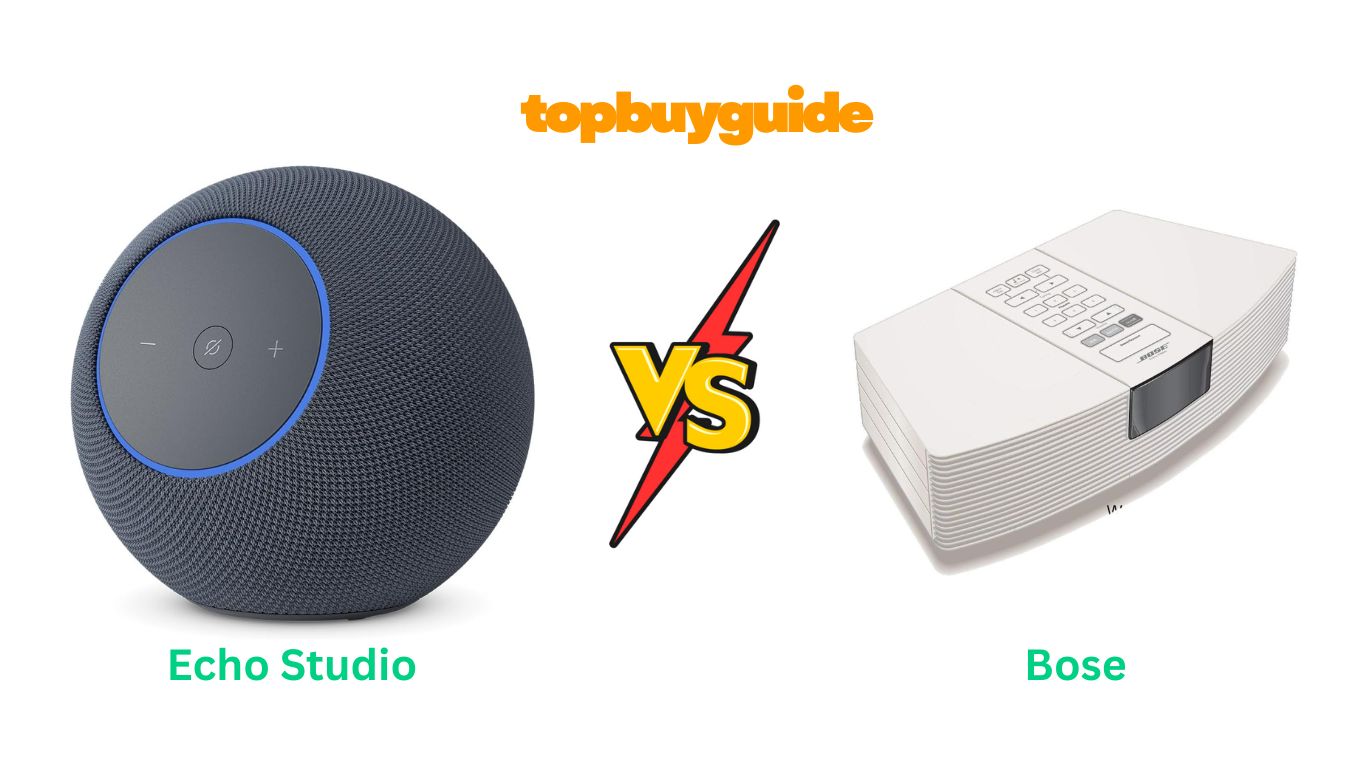
Deciding between Echo Studio and Bose Wave Radio depends on your lifestyle needs. I recommend the Echo Studio for modern homes. Its five-speaker array with Dolby Atmos creates immersive three-dimensional soundscapes. Voice control through Alexa eliminates remote fumbling. Built-in smart home hub integration streamlines device management. Unlimited streaming services replace traditional radio limitations entirely.
Why Do I Recommend The Echo Studio?
The Echo Studio represents the future of home audio with cutting-edge features that transform everyday listening experiences.
- Revolutionary Spatial Audio – The Echo Studio features five strategically positioned speakers creating three-dimensional soundscapes with Dolby Atmos technology. Sound emanates from multiple directions, wrapping you in studio-quality audio. Conversely, the Bose Wave Radio uses traditional waveguide technology producing excellent stereo sound from a single unit. The dimensional difference dramatically affects immersion.
- Voice Control Freedom – With Alexa integration, the Echo Studio responds instantly to voice commands from across the room. You can request specific songs, artists, genres, or playlists hands-free. Meanwhile, the Bose Wave Radio requires physical button presses or remote control operation. The convenience factor proves especially valuable during cooking or multitasking.
- Unlimited Streaming Access – The Echo Studio streams from Amazon Music, Spotify, Apple Music, Pandora, Tidal, and countless other services. Amazon Music HD provides 90 million lossless audio tracks. In contrast, the Bose Wave Radio limits you to AM/FM radio broadcasts and external AUX connections. Modern streaming eclipses traditional radio variety.
- Intelligent Room Adaptation – The Echo Studio automatically analyzes your room’s acoustics using advanced algorithms and far-field microphones. It fine-tunes playback for optimal sound regardless of placement. The Bose Wave Radio delivers consistent sound but cannot adapt to different room environments. This automatic optimization ensures perfect audio everywhere.
- Comprehensive Smart Home Hub – Built-in Zigbee and Matter support allows the Echo Studio to control compatible smart devices directly. Simply say “Alexa, discover my devices” for automatic setup. The Bose Wave Radio offers no smart home integration whatsoever. Central control from your speaker streamlines home automation significantly.
- Continuous Content Updates – The Echo Studio receives regular firmware updates adding new features, improving performance, and expanding capabilities. Amazon consistently enhances functionality without requiring hardware replacement. The Bose Wave Radio remains static after purchase with no update mechanism. Long-term value increases through software evolution.
- Multi-Room Audio Systems – You can group multiple Echo Studios for synchronized whole-home audio or pair two for true stereo separation. The system integrates seamlessly with Fire TV for home theater applications. The Bose Wave Radio functions only as a standalone unit. Expandability matters for growing audio needs.
- High-Resolution Audio Support – The Echo Studio plays Ultra HD music with spatial audio formats delivering studio-quality sound reproduction. Amazon Music Unlimited subscribers access millions of tracks in lossless formats. The Bose Wave Radio’s AM/FM broadcasts offer significantly lower audio quality. Audiophiles appreciate the resolution difference immediately.
Side By Side Comparison Chart Echo Studio vs Bose
| Feature | Echo Studio | Bose Wave Radio |
| Speaker Configuration | 5 speakers (3 full-range, 1 woofer, 1 tweeter) | Waveguide speaker technology |
| Audio Technology | Dolby Atmos, Spatial Audio | Proprietary waveguide |
| Power Output | 330 watts peak | Not specified |
| Voice Control | Full Alexa integration | None |
| Streaming Services | Unlimited (WiFi/Bluetooth) | None (AM/FM only) |
| Music Sources | Amazon Music, Spotify, Apple Music, Pandora, Tidal | AM/FM radio, AUX input |
| Radio | Internet radio unlimited | AM/FM broadcast only |
| Smart Home Hub | Yes (Zigbee, Matter) | No |
| Room Adaptation | Automatic acoustic analysis | No |
| Connectivity | WiFi, Bluetooth, Optical, AUX | AUX input only |
| Multi-Room Audio | Yes | No |
| Stereo Pairing | Yes | No |
| Display | LED ring indicator | LCD clock display |
| Alarm Functions | Voice-controlled, unlimited options | Dual independent alarms |
| Remote Control | Voice, app, optional physical | Included infrared remote |
| Firmware Updates | Regular OTA updates | None |
| Dimensions | 8.1″ H x 6.9″ diameter | 4.5″ H x 14″ W x 8.7″ D |
| Weight | 7.7 lbs | Approximately 7 lbs |
| Power | AC adapter | AC power cord |
| Price | $219.99 | $299-399 (varies by model) |
| Release | 2024 (latest version) | Classic model (various years) |
What Common Echo Studio vs Bose Can Do?
Both audio devices share fundamental capabilities that make them valuable additions to bedrooms, offices, or living spaces.
High-Quality Sound Reproduction – Both the Echo Studio and Bose Wave Radio deliver exceptional audio quality that surpasses basic speakers. The Echo Studio’s five-speaker array produces powerful bass, dynamic midrange, and crisp highs through sophisticated audio processing. The Bose Wave Radio utilizes proprietary waveguide technology creating room-filling sound from a compact enclosure. Both brands prioritize accurate sound reproduction with minimal distortion. Audio enthusiasts appreciate the clarity and depth both devices provide. Music lovers enjoy detailed instrumentation and vocal presence across various genres.
Alarm Clock Functionality – Both devices function as reliable bedside alarm clocks with customizable wake-up options. The Echo Studio allows you to set alarms using voice commands like “Alexa, set alarm for 7 AM.” You can choose from various alarm sounds including music, radio, or tones. The Bose Wave Radio features dual independent alarms with adjustable volume settings from 10 to 99. Both support weekday versus weekend scheduling for consistent routines. The alarm functions work reliably even during power outages with battery backup on the Bose.
Auxiliary Input Connectivity – Both audio systems include auxiliary inputs for connecting external devices like smartphones, tablets, or MP3 players. The Echo Studio provides both AUX and optical inputs for versatile connection options. The Bose Wave Radio offers a standard AUX input on the rear panel. Both allow you to play audio from non-wireless sources. This connectivity proves valuable for older devices lacking Bluetooth capability. You can enjoy content from any audio source through superior speaker systems.
Volume Control Options – Both devices offer intuitive volume adjustment through multiple methods. The Echo Studio features physical volume buttons on the top surface plus voice commands like “Alexa, volume 5.” The Bose Wave Radio includes top-mounted touch controls and remote control volume buttons. Both provide granular volume adjustment from whisper-quiet to room-filling levels. The volume ranges accommodate different listening scenarios from background music to party volumes. Gradual volume changes prevent jarring transitions.
Compact Physical Design – Both audio systems feature relatively compact designs suitable for various room placements. The Echo Studio’s cylindrical form measures 8.1 inches tall with a 6.9-inch diameter footprint. The Bose Wave Radio’s horizontal design fits comfortably on nightstands, desks, or shelves. Both use premium materials and attractive finishes complementing modern decor. The compact footprints maximize sound output while minimizing space requirements. Neither device dominates room aesthetics despite powerful audio capabilities.
Sleep Timer Functions – Both devices include sleep timer features for falling asleep to audio content. The Echo Studio accepts voice commands like “Alexa, stop in 30 minutes” for automatic shutoff. The Bose Wave Radio offers preset sleep timer durations including 75, 60, 45, 30, 15, 10, or 5 minutes. Both gradually fade audio before shutting off completely. This functionality helps users establish healthy sleep routines. The timers prevent devices from playing all night unnecessarily.
Quality Construction – Both manufacturers prioritize durable construction using premium materials. The Echo Studio features a fabric-covered exterior with a solid internal structure weighing 7.7 pounds. The Bose Wave Radio uses high-quality plastics and metals ensuring longevity. Both devices feel substantial rather than cheap or flimsy. The build quality justifies premium pricing for both products. Proper construction ensures years of reliable operation with minimal maintenance required.
Brand Reputation – Both Amazon and Bose enjoy excellent reputations for audio excellence and customer satisfaction. Amazon has invested heavily in Echo development with consistent improvements across generations. Bose established itself decades ago as an audio innovation leader with numerous patents. Both brands offer responsive customer support and comprehensive warranty coverage. Users trust both companies to deliver quality products. The strong reputations provide purchase confidence.
Common Features of Echo Studio vs Bose
| Feature | Echo Studio | Bose Wave Radio |
| High-Quality Audio | Yes | Yes |
| Alarm Clock | Yes | Yes |
| Auxiliary Input | Yes | Yes |
| Volume Control | Yes | Yes |
| Compact Design | Yes | Yes |
| Sleep Timer | Yes | Yes |
| Dual Alarms | Yes | Yes |
| Snooze Function | Yes | Yes |
| Adjustable Alarm Volume | Yes | Yes |
| Premium Build Quality | Yes | Yes |
| Remote Operation | Yes (app/voice) | Yes (infrared remote) |
| Display | Yes (LED indicators) | Yes (LCD screen) |
| Music Playback | Yes | Yes |
| Bedside Placement | Yes | Yes |
| Easy Setup | Yes | Yes |
| Reliable Performance | Yes | Yes |
| Brand Reputation | Yes (Amazon) | Yes (Bose) |
| Warranty Coverage | Yes | Yes |
| Power Adapter Included | Yes | Yes |
| Elegant Aesthetics | Yes | Yes |
A Detailed Comparison Of the Echo Studio vs Bose
Speaker Technology and Audio Quality
The Echo Studio employs five strategically positioned speakers including three full-range drivers, one high-excursion woofer, and one upward-firing tweeter. The configuration creates immersive three-dimensional soundscapes with Dolby Atmos support. Spatial audio processing technology generates wider, more enveloping sound stages. The 330-watt peak power output delivers room-filling volume without distortion.
The Bose Wave Radio utilizes proprietary waveguide speaker technology channeling sound through specially designed chambers. This acoustic architecture produces remarkably full sound from a compact single speaker system. The waveguide design creates the illusion of larger speakers through precise air movement control. While excellent for traditional stereo, it cannot match the Echo Studio’s dimensional audio experience.
Voice Control and User Interface
The Echo Studio integrates Amazon’s Alexa voice assistant providing comprehensive hands-free control. You can play music, adjust volume, set alarms, check weather, control smart home devices, and answer questions using natural language. The seven-microphone array ensures Alexa hears you clearly even during loud music playback. The voice interface eliminates physical interaction needs entirely.
The Bose Wave Radio requires manual operation through top-mounted buttons or the included infrared remote control. You must physically press buttons to change stations, adjust volume, or set alarms. While the remote offers convenience from across the room, it still requires locating and operating a physical device. The lack of voice control feels dated compared to modern smart speakers.
Music Source Variety and Flexibility
The Echo Studio provides unlimited access to streaming services including Amazon Music, Spotify, Apple Music, Pandora, and Tidal. Amazon Music HD offers 90 million songs in lossless formats with growing spatial audio collections. You can request specific songs, albums, artists, genres, or playlists instantly. Bluetooth connectivity allows streaming from any mobile device. Internet radio provides thousands of global stations.
The Bose Wave Radio limits music sources to AM/FM broadcast radio and auxiliary input connections. AM offers talk radio and news while FM provides music programming. The auxiliary input accommodates CD players, smartphones, or other external devices. However, you’re restricted to broadcast schedules and limited AM/FM sound quality. The streaming era has rendered traditional radio increasingly obsolete for music variety.
Smart Home Integration Capabilities
The Echo Studio functions as a comprehensive smart home hub with built-in Zigbee and Matter support. Compatible devices like smart lights, plugs, thermostats, and locks connect directly without additional hubs. Voice commands control your entire smart home ecosystem seamlessly. “Alexa, turn off bedroom lights” executes instantly. Drop In and Announcements enable intercom functionality throughout your home.
The Bose Wave Radio offers absolutely no smart home integration or connectivity beyond audio playback. It cannot communicate with smart devices or participate in home automation routines. The Wave Radio remains purely an audio device without modern smart home capabilities. This limitation significantly reduces its utility in connected homes where device integration creates valuable automation scenarios.
Room Adaptation and Audio Optimization
The Echo Studio features sophisticated room adaptation technology that automatically analyzes your space’s acoustics. Far-field microphones detect room reflections, dimensions, and acoustic properties. Advanced algorithms adjust audio output for optimal sound regardless of placement. Corner placement receives different tuning than open space positioning. This automatic optimization ensures consistently excellent audio everywhere.
The Bose Wave Radio produces the same audio output regardless of room placement or acoustic conditions. While the waveguide technology performs well universally, it cannot adapt to specific environments. Users must experiment with positioning to find optimal sound placement. The static output means performance varies based on room characteristics. Manual adjustment cannot match automated optimization effectiveness.
Connectivity Options and Expandability
The Echo Studio provides comprehensive connectivity including WiFi, Bluetooth, optical input, and 3.5mm auxiliary input. The optical connection enables high-quality audio from televisions for home theater applications. You can pair two Echo Studios for true stereo separation. Multi-room audio allows synchronized playback across multiple Echo devices throughout your home. Fire TV integration creates immersive home theater systems.
The Bose Wave Radio offers only auxiliary input connectivity beyond its AM/FM tuner. No WiFi, Bluetooth, or digital audio connections exist. The device functions exclusively as a standalone unit without expansion capabilities. You cannot create multi-room systems or pair multiple units. The limited connectivity reflects its traditional radio design philosophy without modern networking capabilities.
Display and Visual Feedback
The Echo Studio features a subtle LED ring at the base providing visual feedback during interactions. The light ring illuminates blue during Alexa queries and pulses during music playback. Volume adjustments and alarm activations trigger corresponding light patterns. The minimal visual approach maintains focus on audio performance. The LED indicators provide sufficient feedback without distraction.
The Bose Wave Radio includes a prominent LCD display showing time, alarm settings, radio stations, and system status. The bright display remains visible across rooms for easy time checking. Adjustable brightness prevents bedroom light pollution during sleep. The detailed display provides comprehensive information at a glance. The clock face serves as the device’s primary visual element.
Alarm Customization and Wake-Up Options
The Echo Studio offers unlimited alarm customization through voice commands and the Alexa app. You can wake to specific songs, playlists, artists, radio stations, or custom sounds. Gradual volume increase creates gentle wake-up experiences. Routine integration triggers multiple actions like adjusting lights or reading news briefings. Voice commands like “Alexa, snooze” eliminate fumbling for buttons.
The Bose Wave Radio provides dual independent alarms with radio, CD, or buzzer wake-up options. Each alarm supports separate time settings and volume levels from 10 to 99. The gradual volume increase begins softly then builds to your preset level. However, alarm sounds limit to available radio stations or external sources. Setup requires navigating button sequences rather than simple voice commands.
Update Mechanism and Future-Proofing
The Echo Studio receives regular over-the-air firmware updates adding new features and improving performance. Amazon continuously enhances Alexa capabilities, audio processing algorithms, and smart home integration. Updates install automatically overnight without user intervention. Your device improves over time rather than becoming obsolete. New music service integrations appear without hardware replacement.
The Bose Wave Radio contains no update mechanism or network connectivity for firmware improvements. The device functionality remains static from purchase throughout its lifespan. No new features, services, or enhancements ever appear. The fixed functionality eventually becomes outdated as technology evolves. Long-term value diminishes as newer capabilities emerge elsewhere.
Price Point and Value Proposition
The Echo Studio retails for $219.99 delivering premium audio quality with comprehensive smart home integration. The price includes unlimited streaming access (with separate service subscriptions), voice control, room adaptation, and expandability. Considering the feature set, it represents excellent value for modern smart homes. The investment provides cutting-edge technology at mid-range pricing.
The Bose Wave Radio commands $299-399 depending on model and availability. The higher price reflects Bose’s audio engineering reputation and waveguide technology patents. However, the limited functionality and lack of modern features make it expensive relative to capabilities. Traditional radio listeners may justify the premium for Bose sound quality. Value-conscious buyers find better features elsewhere.
Conclusion
The Echo Studio delivers superior value for contemporary homes. Its five-speaker Dolby Atmos system creates immersive audio experiences impossible with traditional speakers. Voice control through Alexa eliminates remote fumbling entirely. Built-in smart home hub saves $50-100 on additional equipment. At $219.99, it costs less than the Bose while offering exponentially more functionality. Unlimited streaming replaces limited radio broadcasts. [Check availability on Amazon]
FAQs
Q: Can the Bose Wave Radio play Spotify or Apple Music?
A: No, the Bose Wave Radio cannot directly stream Spotify, Apple Music, or other services. It only receives AM/FM radio broadcasts. You can connect a phone via auxiliary input to play streaming services, but this requires keeping your phone nearby and connected. The Echo Studio streams all services directly through WiFi.
Q: Does the Echo Studio work without internet connection?
A: No, the Echo Studio requires WiFi connectivity for streaming services and Alexa functionality. Bluetooth playback works offline from paired devices. However, the Bose Wave Radio functions completely independently without internet since it uses broadcast AM/FM signals and doesn’t require connectivity.
Q: Which device has better bass performance?
A: The Echo Studio produces significantly deeper, more powerful bass through its dedicated high-excursion woofer and larger cabinet volume. The bass extends lower and hits harder than the Bose’s waveguide technology. However, some users find the Echo Studio’s bass overwhelming and may need to reduce it through app settings.
Q: Can I use either device as a home theater speaker?
A: Yes, the Echo Studio works excellently for home theater with Fire TV devices through wireless connectivity or optical input. Dolby Atmos support creates immersive movie soundtracks. The Bose Wave Radio can connect to TVs via auxiliary input but offers only stereo sound without surround capabilities.
Q: Does the Bose Wave Radio have any smart features?
A: No, the Bose Wave Radio contains no smart features, WiFi connectivity, voice control, or app integration. It functions purely as a traditional AM/FM radio with CD player (on certain models) and alarm clock. This simplicity appeals to those wanting straightforward operation without smart technology.
Q: Can I control the Echo Studio without speaking?
A: Yes, the Echo Studio includes physical buttons on top for volume control, microphone muting, and action triggering. The Alexa app provides comprehensive control including music selection, alarm settings, and all features. You can operate it entirely through the app without voice commands if preferred.
Q: Which device is better for audio quality purists?
A: The Echo Studio offers higher resolution audio support through Amazon Music HD’s lossless formats and spatial audio tracks. The Bose Wave Radio’s AM/FM broadcasts provide significantly lower audio quality. However, the Bose waveguide technology delivers excellent sound within traditional stereo limitations. Streaming quality surpasses broadcast radio substantially.
Q: Do both devices work during power outages?
A: The Bose Wave Radio includes battery backup maintaining alarm clock functionality during power outages. The alarms will sound even without AC power. The Echo Studio requires constant AC power and doesn’t include battery backup. Loss of power means loss of all functionality including alarms.

Alex Turner is a dedicated product researcher and reviewer at TopBuyGuide.com, known for his clear, honest, and data-driven insights. He spends countless hours testing, comparing, and analyzing products to help readers make confident and informed buying decisions.