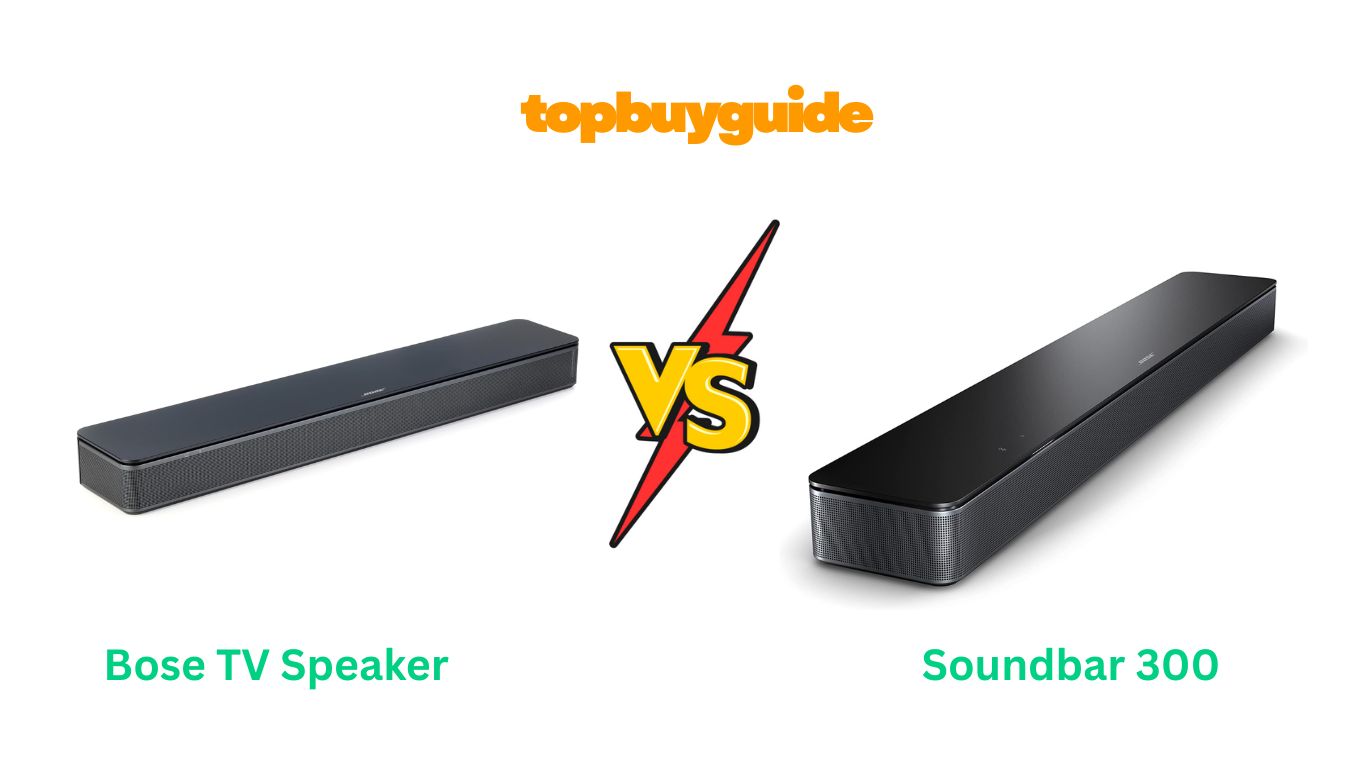
Deciding between the Bose TV Speaker and Soundbar 300 requires understanding their distinct capabilities and intended audiences. I recommend the Bose Smart Soundbar 300 for its advanced smart features and superior audio architecture. The Soundbar 300 delivers built-in voice assistants and Wi-Fi streaming capabilities that the TV Speaker lacks. Its five full-range drivers create more spacious soundscapes compared to the TV Speaker’s simpler configuration. While costing more, the Soundbar 300 provides significantly enhanced functionality.
Why Do I Recommend The Bose Smart Soundbar 300?
Built-in Voice Assistants with Advanced Control: The Soundbar 300 integrates Amazon Alexa and Google Assistant directly into the soundbar for hands-free voice control. Conversely, the TV Speaker lacks any voice assistant integration, requiring manual remote control for all operations. The Soundbar 300’s Voice4Video technology enables controlling your TV, cable box, and soundbar with single voice commands.
Superior Driver Configuration: The Soundbar 300 features five full-range drivers including a dedicated center tweeter for enhanced dialogue clarity. In comparison, the TV Speaker uses only two angled full-range drivers without dedicated center channel support. This architectural difference creates noticeably better sound separation and spatial audio performance in the Soundbar 300.
Comprehensive Wireless Connectivity: The Soundbar 300 supports Wi-Fi, Bluetooth, Apple AirPlay 2, and Spotify Connect for versatile streaming options. Meanwhile, the TV Speaker offers only Bluetooth connectivity without Wi-Fi or AirPlay 2 capabilities. This limitation restricts the TV Speaker to basic wireless streaming compared to the Soundbar 300’s comprehensive options.
Bose Music App Integration: The Soundbar 300 connects to the Bose Music app for complete sound customization including bass, treble, and center adjustments. Conversely, the TV Speaker lacks app connectivity, offering no customization beyond the remote’s basic bass and dialogue buttons. The app provides Wall EQ calibration and preset management unavailable on the TV Speaker.
Advanced SimpleSync Technology: The Soundbar 300 supports Bose SimpleSync for pairing with compatible Bose headphones and speakers in sophisticated configurations. In contrast, the TV Speaker offers limited SimpleSync functionality only with other Bose smart speakers and soundbars. The Soundbar 300 enables synchronized audio across more devices including wireless headphone pairing for private listening.
Smart Home Integration: The Soundbar 300 functions as a complete smart home hub with multi-room audio and voice-controlled smart device management. Meanwhile, the TV Speaker remains a dedicated TV audio solution without smart home capabilities or multi-room functionality. This positions the Soundbar 300 as a more versatile centerpiece for connected homes.
Enhanced Dialogue Mode Performance: The Soundbar 300’s dedicated center tweeter provides superior dialogue enhancement compared to the TV Speaker’s software-based dialogue mode. While both offer dialogue enhancement, the Soundbar 300’s hardware-driven approach delivers clearer speech with less artificial processing artifacts. The dedicated tweeter naturally emphasizes vocal frequencies without compromising overall tonal balance.
Future-Proof Expandability: The Soundbar 300 integrates seamlessly with the broader Bose Smart Family ecosystem for comprehensive multi-room audio configurations. Conversely, the TV Speaker has limited compatibility with only select Bose products requiring specific connection methods. The Soundbar 300’s smart platform ensures compatibility with future Bose products and software updates.
Side By Side Comparison Chart: Bose TV Speaker vs Soundbar 300
| Feature | Bose TV Speaker | Bose Smart Soundbar 300 |
| Driver Configuration | 2 full-range drivers | 5 full-range drivers + center tweeter |
| Power Output | 100W RMS | Not specified (higher than TV Speaker) |
| Voice Assistants | None | Amazon Alexa + Google Assistant |
| Wi-Fi Connectivity | No | Yes (dual-band) |
| Bluetooth Version | 4.2 | 5.0 |
| Apple AirPlay 2 | No | Yes |
| Spotify Connect | No | Yes |
| Bose Music App | No | Yes (full integration) |
| Voice4Video Technology | No | Yes |
| Audio Channels | 3.0 | 3.0 |
| Center Channel Tweeter | No | Yes (dedicated) |
| Wall EQ Calibration | No | Yes (via app) |
| Sound Customization | Basic (Bass & Dialogue buttons) | Advanced (Bass, Treble, Center via app) |
| SimpleSync Headphone Pairing | No | Yes |
| Multi-room Audio | Limited | Full support |
| Microphone System | No | Noise-rejecting (8-mic array) |
| Remote Control | Basic IR | Advanced IR |
| Dimensions (W x H x D) | 23.4″ x 2.2″ x 4″ | 27.5″ x 2.25″ x 4″ |
| Weight | 4.4 lbs (2 kg) | 7 lbs (3.175 kg) |
| HDMI-ARC | Yes | Yes |
| Optical Input | Yes | Yes |
| 3.5mm Aux Input | Yes | No |
| Price Range (2025) | $249-279 | $399-449 |
What Common Features Can Bose TV Speaker and Soundbar 300 Offer?
HDMI-ARC and Optical Connectivity
Both the Bose TV Speaker and Smart Soundbar 300 provide HDMI-ARC connectivity for single-cable connection to compatible televisions. This interface enables audio transmission from the TV to the soundbar while supporting HDMI-CEC control functionality. Users can control both soundbars using their existing TV remote when connected via HDMI-ARC on compatible televisions. The HDMI-ARC connection automatically powers on the soundbars when you activate your television for seamless integration.
Both models also include optical digital audio inputs with cables included in the packaging for legacy TV compatibility. The optical connection provides reliable audio transmission for televisions lacking HDMI-ARC functionality or users preferring traditional connections. Both soundbars support Dolby Digital audio formats through their optical and HDMI-ARC connections for enhanced surround sound. The dual connectivity options ensure compatibility with virtually any modern or older television on the market.
Dialogue Enhancement Mode
The TV Speaker and Soundbar 300 both feature dedicated Dialogue modes designed to enhance speech clarity in movies and shows. This mode analyzes the audio signal to separate and amplify vocal frequencies above other sound elements. Both soundbars make voices sound clearer and more intelligible, particularly beneficial for users with hearing difficulties. The Dialogue mode proves especially useful for news programs, podcasts, and dialogue-heavy television shows where speech intelligibility matters most.
Both models allow Dialogue mode to be set as persistent, maintaining the setting across power cycles without reactivation. Users can toggle Dialogue mode on or off using the included remote control with dedicated buttons. The enhancement algorithms work dynamically, adapting to different content types and adjusting vocal emphasis accordingly. Both soundbars balance dialogue enhancement without completely eliminating background music and sound effects from the audio mix.
Bass Enhancement Capabilities
Both Bose soundbars include dedicated bass boost functionality accessible through buttons on their respective remote controls. This feature temporarily increases low-frequency output for more impactful bass response during movies, music, and gaming sessions. The bass boost operates independently of dialogue mode, allowing users to combine both enhancements simultaneously if desired. Both soundbars utilize QuietPort technology with precision-designed vents to minimize distortion at higher bass levels.
The TV Speaker and Soundbar 300 both support wired connection to optional Bose Bass Module subwoofers for dramatic bass extension. Users can add the Bass Module 500 or Bass Module 700 to either soundbar using standard audio cables. The external subwoofer integration provides theater-quality low-frequency reproduction that standalone soundbars cannot physically produce within their compact housings. Both soundbars automatically detect and configure themselves when bass modules are connected for optimized performance.
Bluetooth Audio Streaming
Both models feature integrated Bluetooth technology for wireless audio streaming from smartphones, tablets, and computers without physical connections. Users can stream music, podcasts, and other audio content directly to either soundbar from Bluetooth-enabled devices. The TV Speaker and Soundbar 300 both remember previously paired devices for quick reconnection without repeating pairing procedures. Both soundbars automatically switch to Bluetooth input when previously paired devices initiate connections from their Bluetooth settings.
The remote controls for both soundbars include dedicated Bluetooth buttons for entering pairing mode and managing connections. Both models support multiple device memory, allowing switching between different users’ devices without deleting previous pairings. The Bluetooth functionality operates independently from TV connections, enabling music playback without activating the television. Both soundbars deliver high-quality wireless audio reproduction suitable for casual music listening and podcast consumption throughout your home.
SimpleSync Technology Integration
The Bose TV Speaker and Smart Soundbar 300 both support Bose’s proprietary SimpleSync technology for synchronized audio playback. This feature enables pairing either soundbar with compatible Bose smart speakers for multi-room audio configurations. Users can play synchronized audio from the soundbar to additional Bose speakers placed in adjacent rooms simultaneously. The SimpleSync pairing creates seamless whole-home audio experiences without noticeable delays between different speaker locations.
Both soundbars maintain their TV audio functionality while simultaneously streaming synchronized content to paired Bose speakers. The technology allows independent volume control on the soundbar while adjusting paired speakers separately through their controls. Both models support SimpleSync connections managed through the Bose Music app on compatible Bose smart products. The synchronized audio capability makes both soundbars versatile for both dedicated TV use and broader home audio applications.
Compact Low-Profile Design
Both the TV Speaker and Soundbar 300 feature slim designs measuring just over two inches tall for minimal visual impact. This low-profile height allows placement directly in front of televisions without blocking screen content or infrared remote sensors. Both soundbars utilize premium materials including metal grilles that provide acoustic transparency while protecting internal components from damage. The compact dimensions make both models suitable for smaller entertainment centers, shelves, and wall-mounted installations.
Both Bose soundbars support optional wall mounting using dedicated Bose wall brackets sold separately from the soundbars themselves. The wall-mounting capability enables clean installations below wall-mounted televisions for streamlined, cable-free aesthetics in modern living spaces. Both models feature understated black finishes that complement contemporary television designs without drawing excessive attention to themselves. The similar form factors ensure both soundbars integrate seamlessly into various room layouts and décor styles.
Expandable Surround Sound Systems
The TV Speaker and Soundbar 300 both serve as foundations for expandable home theater systems with optional components. Users can add Bose Surround Speakers to either soundbar for authentic rear-channel audio creating immersive surround sound experiences. Both soundbars support simultaneous connection of bass modules and surround speakers for complete 5.1-channel home theater configurations. The modular approach allows users to start with the soundbar alone and expand their system gradually as budgets permit.
Both models automatically detect and configure connected surround speakers and bass modules without complex manual setup procedures. The expandability transforms either compact soundbar into comprehensive home theater systems rivaling traditional receiver-based audio setups. Both soundbars maintain their individual functionality even when not connected to additional speakers, ensuring flexibility for different usage scenarios. The upgrade path provides long-term value for users who may want more immersive audio in the future.
Common Features Chart: Bose TV Speaker vs Soundbar 300
| Feature | Bose TV Speaker | Bose Smart Soundbar 300 |
| HDMI-ARC | Yes | Yes |
| Optical Input | Yes (cable included) | Yes (cable included) |
| Dolby Digital Support | Yes (up to 5.1ch) | Yes (up to 5.1ch) |
| Dialogue Enhancement Mode | Yes | Yes |
| Persistent Dialogue Setting | Yes | Yes |
| Bass Boost Button | Yes (remote) | Yes (remote) |
| QuietPort Technology | Yes | Yes |
| Compatible Bass Modules | 500 & 700 | 500 & 700 |
| Bluetooth Streaming | Yes | Yes |
| Multi-device Bluetooth Memory | Yes | Yes |
| SimpleSync Support | Yes (limited) | Yes (full) |
| Multi-room Audio | Yes (limited) | Yes (full) |
| Surround Speaker Compatibility | Yes | Yes |
| Wall Mount Compatible | Yes (bracket sold separately) | Yes (bracket sold separately) |
| Low-Profile Design | Yes (2.2″ height) | Yes (2.25″ height) |
| Premium Metal Grille | Yes | Yes |
| Remote Control Included | Yes | Yes |
| HDMI-CEC Support | Yes | Yes |
| Optical Cable Included | Yes | Yes |
| Power Cord Length | 5 ft (1.52m) | 5 ft (1.52m) |
A Detailed Comparison Of Bose TV Speaker vs Soundbar 300
Speaker Driver Configuration
The Bose Smart Soundbar 300 employs five full-range drivers arranged strategically across its housing for enhanced soundstage width. Four drivers handle left and right channel separation while a dedicated center tweeter focuses exclusively on dialogue reproduction. This configuration creates distinct audio imaging with clear separation between different sound elements across the stereo field. The center tweeter’s dedicated focus on vocal frequencies delivers exceptional speech clarity without requiring aggressive digital processing.
The Bose TV Speaker utilizes only two angled full-range drivers positioned to fire sound outward from the soundbar’s ends. These drivers must reproduce all frequency ranges simultaneously without dedicated tweeters or center channel separation. While the angled placement creates some spatial effect, it cannot match the Soundbar 300’s discrete driver architecture. The simpler two-driver system limits the TV Speaker’s ability to create wide, immersive soundscapes compared to its premium sibling.
Voice Assistant Integration
The Smart Soundbar 300 incorporates both Amazon Alexa and Google Assistant directly into its hardware with noise-rejecting microphone arrays. Users can issue voice commands to control playback, adjust volume, check weather, set timers, and manage smart home devices. The eight-microphone system effectively captures voice commands even during loud playback without requiring shouting or pausing content. Voice4Video technology uniquely extends Alexa capabilities to control TVs and cable boxes through single integrated voice commands.
The Bose TV Speaker lacks any built-in voice assistant functionality or microphones for voice command recognition entirely. Users must rely exclusively on the included physical remote control or their TV remote for all soundbar operations. The absence of voice control means users cannot leverage hands-free convenience for volume adjustments or content control. This fundamental difference positions the TV Speaker as a traditional audio device while the Soundbar 300 embraces modern smart functionality.
Wireless Connectivity Options
The Soundbar 300 supports comprehensive wireless connectivity including dual-band Wi-Fi, Bluetooth 5.0, Apple AirPlay 2, and Spotify Connect integration. This extensive connectivity enables streaming from virtually any device, service, or platform without physical cable connections. The Wi-Fi connectivity specifically allows integration with home networks for more stable, higher-quality audio streaming than Bluetooth alone. AirPlay 2 support provides seamless integration with Apple ecosystems, allowing iPhone and iPad users to stream with minimal latency.
The TV Speaker offers only Bluetooth 4.2 connectivity without Wi-Fi, AirPlay 2, or direct streaming service integration capabilities. This limitation restricts wireless streaming to basic Bluetooth connections from nearby devices within Bluetooth’s limited range. The older Bluetooth 4.2 standard provides adequate audio quality but lacks the improved stability and efficiency of newer versions. The TV Speaker’s connectivity simplicity appeals to users seeking straightforward operation without smart home network integration complexity.
App Control and Customization
The Soundbar 300 integrates fully with the Bose Music app providing comprehensive control over all soundbar functions and settings. Users can adjust bass, treble, and center channel levels independently through intuitive app sliders for personalized sound profiles. The app enables Wall EQ calibration that analyzes room acoustics to optimize audio output for specific listening environments. Preset creation allows saving favorite streaming services and radio stations for instant one-touch access through the app interface.
The TV Speaker lacks any smartphone app connectivity or advanced customization options beyond its remote control’s basic functions. Users can only toggle dialogue mode and bass boost using physical remote buttons without granular frequency adjustments. The absence of app integration means no room calibration, preset management, or detailed sound profiling capabilities exist. This simplified approach benefits users who prefer straightforward operation without navigating smartphone apps for basic sound adjustments.
Physical Size and Weight
The Smart Soundbar 300 measures 27.5 inches wide, making it suitable for televisions 50 inches and larger for proportional aesthetics. It weighs 7 pounds (3.175 kg), reflecting its more substantial internal components and premium construction with additional drivers. The larger physical footprint accommodates more acoustic components but requires more shelf or stand space beneath televisions. Despite the increased size, the 2.25-inch height maintains the low-profile design philosophy shared across Bose’s soundbar lineup.
The TV Speaker measures 23.4 inches wide, making it ideal for smaller televisions between 32 and 49 inches in screen size. It weighs only 4.4 pounds (2 kg), significantly lighter than the Soundbar 300 for easier handling and installation. The more compact dimensions fit smaller entertainment centers and tight spaces where the Soundbar 300 might overwhelm the setup. The reduced size necessarily limits internal acoustic volume and driver quantity compared to the larger Soundbar 300.
Price and Value Positioning
The Soundbar 300 typically retails between $399 and $449, positioning it as a premium compact soundbar with smart features. This pricing reflects the advanced voice assistant integration, comprehensive app control, and superior driver configuration justifying the investment. The higher cost targets users prioritizing smart home integration and sophisticated audio quality over budget constraints. The feature-rich package delivers substantial value for users who will actively utilize its extensive connectivity and voice control capabilities.
The TV Speaker retails between $249 and $279, offering a more affordable entry point into Bose’s soundbar ecosystem. This lower price makes premium Bose audio quality accessible to budget-conscious consumers seeking simple TV audio enhancement. The cost savings come from eliminating voice assistants, Wi-Fi connectivity, and app integration that many users may not require. For users wanting straightforward TV audio improvement without smart features, the TV Speaker provides excellent value at its price point.
Audio Processing Technology
The Soundbar 300 features real-time audio processing that automatically analyzes content type and optimizes sound profiles accordingly. This intelligent processing recognizes differences between movies, music, television shows, and gaming audio, adjusting EQ dynamically. The automatic adaptation ensures optimal sound regardless of source material without requiring manual mode switching by users. The processing happens transparently in the background, maintaining the intended creative intent of different audio content types.
The TV Speaker utilizes simpler audio processing focused primarily on dialogue enhancement and basic bass management without dynamic content recognition. The processing remains consistent regardless of whether users watch movies, listen to music, or play video games. This straightforward approach works well but cannot adapt to the specific acoustic characteristics of different content types. The TV Speaker’s processing prioritizes reliability and simplicity over sophisticated adaptive audio management found in premium models.
Smart Home Ecosystem Integration
The Soundbar 300 functions as a smart home hub capable of controlling compatible smart devices through voice commands. Users can adjust smart lights, thermostats, and other connected devices using Alexa or Google Assistant through the soundbar. The integration allows the soundbar to announce notifications, reminders, and calendar events like standalone smart speakers. Multi-room audio capabilities enable synchronized playback across compatible Bose speakers throughout homes creating cohesive audio environments.
The TV Speaker operates as a standalone audio device without smart home control capabilities or integration with broader ecosystems. It cannot control other devices, announce notifications, or function as a smart speaker beyond basic audio playback. The limited SimpleSync functionality only supports audio synchronization with other Bose speakers without broader smart home coordination. This focused approach suits users wanting dedicated TV audio enhancement without embracing comprehensive smart home automation.
Remote Control Functionality
The Soundbar 300’s remote control includes advanced functions including voice assistant activation, input selection, and preset access buttons. The remote provides complete control over all soundbar features without requiring smartphone access for routine operations. Dedicated buttons for dialogue mode, bass adjustment, and Bluetooth pairing streamline common adjustments during viewing sessions. The remote uses infrared technology requiring direct line-of-sight to the soundbar for command transmission.
The TV Speaker’s remote offers basic functionality with volume, mute, Bluetooth, bass, and dialogue mode buttons for essential control. The simpler button layout reflects the soundbar’s more straightforward feature set without voice assistant or smart controls. The remote design prioritizes ease of use for less tech-savvy users who appreciate uncomplicated interfaces. Like the Soundbar 300, the TV Speaker remote uses infrared requiring clear sightlines between remote and soundbar.
Microphone System Quality
The Smart Soundbar 300 incorporates an eight-microphone array with advanced noise-rejection algorithms for reliable voice recognition. This sophisticated system captures voice commands clearly even during loud movie playback or in noisy household environments. The microphones listen omnidirectionally around the soundbar, ensuring voice detection from various positions within the room. The noise-rejection processing filters background sounds, music, and TV audio to isolate user voice commands effectively.
The Bose TV Speaker contains no microphones whatsoever, eliminating any voice capture or voice assistant functionality capabilities. The absence of microphones addresses privacy concerns some users have about always-listening devices in their homes. Without microphones, the TV Speaker cannot support voice control regardless of future software updates or external integrations. This hardware limitation represents a fundamental philosophical difference between the simple TV Speaker and smart Soundbar 300.
Conclusion
The Bose Smart Soundbar 300 stands out with its voice assistant integration and comprehensive smart features unavailable on the TV Speaker. Its five-driver configuration delivers superior soundstage width and dialogue clarity through dedicated center tweeter architecture. The Bose Music app enables precise audio customization and room calibration for optimized performance.
While the Soundbar 300 costs $120-170 more, the enhanced functionality justifies the premium for smart home enthusiasts. The investment delivers futureproof smart features, advanced connectivity, and superior audio that budget-conscious TV Speaker buyers sacrifice.
FAQs
Can I use my TV remote to control both soundbars?
Yes, both soundbars support HDMI-CEC when connected via HDMI-ARC cables to compatible televisions. This functionality allows your existing TV remote to control power on/off and volume adjustments. However, accessing special features like dialogue mode or bass boost requires the included Bose remote control.
Does the Soundbar 300 work without internet connectivity?
Yes, the Soundbar 300 functions perfectly for TV audio without Wi-Fi or internet connections using HDMI-ARC or optical inputs. However, you’ll lose voice assistant functionality, streaming service access, software updates, and app control without internet connectivity. Bluetooth streaming still works offline for local device playback.
Can either soundbar create stereo pairs with another identical unit?
No, neither the TV Speaker nor Soundbar 300 supports stereo pairing with duplicate units creating left-right configurations. However, both soundbars connect to optional Bose Surround Speakers for rear-channel audio in true surround sound systems. The soundbars themselves must remain single units in your setup.
Which soundbar provides better value for music listening?
The Soundbar 300 offers superior music performance with five drivers creating wider soundstage and better frequency separation. Its Wi-Fi streaming, AirPlay 2, and Spotify Connect provide convenient access to music services without Bluetooth limitations. For dedicated music listening, the Soundbar 300 justifies its higher cost.
Do these soundbars support Dolby Atmos audio?
No, neither the TV Speaker nor Soundbar 300 supports Dolby Atmos immersive audio technology. Both soundbars are 3.0-channel systems supporting only Dolby Digital up to 5.1 channels. For Atmos support, consider Bose’s premium Smart Ultra Soundbar or Smart Soundbar 900 models instead.
Can I add a subwoofer to either soundbar later?
Yes, both soundbars accept wired connections to Bose Bass Module 500 or Bass Module 700 subwoofers. The connection requires standard 3.5mm audio cables (sold separately) to dedicated subwoofer outputs on each soundbar. Neither soundbar supports wireless subwoofer connections requiring physical cable links.
Which soundbar is better for small apartments or bedrooms?
The TV Speaker suits smaller spaces better with its 23.4-inch width and straightforward operation without smart features. Its compact size complements smaller TVs under 50 inches typically found in bedrooms. The simplified controls and lower price make it ideal for secondary room installations.
Do these soundbars require professional installation?
No, both soundbars feature plug-and-play installation requiring only single cable connection to your TV. The TV Speaker needs only optical or HDMI cable connection without any app setup. The Soundbar 300 requires Bose Music app setup for Wi-Fi and voice assistants but remains user-friendly for DIY installation.

Alex Turner is a dedicated product researcher and reviewer at TopBuyGuide.com, known for his clear, honest, and data-driven insights. He spends countless hours testing, comparing, and analyzing products to help readers make confident and informed buying decisions.