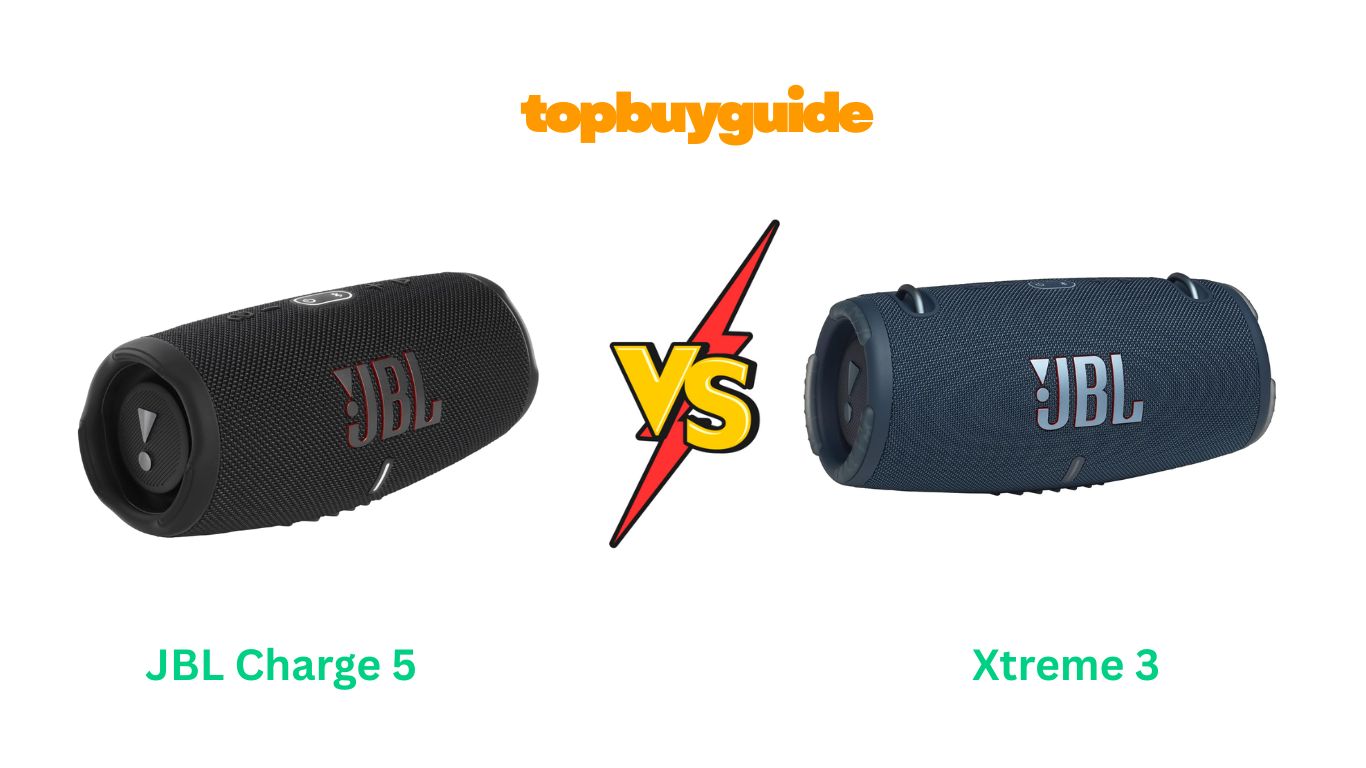
Deciding between the JBL Charge 5 and Xtreme 3 requires careful consideration of your priorities. I recommend the JBL Charge 5 for most users seeking balanced performance. It offers 20 hours of battery life and exceptional portability at nearly half the price. The Charge 5 weighs just 960g compared to the Xtreme 3’s hefty 1968g. While the Xtreme 3 delivers louder output with 100W power, the Charge 5’s 40W output satisfies most listening scenarios with superior value.
Why Do I Recommend The JBL Charge 5?
The JBL Charge 5 emerges as the smarter choice for most buyers based on several compelling advantages:
- Superior Battery Endurance: The Charge 5 delivers 20 hours of continuous playback, outlasting the Xtreme 3’s 15-hour runtime. This 5-hour advantage proves invaluable during extended outdoor adventures and multi-day camping trips without charging access.
- Enhanced Portability Factor: Weighing 960g and measuring 22.3 x 9.65 x 9.4 cm, the Charge 5 offers exceptional portability. Conversely, the Xtreme 3 weighs 1968g with dimensions of 29.85 x 13.6 x 13.4 cm, making it twice as heavy.
- Outstanding Value Proposition: The Charge 5 retails around $160-$180, while the Xtreme 3 commands $300-$380. This significant price difference means you’re paying nearly double for the larger speaker with only marginal improvements.
- Faster Charging Recovery: The Charge 5’s smaller 7500mAh battery recharges in approximately 4 hours. Meanwhile, the Xtreme 3’s 10000mAh battery requires 4 hours but drains its power faster due to higher consumption.
- Simplified Transportation: The Charge 5’s compact size fits easily into backpack side pockets and bags. In contrast, the Xtreme 3 requires a dedicated shoulder strap for comfortable carrying, limiting spontaneous portability.
- Balanced Sound Profile: The Charge 5 delivers well-balanced audio with impactful bass starting at 60Hz. While the Xtreme 3 produces louder volume with 53.5Hz bass extension, real-world tests show minimal perceived difference.
- More Color Variety: The Charge 5 offers 9+ color options including Black, Red, Blue, Teal, Grey, White, Pink, and Squad. The Xtreme 3 provides only 3 color choices: Black, Blue, and Camouflage.
- Identical Core Features: Both speakers share IP67 waterproof rating, PartyBoost connectivity, powerbank functionality, and JBL’s signature sound. The Charge 5 provides these features at substantially lower cost without significant compromise.
Side By Side Comparison Chart: JBL Charge 5 vs Xtreme 3
| Feature | JBL Charge 5 | JBL Xtreme 3 |
| Audio Output | 40W RMS | 100W RMS (50W woofer + 50W tweeter) |
| Battery Life | 20 hours | 15 hours |
| Battery Capacity | 7500mAh | 10000mAh (5000mAh equivalent) |
| Charging Time | 4 hours | 4 hours |
| Bluetooth Version | 5.1 | 5.1 |
| Waterproof Rating | IP67 | IP67 |
| Driver Configuration | 1 x tweeter + 1 x woofer | 2 x 70mm woofers + 2 x 20mm tweeters |
| Bass Radiators | 2 x 2.25″ passive | 2 x 3″ passive |
| Frequency Response | 60Hz – 20kHz | 53.5Hz – 20kHz |
| Weight | 960g (2.11 lbs) | 1968g (4.34 lbs) |
| Dimensions | 22.3 x 9.65 x 9.4 cm | 29.85 x 13.6 x 13.4 cm |
| Powerbank Feature | Yes (USB-A output) | Yes (USB-A + USB-C output) |
| Aux Input | No | Yes (3.5mm jack) |
| Speakerphone | No | No |
| PartyBoost | Yes | Yes |
| Stereo Mode | No (Mono) | Yes (with 2 units) |
| Carrying Strap | No | Yes (with bottle opener) |
| Price Range | $160-$180 | $300-$380 |
What Common JBL Charge 5 vs Xtreme 3 Features Can Do?
IP67 Waterproof and Dustproof Protection
Both speakers feature comprehensive IP67 certification, providing complete protection against water immersion and dust infiltration. Users can submerge either speaker in 1 meter of water for 30 minutes without damage. The sealed design prevents dust particles from entering sensitive internal components during outdoor activities. Beach environments, pool parties, and desert camping pose no threat to either speaker’s functionality. Rubber flaps cover all ports, maintaining waterproof integrity when properly sealed. The IP67 rating exceeds basic splash resistance, allowing worry-free use in harsh conditions.
PartyBoost Multi-Speaker Connectivity
JBL’s PartyBoost technology enables wireless connection between multiple compatible speakers for enhanced audio experiences. Users can pair two identical speakers for true wireless stereo sound with distinct left and right channels. Alternatively, connect up to 100 PartyBoost-enabled speakers for synchronized mono playback at large gatherings. The pairing process works through physical buttons or the JBL Portable app interface. PartyBoost replaced the older Connect+ system with improved stability and broader device compatibility. Both speakers maintain synchronized playback without noticeable audio delay during multi-speaker operation.
Built-in Powerbank Functionality
Each speaker functions as a portable powerbank, charging external devices through integrated USB ports. The powerbank feature proves invaluable during camping trips, outdoor festivals, and emergency situations without electrical outlets. Users simply connect their smartphone or tablet to the USB output for on-the-go charging. Both speakers continue playing music while simultaneously charging connected devices. The powerbank drains the speaker’s battery faster, reducing available playback time proportionally. This dual-purpose design eliminates the need for separate portable battery packs during outdoor adventures.
Bluetooth 5.1 Wireless Connectivity
Modern Bluetooth 5.1 technology equips both speakers for reliable wireless streaming from smartphones, tablets, and computers. The updated standard provides extended range, faster pairing, and improved connection stability compared to older versions. Both speakers support dual-device connectivity, allowing two users to take turns controlling music playback. Bluetooth 5.1 reduces latency and interference in crowded wireless environments with multiple active connections. The wireless connection remains stable within typical ranges of 30-50 feet depending on obstacles. Quick pairing occurs within seconds after initial device setup and configuration.
JBL Signature Sound Tuning
Both speakers deliver JBL’s characteristic audio signature with emphasized bass response and clear vocal reproduction. The signature tuning works effectively across various music genres without requiring extensive equalization adjustments. JBL’s audio engineers optimize frequency response for both outdoor and indoor listening environments. The sound profile prioritizes impactful bass while maintaining intelligible midrange and treble frequencies. Users enjoy high-quality audio straight from the box without complicated setup procedures. Both speakers handle dynamic music with deep bass and intricate instrumentation competently.
USB-C Fast Charging
Contemporary USB-C charging ports equip both speakers for efficient power replenishment using modern charging standards. The reversible connector design eliminates frustration from trying to insert cables in specific orientations. USB-C provides faster charging speeds compared to outdated micro-USB technology found on older models. Both speakers include USB-C cables in their original packaging for immediate use. The universal charging standard works with common smartphone chargers and powerbanks. Fast charging capabilities minimize waiting time between listening sessions during busy schedules.
Durable Fabric Exterior Construction
Premium fabric grilles wrap both speakers, providing aesthetic appeal while protecting sensitive internal components from damage. The mesh material resists tears, abrasions, and UV degradation from prolonged sunlight exposure. Fabric covering allows sound waves to pass through efficiently while maintaining speaker durability. Both speakers offer multiple color options to match personal style preferences and tastes. The material cleans easily with damp cloth when soiled from outdoor use. Durable construction ensures the fabric maintains its appearance through years of regular handling.
Dual Passive Bass Radiators
Each speaker incorporates two passive bass radiators positioned on opposite ends for enhanced low-frequency performance. These radiators vibrate sympathetically with the active drivers, amplifying bass without requiring additional amplification power. The passive design delivers deeper, more impactful bass than speaker size alone would normally produce. Users can visually observe the radiators pulsing during bass-heavy music playback. Both speakers position radiators on rubberized end caps that also serve as protective feet. This technology provides impressive bass response from relatively compact speaker bodies.
Common Features of JBL Charge 5 vs Xtreme 3
| Feature | JBL Charge 5 | JBL Xtreme 3 |
| IP67 Rating | Yes | Yes |
| PartyBoost | Yes | Yes |
| Bluetooth 5.1 | Yes | Yes |
| Powerbank | Yes (USB-A) | Yes (USB-A + USB-C) |
| USB-C Charging | Yes | Yes |
| Passive Bass Radiators | 2 | 2 |
| Fabric Exterior | Yes | Yes |
| JBL Signature Sound | Yes | Yes |
| Dual Device Connect | Yes | Yes |
| Physical Controls | Yes | Yes |
| JBL Portable App | Yes | Yes |
| Graphic EQ | Yes | Yes |
A Detailed Comparison Of the JBL Charge 5 vs Xtreme 3
Audio Output Power
The Xtreme 3 delivers 100W RMS total output power with dedicated 2 x 25W woofers and 2 x 25W tweeters. This configuration produces significantly louder maximum volume suitable for large outdoor gatherings and parties. The four-driver system with separate woofers and tweeters provides superior frequency separation and audio detail. However, real-world testing reveals the volume difference isn’t as dramatic as specifications suggest. The Charge 5’s 40W RMS output proves surprisingly powerful, adequately filling medium-sized spaces with clear sound. Most users find the Charge 5’s maximum volume sufficient for typical outdoor activities and backyard gatherings.
Battery Life Duration
The Charge 5 achieves 20 hours of continuous playback on a single charge, outperforming the Xtreme 3’s 15-hour specification. This 5-hour advantage translates to nearly an additional full day of music during weekend camping trips. Real-world usage typically yields 12-14 hours for the Charge 5 and 8-10 hours for the Xtreme 3 at moderate volumes. The Xtreme 3’s higher power output consumes battery faster despite its larger 10000mAh capacity. Extended battery life reduces charging frequency and provides peace of mind during multi-day outdoor adventures. The Charge 5’s superior endurance makes it more reliable for situations with limited charging access.
Physical Size and Portability
The Charge 5 weighs 960g with compact dimensions of 22.3 x 9.65 x 9.4 cm, offering exceptional portability for daily carry. It fits comfortably in backpack side pockets, messenger bags, or car cup holders without consuming excessive space. The Xtreme 3 weighs 1968g with larger dimensions of 29.85 x 13.6 x 13.4 cm, doubling the Charge 5’s weight. While still portable, the Xtreme 3 requires dedicated carrying arrangements like its included shoulder strap with bottle opener. The weight difference becomes significant during extended hiking or walking with the speaker.
Driver Configuration Architecture
The Xtreme 3 features an advanced four-driver system with dual 70mm woofers and dual 20mm tweeters. This separation allows woofers to handle bass and midrange while tweeters reproduce high frequencies with precision. The dedicated driver configuration produces clearer instrument separation and more detailed soundstage presentation. The Charge 5 uses a single tweeter and woofer combination with simpler driver architecture. While less sophisticated, the Charge 5’s drivers still deliver impressive audio quality for its size. The Xtreme 3’s additional drivers justify its larger size and higher price for discerning listeners.
Frequency Response Range
The Xtreme 3 extends bass response down to 53.5Hz, producing deeper low-frequency reproduction than the Charge 5. This 6.5Hz advantage creates more impactful bass during electronic music, hip-hop, and bass-heavy tracks. The Charge 5’s 60Hz low-end cutoff still produces satisfying bass for most music genres. Both speakers reach 20kHz at the high frequency end, covering the complete human hearing range. The Xtreme 3’s deeper bass proves more noticeable in outdoor environments where low frequencies dissipate quickly. However, many listeners find the Charge 5’s bass response adequate for typical listening scenarios.
Auxiliary Input Availability
The Xtreme 3 includes a 3.5mm auxiliary input jack for wired audio connections from external sources. This feature allows direct connection to mixing consoles, CD players, game consoles, and older devices without Bluetooth. Wired connections eliminate potential Bluetooth latency and compression, delivering higher audio quality. The Charge 5 lacks any auxiliary input, relying exclusively on Bluetooth wireless connectivity. Users requiring wired connections for professional applications or specific use cases must choose the Xtreme 3. The auxiliary input increases the Xtreme 3’s versatility for various audio source configurations.
Stereo Sound Capability
The Xtreme 3 supports true wireless stereo mode when pairing two identical units together via PartyBoost. Stereo pairing creates distinct left and right channels for immersive three-dimensional soundstage presentation. Music production elements spread across the stereo field, providing more engaging listening experiences. The Charge 5 only supports mono playback even when pairing multiple units with PartyBoost technology. All paired Charge 5 speakers play identical audio content without channel separation benefits. Audiophiles seeking stereo imaging must invest in two Xtreme 3 speakers for authentic stereo reproduction.
Carrying Convenience Features
The Xtreme 3 includes a durable shoulder strap with integrated bottle opener for convenient outdoor transportation. The strap features ribbed padding to prevent slipping off shoulders during movement. Built-in hooks on the speaker body allow easy strap attachment and removal as needed. The included bottle opener adds practical utility for outdoor gatherings and parties. The Charge 5 provides no carrying strap or attachment points, requiring bag or hand transportation. The Xtreme 3’s strap makes extended carrying more comfortable despite its heavier weight.
Powerbank Output Options
The Charge 5 provides powerbank functionality through a single USB-A output port rated at 5V/2A maximum. Users can charge one external device at a time from the speaker’s 7500mAh battery. The Xtreme 3 offers both USB-A (5V/2A max) and USB-C (5V/1.5A max) output ports with 2.5A total maximum. The dual output capability allows simultaneous charging of two devices, though power splits between ports. The Xtreme 3’s USB-C port functions as both input (charging) and output (powerbank), providing greater flexibility. Both speakers deliver sufficient power for smartphone charging during outdoor activities and emergencies.
Price and Value Comparison
The Charge 5 retails for $160-$180, positioning it as a mid-range portable Bluetooth speaker option. This pricing delivers exceptional value considering its 20-hour battery, IP67 rating, and quality audio performance. The Xtreme 3 commands $300-$380, nearly doubling the Charge 5’s cost for enhanced features and capabilities.
The substantial price difference makes the Charge 5 more accessible to budget-conscious consumers and students. Frequent sales often bring the Charge 5 below $150 and the Xtreme 3 below $320. The Charge 5 offers better value for money, while the Xtreme 3 justifies its premium pricing for power users.
Conclusion
The JBL Charge 5 provides superior value for most users with its 20-hour battery, 960g portability, and $160-$180 price point. It delivers impressive 40W sound output suitable for typical outdoor activities and indoor listening. The Xtreme 3 offers louder 100W output, stereo capability, and auxiliary input for demanding audiophiles. However, its $300-$380 price and 1968g weight limit its appeal. Budget-conscious buyers and travelers should choose the versatile Charge 5. For maximum power and premium features, the Xtreme 3 delivers uncompromising performance worth its higher investment.
FAQs
Q1: Can the JBL Charge 5 and Xtreme 3 be paired together using PartyBoost?
Yes, both speakers support PartyBoost technology and can pair together for synchronized mono playback. However, you cannot create stereo sound by pairing different speaker models together. True wireless stereo mode requires pairing two identical speakers (two Charge 5s or two Xtreme 3s). The PartyBoost feature works seamlessly through physical buttons or the JBL Portable app.
Q2: Which speaker sounds better for music quality?
The Xtreme 3 delivers superior sound quality with its four-driver system featuring separate woofers and tweeters. It produces deeper bass starting at 53.5Hz and better instrument separation. However, the Charge 5 offers impressive audio quality with well-balanced sound profile. For casual listening, most users find minimal audible difference. Audiophiles preferring pristine sound reproduction should choose the Xtreme 3.
Q3: How much louder is the Xtreme 3 compared to the Charge 5?
The Xtreme 3’s 100W output theoretically produces significantly louder volume than the Charge 5’s 40W. However, real-world decibel testing shows only minimal differences at maximum volume levels. Both speakers employ dynamic sound processing that adjusts bass based on volume. The Charge 5 proves sufficiently loud for most outdoor gatherings. The Xtreme 3’s advantage becomes noticeable only in very large spaces.
Q4: Does the weight difference affect portability significantly?
Yes, the Xtreme 3’s 1968g weight is noticeably heavier than the Charge 5’s 960g during extended carrying. The Charge 5 fits easily in bags without requiring dedicated straps or harnesses. The Xtreme 3 includes a shoulder strap specifically because its weight makes hand-carrying uncomfortable. Hikers, travelers, and daily commuters greatly appreciate the Charge 5’s lighter, more compact design.
Q5: Which speaker offers better value for money?
The Charge 5 provides exceptional value at $160-$180 with 20-hour battery, IP67 rating, and quality sound. It costs nearly half the Xtreme 3’s $300-$380 price while sharing most core features. The Xtreme 3 justifies its premium pricing with louder output, auxiliary input, and stereo capability. Budget-conscious buyers should choose the Charge 5. Those prioritizing maximum performance should invest in the Xtreme 3.
Q6: Can both speakers charge laptops through their powerbank feature?
Neither speaker can effectively charge laptops due to insufficient power output. The Charge 5 provides 5V/2A through USB-A, while the Xtreme 3 offers 5V/2A (USB-A) and 5V/1.5A (USB-C). These specifications work well for smartphones and tablets. Laptops typically require 45-65W power delivery that portable speakers cannot provide. Use these speakers exclusively for charging mobile devices.
Q7: How durable are these speakers for outdoor adventures?
Both speakers feature extremely rugged construction with IP67 waterproof and dustproof certification. The fabric grilles resist tears, abrasions, and UV damage from sunlight. Rubberized end caps protect against drops and impacts. Users report reliable performance after years of regular outdoor use. However, the exposed passive radiators on both models remain vulnerable to sharp objects. Handle with reasonable care despite their rugged build quality.
Q8: Does the auxiliary input on the Xtreme 3 improve sound quality?
Yes, the Xtreme 3’s 3.5mm auxiliary input provides superior audio quality compared to Bluetooth connections. Wired connections eliminate Bluetooth compression artifacts and latency issues. Professional users and audiophiles benefit from lossless wired audio transmission. However, most casual listeners won’t perceive significant quality differences. The auxiliary input adds valuable versatility for specific use cases where Bluetooth proves inadequate or unavailable.

Alex Turner is a dedicated product researcher and reviewer at TopBuyGuide.com, known for his clear, honest, and data-driven insights. He spends countless hours testing, comparing, and analyzing products to help readers make confident and informed buying decisions.