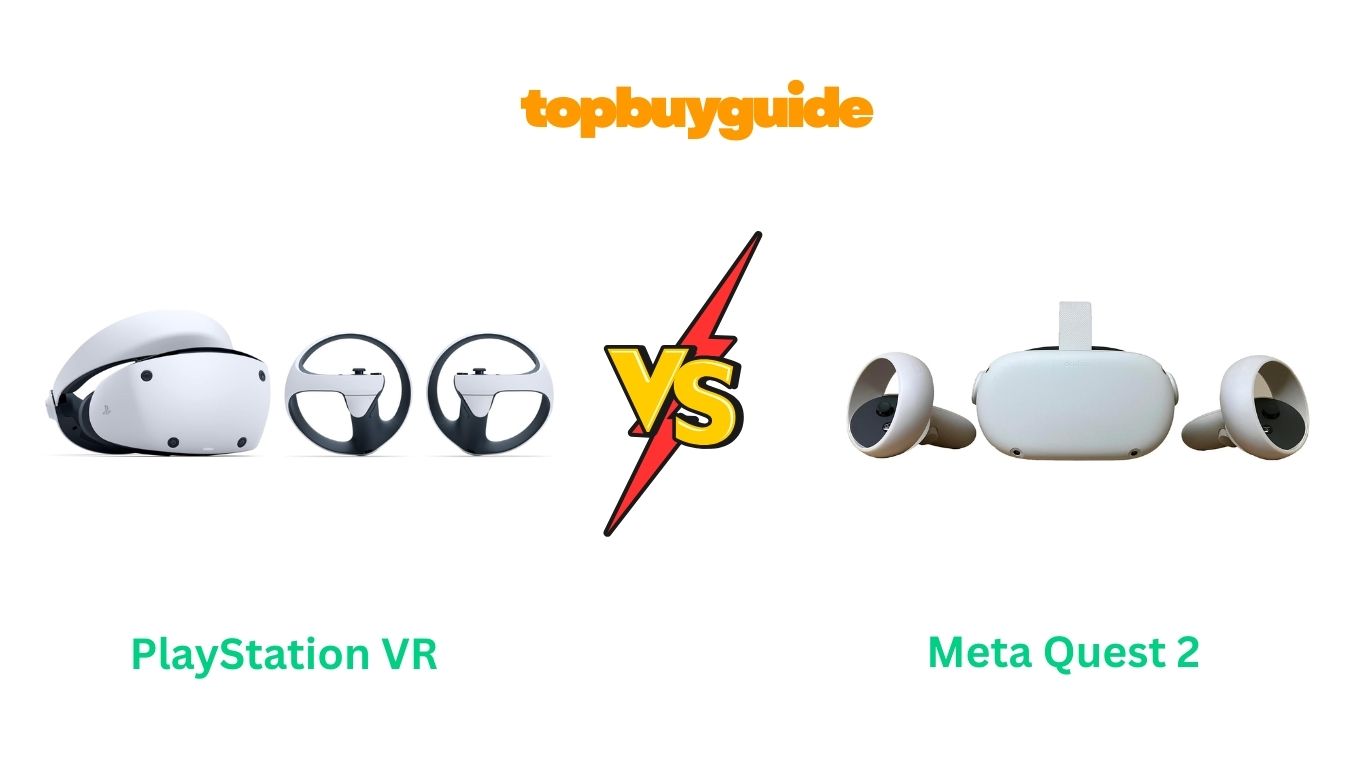
Choosing between the PlayStation VR and the Meta Quest 2 can be a real head-scratcher. Both are fantastic entry points into virtual reality. However, I recommend the Meta Quest 2 for most people. Its all-in-one, wireless freedom offers an unmatched level of convenience and accessibility. It has a massive game library you can enjoy anywhere. Ready to see why the Quest 2 often comes out on top? Let’s get into the details.
Why Do I Recommend The Meta Quest 2?
When you put these two VR giants side-by-side, the Meta Quest 2 offers a more versatile and user-friendly experience for the majority of users. Here’s a detailed breakdown of why it gets my top recommendation over the PlayStation VR.
- True Wireless Freedom: The Meta Quest 2 is a completely standalone device. You don’t need a PC or a console. You can play anywhere, anytime. In contrast, the PlayStation VR must be physically tethered to a PlayStation console with a cable. This wire can limit movement and break the sense of immersion during intense gameplay.
- Massive and Mature Game Library: The Meta Quest Store is the largest and most established VR content library available. It boasts over 250 titles, including blockbuster exclusives and a huge variety of experiences. While the PlayStation VR has some excellent exclusive games like Horizon Call of the Mountain, its library is smaller and more curated, offering fewer choices overall.
- Effortless Setup: Getting started with the Meta Quest 2 is incredibly simple. You just put on the headset, define your play space through the passthrough cameras, and you’re ready. The PlayStation VR, on the other hand, involves connecting a cable to your console, which is simpler than its predecessor but still more cumbersome than the Quest 2’s wire-free setup.
- Superior Portability: Because it’s an all-in-one system, the Meta Quest 2 is highly portable. You can easily pack it up and take it to a friend’s house or on vacation. The PlayStation VR is tied to your PS5, making it a stationary, at-home experience only.
- PC VR Compatibility: The Meta Quest 2 can connect to a PC, both wirelessly via Air Link and with a USB-C cable. This gives you access to the vast library of PC VR games on platforms like SteamVR. While Sony is introducing a PC adapter for the PSVR2, the Quest 2’s feature is more established and offers greater flexibility right out of the box.
- Hand Tracking Technology: The Meta Quest 2 features advanced hand-tracking capabilities. This allows you to navigate menus and interact with certain apps using just your hands, which can feel incredibly intuitive. The PlayStation VR relies solely on its Sense controllers for all interactions.
- Lower Barrier to Entry: The Meta Quest 2 is a self-contained system. The PlayStation VR requires you to own a PlayStation 5 console, which is a significant additional cost if you don’t already have one. This makes the total investment for getting into VR much lower with the Quest 2.
- Vibrant Community and Social Features: Meta has heavily invested in social VR spaces like Horizon Worlds. The Quest 2 is designed for multiplayer experiences and social interaction, with a massive existing user base to connect with. While PlayStation has its own network, the Quest ecosystem is more focused on building VR communities.
Side-By-Side Comparison Chart: PlayStation VR vs Meta Quest 2
| Feature | PlayStation VR | Meta Quest 2 |
| System Type | Console-Tethered (Requires PS5) | All-in-One (Standalone) |
| Resolution Per Eye | 2000 x 2040 pixels | 1832 x 1920 pixels |
| Display Type | OLED with HDR | LCD |
| Refresh Rate | 90Hz, 120Hz | Up to 120Hz |
| Field of View (FOV) | Approx. 110 degrees | Approx. 97 degrees |
| Tracking | Inside-out (4 cameras) | Inside-out (4 cameras) |
| Audio | Built-in stereo headphones | Integrated speakers, 3.5mm jack |
| Controllers | Sense Controllers with Haptics | Touch Controllers with Haptics |
| PC VR Support | Yes (via separate adapter) | Yes (Wireless and Wired) |
| Hand Tracking | No | Yes |
What Common PlayStation VR vs Meta Quest 2 Can Do?
Despite their core differences, the PlayStation VR and Meta Quest 2 share foundational technologies that make them both powerful modern VR headsets. They both aim to provide deeply immersive experiences that transport you to new digital worlds.
A key shared feature is inside-out tracking with a four-camera setup. This means neither headset requires external sensors or “lighthouses” placed around your room to track your movement. The cameras built into the headsets scan the environment, allowing for six degrees of freedom (6DoF). This lets you move forward, backward, side-to-side, and up and down within your virtual space. This technology makes setting up your play area quick and easy for both devices, allowing you to simply put on the headset and start playing.
Both headsets also feature advanced haptic feedback in their controllers. The PlayStation VR has its Sense controllers, and the Meta Quest 2 has its Touch controllers. Both are designed to vibrate and provide resistance in nuanced ways that correspond to your in-game actions. Whether you’re drawing a bowstring, firing a weapon, or interacting with objects, this haptic feedback adds a tangible layer of immersion, making virtual actions feel more real and impactful.
Each device offers built-in audio solutions to provide immersive 3D soundscapes without needing separate headphones. The PSVR2 integrates stereo headphones directly into the headband, while the Quest 2 uses speakers embedded in the head strap. Both can process 3D positional audio, meaning sounds in the virtual world come from the correct direction relative to your head’s position. This auditory immersion is critical for creating a believable virtual environment and enhancing gameplay.
Finally, both systems support a high refresh rate of up to 120Hz. A higher refresh rate means the image on the screen updates more times per second, resulting in smoother motion and a more comfortable viewing experience. This is especially important in VR to reduce the likelihood of motion sickness and to make fast-paced action games feel fluid and responsive. While not all games run at 120Hz, the capability is there on both platforms for developers to utilize.
Common Features of PlayStation VR vs Meta Quest 2
| Feature | PlayStation VR | Meta Quest 2 |
| Tracking System | Inside-out (4 cameras) | Inside-out (4 cameras) |
| Degrees of Freedom | 6DoF | 6DoF |
| Max Refresh Rate | 120Hz | 120Hz |
| Controller Haptics | Advanced Haptic Feedback | Haptic Feedback |
| Built-in Audio | Yes | Yes |
| Guardian System | Roomscale Boundary Setup | Roomscale Boundary Setup |
| App Store | PlayStation Store | Meta Quest Store |
A Detailed Comparison Of the PlayStation VR vs Meta Quest 2
Let’s dive deeper into the specific features to see how these two headsets stack up in a direct confrontation.
Display and Visual Fidelity
The PlayStation VR headset boasts a stunning 4K HDR OLED display. It delivers a resolution of 2000 x 2040 pixels per eye. The use of OLED technology means you get incredibly deep blacks and vibrant, high-contrast colors that make virtual worlds pop. This is one of the PSVR2’s biggest selling points, offering a visual experience that is arguably best-in-class for consumer VR.
The Meta Quest 2 uses a fast-switch LCD panel with a resolution of 1832 x 1920 pixels per eye. While this resolution is slightly lower than the PSVR2’s, the image is still very sharp and clear for a standalone device. However, as an LCD panel, it cannot achieve the same perfect blacks and color depth as the PSVR2’s OLED screen. The difference is noticeable, especially in dark, atmospheric games.
Comfort and Ergonomics
Sony designed the PlayStation VR with an adjustable halo-style headband that balances the weight of the device around your head, rather than putting pressure on your face. This makes it quite comfortable for many users, even during longer play sessions. At 560 grams, it is relatively lightweight for a tethered headset, but the required cable can sometimes get in the way and detract from the overall comfort.
The Meta Quest 2 comes with a basic soft strap by default. At 503 grams, the headset is lighter than the PSVR2, but this default strap can cause the weight to feel front-heavy, leading to pressure on the face. Many users opt to purchase an upgraded strap, like the official Elite Strap, which provides much better balance and comfort, making the Quest 2 feel secure and lightweight.
Controllers and Haptics
The PlayStation VR Sense controllers are a technological marvel, featuring adaptive triggers and advanced haptic feedback similar to the PS5’s DualSense controller. These features provide incredibly nuanced sensations, from the tension of a bowstring to the recoil of a gun. The controllers also include finger touch detection, allowing for more natural gestures. The immersive feedback from the Sense controllers is a major highlight.
The Meta Quest 2’s Touch controllers are the third generation of a highly refined design. They are lightweight, ergonomic, and offer reliable haptic feedback that enhances immersion. While they lack the adaptive triggers of the Sense controllers, their tracking is excellent, and their design is comfortable for a wide range of hand sizes. They run on a single AA battery per controller, which provides weeks of playtime.
Game Library and Content
The PlayStation VR has a strong, but smaller, library of high-quality, graphically intensive games that leverage the power of the PS5. Titles like Horizon Call of the Mountain and Gran Turismo 7 showcase stunning visuals that are not possible on a standalone headset. However, the library is curated by Sony, and the number of available titles is more limited compared to the Quest’s expansive store.
The Meta Quest 2 has access to the largest standalone VR library on the market, with hundreds of games, social apps, fitness experiences, and more. From massive hits like Beat Saber and Among Us VR to a huge indie scene on App Lab, there is something for everyone. Its ability to also connect to a PC and play SteamVR games gives it an almost limitless content library, making it the clear winner in terms of sheer variety and volume.
Price and Overall Value
To use the PlayStation VR, you must own a PlayStation 5 console (around $500). The headset itself is priced at $399. This brings the total cost for a new user to approximately $900, making it a significant investment. This price is justified by the high-end graphical power and premium haptics, but it places it in a higher tier of entry.
The Meta Quest 2 is priced starting at $299 for the 256GB model. As a standalone device, this is the only hardware you need to buy to jump into VR. This incredibly low barrier to entry is what made the Quest 2 a revolutionary product. It offers fantastic value by providing a high-quality, wireless VR experience for a fraction of the cost of a console or PC-based setup.
Conclusion
For most people stepping into the world of VR, the Meta Quest 2 is the clear winner. Its incredible value, wireless freedom, and vast content library make it the most accessible and versatile headset on the market. You can play anywhere, connect with a huge community, and even stream PC VR games if you want to.
However, if you are a dedicated PlayStation 5 owner who prioritizes cutting-edge graphics and the most immersive haptics available, the PlayStation VR is a phenomenal piece of hardware that delivers truly next-generation experiences.
FAQs
- Do I need a console or computer for the Meta Quest 2?
No, the Meta Quest 2 is a completely standalone, all-in-one VR headset. It has its own processor, storage, and battery, so you don’t need any other hardware to use it. - Which headset has better graphics?
The PlayStation VR has technically superior graphics. Its 4K HDR OLED display, powered by the PS5, delivers deeper blacks, more vibrant colors, and a higher resolution than the Meta Quest 2’s LCD screen. - Can I play PC VR games on these headsets?
Yes, both can play PC VR games. The Meta Quest 2 supports this out of the box with its wireless Air Link feature or a USB-C cable. The PlayStation VR requires a separate adapter, sold by Sony, to connect to a PC. - Which headset is more comfortable?
Comfort is subjective, but the PlayStation VR’s halo strap is often considered more comfortable out of the box. However, many users purchase an upgraded “Elite Strap” for the Meta Quest 2, which greatly improves its balance and comfort. - Is the PlayStation VR wireless?
No, the PlayStation VR must be connected to the PlayStation 5 console with a single USB-C cable. The Meta Quest 2 is completely wireless. - What is the battery life like on the Meta Quest 2?
The Meta Quest 2’s built-in battery lasts for about 2-3 hours of continuous use, depending on the application. Many accessories are available, like battery head straps, to extend playtime. - Which headset has a bigger game library?
The Meta Quest 2 has a much larger library of games and applications. The Meta Quest Store is the most extensive VR content platform, and the headset can also access PC VR games from Steam. - Are the controllers better on the PSVR or Quest 2?
The PlayStation VR’s Sense controllers have more advanced technology, including adaptive triggers and more nuanced haptics. However, the Meta Quest 2’s Touch controllers are highly praised for their ergonomic design and reliable tracking.

Alex Turner is a dedicated product researcher and reviewer at TopBuyGuide.com, known for his clear, honest, and data-driven insights. He spends countless hours testing, comparing, and analyzing products to help readers make confident and informed buying decisions.