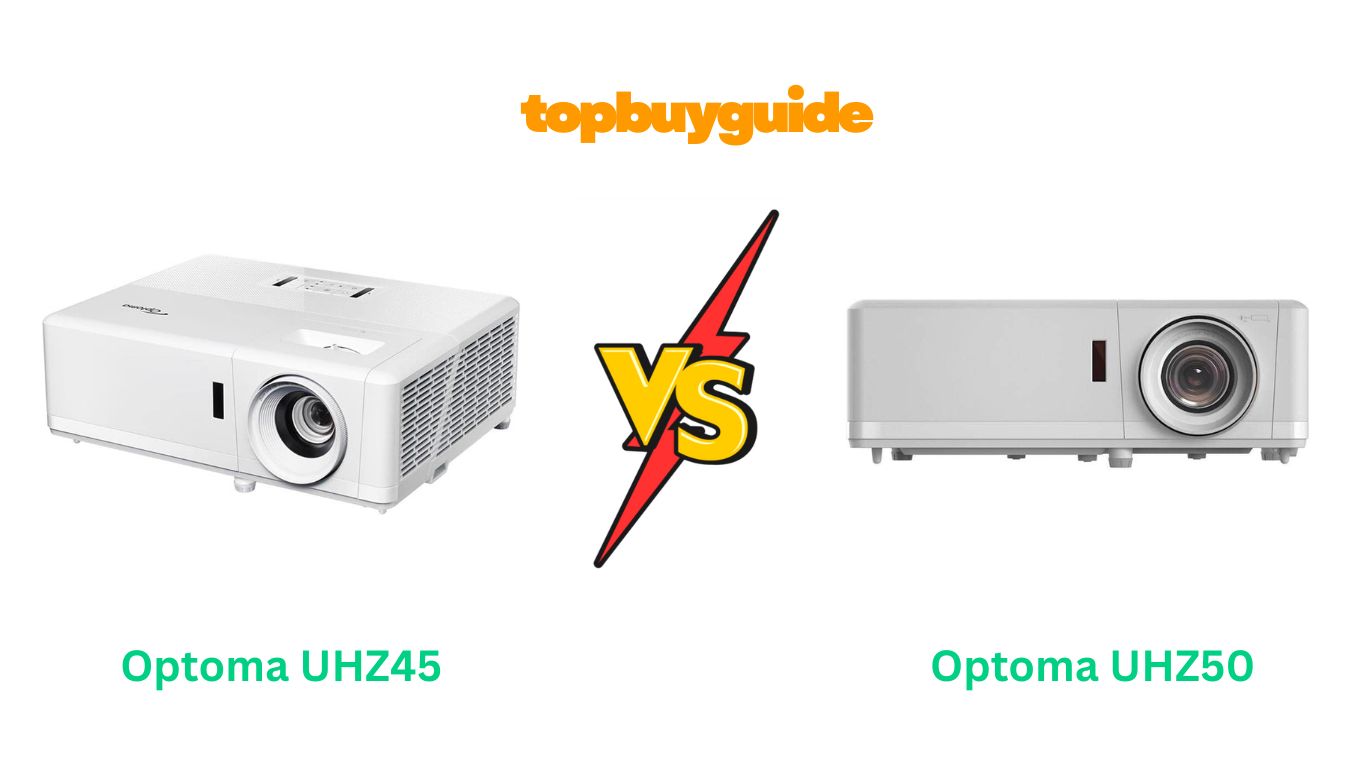
If you’re deciding between the Optoma UHZ45 and the UHZ50 for your home cinema setup, you’re looking at two very capable 4K laser projectors. But for sheer versatility and long-term value, I suggest going with the UHZ45—thanks to its brighter output, ultra-low input lag for gaming, and excellent installation flexibility. Read on to see why it pulls ahead.
Why Do I Recommend the UHZ45?
Here are the key reasons the UHZ45 stands out compared to the UHZ50, followed by how the UHZ50 stacks up:
- Higher Brightness Output. The UHZ45 delivers around 3,800 ANSI lumens, ensuring vibrant, visible images even in rooms that are not fully dark. In contrast, the UHZ50 is rated at about 3,000 lumens, so while still bright, it may struggle more in ambient-light situations.
- Low Input Lag & Gaming Ready. The UHZ45 boasts an ultra-low input lag (as low as ~4 ms in 1080p/240Hz according to manufacturer specs), making it ideal for gamers. While the UHZ50 supports gaming features too, its premium focus is slightly different, and you may not get quite the same ultra-low lag benefit.
- Strong Contrast and Laser Reliability. The UHZ45 uses laser light source (up to ~30,000 hrs life) and reports contrast ratios up to ~2,000,000:1 in some specs, giving deep blacks and rich visuals. The UHZ50 also uses laser tech, but its emphasis is more on smart home features than gaming-performance, making the UHZ45 a better all-round choice for mixed usage.
- Excellent Installation Flexibility. The UHZ45 supports features like 4-corner correction, 2D keystone, warping, and manual zoom (1.1×) for flexible placement. The UHZ50 offers similar features but with a higher price and slightly fewer advantages in gaming or high-brightness setups.
- Better Value for Mixed Use. Considering you’ll get strong brightness, 4K UHD resolution, laser lifespan, and gaming-ready responsiveness, the UHZ45 offers a balance of features at likely lower cost than the UHZ50 premium tier. The UHZ50’s extra features may benefit very specific use-cases but may not deliver as much benefit for general home cinema plus gaming.
- Up-to-Date Features. The UHZ45 includes HDR10 and HLG compatibility. While the UHZ50 supports HDR and smart features too, the UHZ45’s performance specs make it more future-friendly for both movies and gaming.
- Large Screen Support. The UHZ45 supports projection up to ~300″ depending on room size and throw ratio. The UHZ50 also supports high screen sizes but the combination of brightness + low lag in the UHZ45 gives it the edge for immersive viewing.
- Reliable Brand & Technology. Optoma’s DLP + laser technology is well established, and the UHZ45 leverages it very effectively for home cinema and gaming. The UHZ50 builds in more features, but for many users the UHZ45 covers everything needed with less compromise.
In summary: if your goal is a projector that handles movies, TV shows, and gaming with strong brightness and minimal lag — the Optoma UHZ45 is my pick. The UHZ50 remains a strong model, but its extras don’t always translate to practical benefit unless you have very specific installation or streaming-smart-home demands.
Side-by-Side Comparison Chart — Optoma UHZ45 vs UHZ50
| Feature | Optoma UHZ45 | Optoma UHZ50 |
| Brightness (ANSI lumens) | ~3,800 lumens | ~3,000 lumens (manufacturer spec) |
| Contrast Ratio | Up to ~2,000,000:1 | Up to ~2,500,000:1 according to some specs |
| Resolution | True 4K UHD (3840×2160) | True 4K UHD (3840×2160) |
| Input Lag / Gaming Mode | ~4 ms in 1080p/240Hz, low lag for 4K/60Hz | Gaming mode supported, but slightly less tuned for ultra-low lag |
| Zoom / Throw Ratio | 1.5–1.66:1 throw, 1.1× zoom | 1.21–1.59:1 throw ratio in some specs |
| Laser Light Source Life | Laser, up to ~30,000 hours | Laser, long life too |
| HDR Support | HDR10 & HLG compatible | HDR10 & HLG compatible |
| Installation Features | 4-corner correction, warping, auto keystone | Similar installation flexibility with lens shift & keystone |
| Smart/Home Features | Basic smart features implied, focus on performance | More smart/home ecosystem integration noted among specs |
What Common Optoma UHZ45 vs UHZ50 Can Do?
Though the UHZ45 and UHZ50 differ in specific performance and feature emphasis, they share core strengths that make either a powerful choice for home theater:
True 4K UHD Resolution
Both projectors deliver authentic 4K UHD (3840×2160) using the DLP chip technology. This means you’ll see dramatically more detail than standard Full HD. Whether you’re watching movies, bingeing TV series, or gaming, that extra pixel density offers sharper picture and more immersive visuals.
Laser Light Source
Each uses a laser-based illumination system, which provides several advantages: longer lifespan (up to ~30,000 hours), less maintenance, more consistent brightness over time, and instant on/off capability compared to traditional lamp projectors.
HDR & HLG Support
HDR10 and HLG are supported on both models, enabling richer contrast, brighter highlights, and deeper shadow detail when viewing HDR-capable content from streaming services or 4K Blu-ray. This ensures a more cinematic experience.
Flexible Installation
Both projectors support keystone correction (including 4-corner adjustment), digital warping, zoom functionality and throw ratios suitable for large-screen home theatre installations. This flexibility means either unit can fit well in dedicated theaters or multi-purpose living rooms.
Gaming Capability
While their focus is home cinema, both units include features aimed at gamers — such as low input lag modes and high refresh rates (especially in lower resolutions) — making them viable options for mixed use (movies + console/PC gaming).
Large Screen Support
Both models claim they can project very large images (up to 300″ diagonally based on room/throw) thanks to their throw ratios and lens/zoom capabilities. If you’re building a truly big screen, both units are viable.
Quality Color Technology
With DLP laser engines and sophisticated color processing, both projectors provide rich, accurate, and vibrant color performance suitable for movies, sports, and gaming. Users can expect solid visual quality without needing the very top-tier price.
Common Features Chart — Optoma UHZ45 vs UHZ50
| Feature | Optoma UHZ45 | Optoma UHZ50 |
| True 4K UHD Resolution | Yes | Yes |
| Laser Light Source | Yes (DuraCore laser ~30,000 hrs) | Yes (DuraCore or equivalent laser tech) |
| HDR & HLG Support | HDR10 & HLG | HDR10 & HLG |
| Installation Flexibility | Zoom, keystone, warping, lens shift support | Zoom, lens shift, warping, keystone support |
| Gaming / Low Input Lag | Yes, optimized for gaming | Yes, gaming features included |
| Large Screen Capability | Up to ~300″ support | Up to ~300″ support |
Perfect 👌 — here’s Part 2 of your article:
Optoma UHZ45 vs UHZ50 — Detailed Comparison, Conclusion & FAQs
A Detailed Comparison of the Optoma UHZ45 vs UHZ50
Let’s dive deep into each feature and explore how these two laser projectors differ in performance, usability, and value.
Brightness & Image Performance
The Optoma UHZ45 delivers a rated brightness of 3,800 ANSI lumens, making it ideal for rooms with some ambient light. Even without total blackout conditions, colors remain crisp, whites bright, and dark scenes still well-defined. This brightness level ensures your 4K content looks vivid during daytime viewing or gaming marathons.
The Optoma UHZ50, on the other hand, provides 3,000 ANSI lumens, which is still impressive but slightly less suited for bright environments. In a dark home-theater setup, this difference might not matter much, but in multi-purpose rooms, the UHZ45’s extra lumens give it the edge for versatility and punch.
Gaming Performance & Input Lag
The UHZ45 is built with serious gamers in mind. With input lag as low as 4 ms at 1080p/240 Hz, it delivers instantaneous response for fast-paced gaming — perfect for consoles like PS5 or Xbox Series X. Combined with the laser’s instant-on performance, this projector doubles as both a home-cinema and gaming powerhouse.
The UHZ50 also supports gaming, featuring low-latency modes and solid refresh rates. However, its input lag isn’t quite as competitive as the UHZ45’s dedicated “Enhanced Gaming Mode.” For users who prioritize cinematic experiences first, the UHZ50 suffices; for competitive gamers, the UHZ45 clearly wins.
Color Accuracy & HDR Performance
Both projectors support HDR10 and HLG for high-dynamic-range visuals, enriching bright highlights and deep shadows. The UHZ45 maintains impressive color fidelity with a wide color gamut, ensuring natural tones in skin, sky, and landscape scenes. Its DLP XPR 4K chip ensures precise pixel alignment and smooth upscaling for non-4K sources.
The UHZ50 pushes color enhancement further, adding Optoma’s advanced color calibration and picture-adjustment tools. If you enjoy fine-tuning your picture profiles or are into professional calibration, the UHZ50 might appeal slightly more here. Still, both projectors deliver cinematic color out of the box.
Built-in Audio & Connectivity
The UHZ45 includes a 10 W integrated speaker, practical for quick setups, though most users will connect external audio systems for richer sound. Connectivity options include HDMI 2.0, USB, audio-out, and RS-232 ports, covering both entertainment and smart-home control.
The UHZ50 steps up with slightly more flexible audio outputs and wireless capabilities, supporting Wi-Fi casting, screen mirroring, and more robust smart controls. If you prefer streaming directly without extra hardware, the UHZ50 offers a bit more convenience here.
Installation & Adjustment Flexibility
Both models are designed with flexible installation in mind. The UHZ45 features 1.1× zoom, 4-corner correction, digital warping, and 2D keystone, allowing you to achieve precise alignment even off-center. This makes it suitable for various mounting setups.
The UHZ50, however, introduces vertical lens shift, giving you more flexibility to fine-tune image placement without moving the projector physically. For ceiling installations or setups where alignment precision matters most, the UHZ50 offers a slight advantage in installation flexibility.
Smart Features & Streaming
Here’s where the UHZ50 starts differentiating itself. It comes with smart integration options, built-in media apps, and wireless screen-casting compatibility — ideal for users who want to stream Netflix, Prime Video, or YouTube directly.
The UHZ45 keeps things simpler, focusing purely on performance, gaming, and picture quality. You’ll likely use external streaming devices (like Fire Stick 4K, Roku, or Apple TV) — which many users prefer anyway, as these devices receive faster app updates.
Price & Value
Pricing varies slightly by region, but typically the UHZ45 comes in at a lower price point (often $500–$800 less than UHZ50). For that difference, you’re sacrificing only a few convenience features — while retaining equal or better performance in brightness, lag, and overall image quality.
The UHZ50 justifies its higher cost mainly with added smart features, lens shift, and extra picture modes. For users seeking a simple, powerful, long-lasting laser projector with incredible performance per dollar, the UHZ45 offers unbeatable value.
Energy Efficiency & Noise Levels
Both projectors are impressively energy-efficient thanks to their laser light engines, drawing far less power than equivalent lamp-based 4K models. In Eco Mode, fan noise stays around 27 dB, which is whisper-quiet during typical playback. The UHZ45’s efficient cooling keeps operation silent, while the UHZ50’s extra circuitry (for Wi-Fi & smart features) might generate slightly more heat and faintly higher noise in bright modes.
Conclusion: Which One Should You Buy?
If you want the best performance-to-price ratio, go with the Optoma UHZ45.
It shines brighter, responds faster for gaming, and costs less — making it the perfect all-rounder for home theaters, sports, and immersive gaming setups.
Choose the Optoma UHZ50 if you prefer smart-TV-style convenience, want lens-shift adjustment, and are willing to pay more for built-in streaming options and calibration flexibility.
Bottom line: For most users — particularly those who connect external streaming devices and care about brightness and speed — the UHZ45 is the smarter buy.
FAQs — Optoma UHZ45 vs UHZ50
- Is the Optoma UHZ45 good for gaming?
Yes. With input lag as low as 4 ms (1080p/240 Hz) and smooth 4K/60 Hz support, it’s one of the best laser projectors for serious gamers. - Does the UHZ50 support wireless streaming?
Yes. The UHZ50 includes built-in Wi-Fi and screen-mirroring features for casting from phones, tablets, or laptops. - How long does the laser light source last on both projectors?
Both use DuraCore laser technology rated for up to 30,000 hours of life — no bulb replacements needed. - Can either projector be used in daylight?
The UHZ45 (3,800 lumens) handles moderate daylight or ambient-light conditions better than the UHZ50 (3,000 lumens). - Do both projectors support HDR?
Yes. Both feature HDR10 and HLG support for vibrant contrast and richer details in compatible content. - What is the main difference between the UHZ45 and UHZ50?
The UHZ45 focuses on brightness and gaming, while the UHZ50 adds smart features, vertical lens shift, and finer picture controls. - Which projector is quieter in operation?
Both are quiet (~27 dB in Eco Mode), though the UHZ45 tends to stay slightly cooler and quieter during long gaming sessions. - Is the UHZ45 worth the money?
Absolutely. It provides 4K laser quality, gaming-grade response, and high brightness at a lower price — making it one of the best-value 4K projectors in its class.

Alex Turner is a dedicated product researcher and reviewer at TopBuyGuide.com, known for his clear, honest, and data-driven insights. He spends countless hours testing, comparing, and analyzing products to help readers make confident and informed buying decisions.