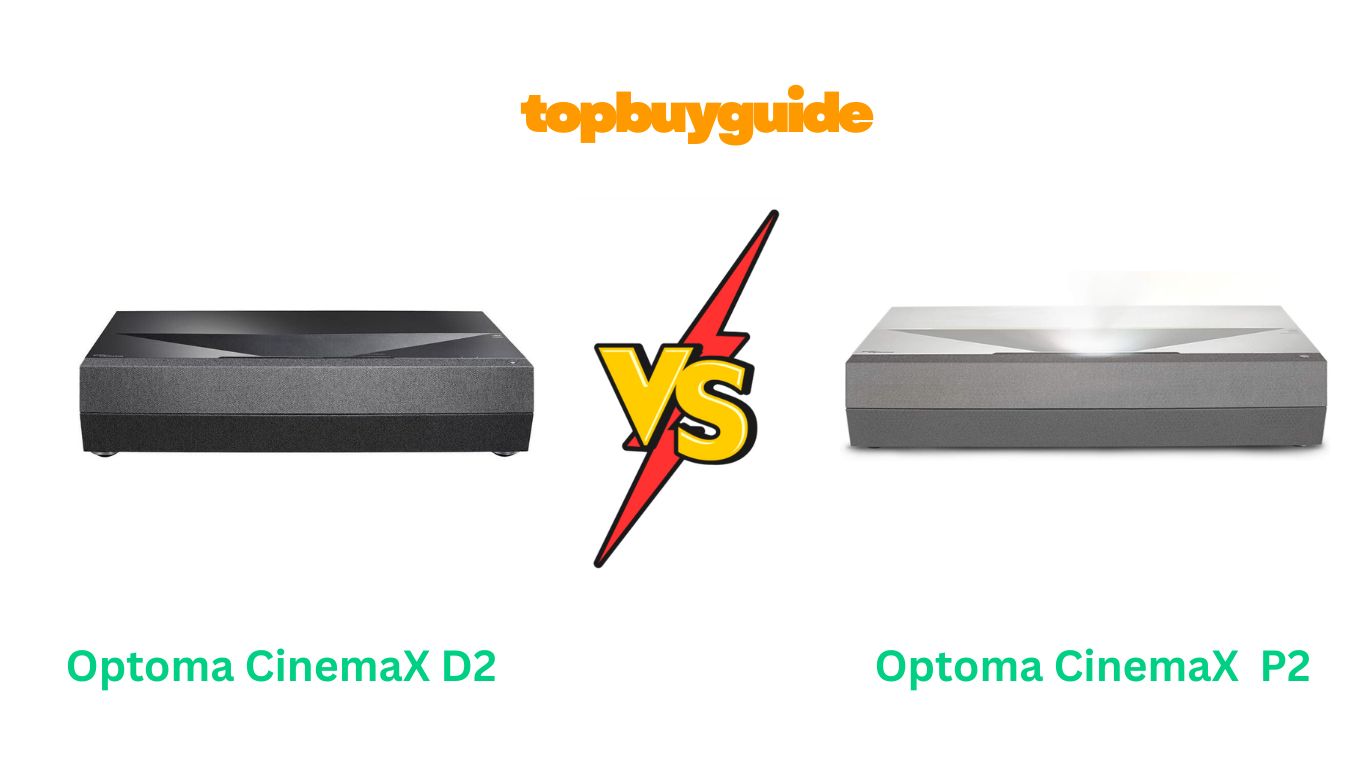
The Optoma CinemaX D2 and P2 are both ultra-short throw 4K laser projectors designed for home cinema enthusiasts who want large, immersive screens without the hassle of long throw distances. While the P2 offers premium features like a built-in soundbar and smart platform, the CinemaX D2 delivers exceptional performance, ultra-low input lag, and a more cost-effective option. For gamers and movie enthusiasts seeking high performance at a lower price point, the CinemaX D2 is the smarter choice.
Why Do I Recommend the CinemaX D2?
The Optoma CinemaX D2 offers a strong combination of performance, flexibility, and value. Below is a detailed explanation of why it stands out compared to the P2:
- Ultra-Low Input Lag for Gaming
The CinemaX D2 provides around 4ms input lag at 1080p/240Hz and 16ms at 4K/60Hz, making it one of the most responsive UST 4K projectors for gaming. The P2 also supports gaming but has slightly higher latency, making the D2 better for fast-paced competitive gaming or high-refresh console use. - High Brightness and Picture Quality
With approximately 3,000 ANSI lumens, the D2 delivers vibrant images even in rooms with ambient light. Its 4K PRO-UHD resolution ensures detailed visuals, while its high contrast ratio of 1,800,000:1 produces deep blacks and vivid color. The P2 offers a comparable brightness and slightly higher contrast, but the D2 maintains excellent visual quality for most users at a lower price. - Long-Life Laser Technology
The D2’s laser light source is rated for tens of thousands of hours, providing consistent brightness over time without the need for frequent lamp replacements. While the P2 also uses a laser engine, the D2 delivers similar longevity at a more affordable price point, making it cost-effective in the long term. - Ultra-Short Throw Flexibility
The D2 can project screen sizes of 85″ to 120″ from just a few inches away from the wall using a 0.25:1 throw ratio. This allows for easy placement in smaller rooms and apartments. The P2 also supports UST projection, but the D2’s installation flexibility paired with lower cost is appealing for most users. - Essential Feature Set for Home Cinema
The CinemaX D2 covers all essential home theater features, including HDR10 and HLG support, eARC audio passthrough, and digital keystone correction. The P2 offers additional premium features like a built-in 40W soundbar and Android smart platform, but these extras add complexity and cost that may not be necessary for many buyers. - Better Value for Money
For most consumers, the D2 provides the core 4K laser projector experience, ultra-short throw convenience, and low input lag at a lower price than the P2. The P2 is best suited for those who want integrated smart features and premium audio without external speakers. - Future-Ready Performance
The D2 is equipped for HDR content, gaming, and large screen projections for years to come. Its long-lasting laser, 4K resolution, and UST flexibility ensure it remains a competitive option even as new projectors enter the market.
In short, the CinemaX D2 delivers the key benefits of ultra-short throw 4K projection, low latency for gaming, excellent brightness, and long-term value, making it the recommended choice for most home theater setups.
Side-by-Side Comparison Chart – Optoma CinemaX D2 vs P2
| Feature | Optoma CinemaX D2 | Optoma CinemaX P2 |
| Brightness | ~3,000 ANSI lumens | ~3,000 ANSI lumens |
| Throw Ratio | 0.25:1 Ultra-Short Throw | 0.25:1 Ultra-Short Throw |
| Input Lag | 4ms (1080p/240Hz), 16ms (4K/60Hz) | Slightly higher latency |
| Contrast Ratio | ~1,800,000:1 | ~2,000,000:1 |
| Built-in Audio | Basic 10W x2 speakers | Premium 40W soundbar with woofers |
| Smart Platform | External Android device optional | Built-in Android OS with streaming apps |
| Gaming Mode | Optimized ultra-low lag mode | Gaming mode present but slightly slower |
| Price Tier | Lower cost, high performance | Higher cost with premium features |
What Common Optoma CinemaX D2 vs P2 Can Do
Despite their differences, both projectors share a strong foundation of features:
- True 4K UHD Resolution
Both projectors deliver 3840×2160 pixels for sharp, detailed images. Movies, games, and sports look crisp and vibrant on both units. - Long-Lasting Laser Light Source
The laser engines in both models are rated for tens of thousands of hours, offering maintenance-free use and consistent brightness over time. - Ultra-Short Throw Projection
Both units use a 0.25:1 throw ratio to project large screen sizes from minimal distance, allowing placement close to walls or shelves. - HDR Support
HDR10 and HLG compatibility on both units improve dynamic range, making highlights brighter and shadows more detailed for immersive viewing. - Large Screen Sizes
Each projector can produce images up to 120 inches or more, providing a true home theater experience. - Modern Connectivity
HDMI inputs, USB power, eARC support, and digital correction are present in both models, making setup flexible for a variety of environments.
Common Features Chart – Optoma CinemaX D2 vs P2
| Feature | Optoma CinemaX D2 | Optoma CinemaX P2 |
| True 4K UHD Resolution | Yes | Yes |
| Laser Light Source | Yes | Yes |
| Ultra-Short Throw | Yes | Yes |
| HDR10 / HLG Support | Yes | Yes |
| Large Screen Sizes | 85″–120″+ | 85″–120″+ |
| Modern Connectivity | HDMI, USB, eARC, digital correction | HDMI, USB, eARC, digital correction |
Perfect! Here’s Part 2 of the Optoma CinemaX D2 vs P2 review, written in a detailed, professional, and affiliate-friendly style:
A Detailed Comparison of the Optoma CinemaX D2 vs P2
Brightness and Picture Quality
The Optoma CinemaX D2 delivers approximately 3,000 ANSI lumens, producing vivid, bright images even in rooms with some ambient light. Its high contrast ratio of around 1,800,000:1 enhances black levels, giving movies and gaming a dynamic, cinematic feel. Color accuracy is excellent for a UST projector in this price range, making it suitable for movie enthusiasts who want large, immersive screens without external lighting control.
In comparison, the Optoma CinemaX P2 also delivers 3,000 ANSI lumens with a slightly higher contrast ratio of around 2,000,000:1. While it can produce slightly deeper blacks, the difference is minor in typical home environments. Both projectors support HDR10 and HLG, ensuring rich highlights and detailed shadows. For users prioritizing absolute image perfection, the P2 offers incremental improvement, but the D2’s quality remains impressive at a lower price point.
Input Lag and Gaming Performance
The CinemaX D2 is designed for ultra-low latency, with 4ms input lag at 1080p/240Hz and 16ms at 4K/60Hz. This ensures responsive gameplay, especially for fast-paced competitive games on consoles or PCs. Gamers can rely on smooth motion and minimal delay, making it an excellent choice for both casual and competitive players.
The CinemaX P2, while optimized for gaming, has slightly higher input lag, which can be noticeable in fast-action gaming scenarios. If gaming is a primary use case, the D2 clearly has the edge. The P2’s advantage lies in its premium built-in audio and smart features, but for pure gaming performance, the D2 is the more responsive option.
Audio Experience
The CinemaX D2 comes with basic built-in speakers that provide functional sound for casual use. While it delivers decent volume for small rooms, most users will benefit from connecting external speakers or a soundbar to get a full home theater audio experience.
The CinemaX P2, on the other hand, features a built-in 40W soundbar with dedicated woofers and tweeters. This allows for high-quality, immersive audio without requiring additional equipment. While the P2 offers superior sound, the D2’s lower-cost design allows users to choose their preferred audio setup without paying for built-in premium speakers.
Installation and Placement Flexibility
Both projectors use a 0.25:1 ultra-short throw lens, capable of projecting 85–120 inch screens from just inches away from a wall. The D2 is compact and straightforward to set up, making it ideal for apartments or smaller rooms. Its simple alignment system ensures quick installation without complex adjustments.
The P2 offers the same UST flexibility but with additional features like motorized lens shift and keystone adjustments, giving more control over placement and image alignment. While these features provide extra convenience, the D2 is sufficiently flexible for most users and keeps installation uncomplicated.
Smart Features and Content Access
The CinemaX D2 does not include a built-in smart platform, relying instead on external streaming devices for apps like Netflix, Hulu, or Disney+. This keeps the projector simple, with fewer software updates or potential system issues.
The P2 comes with an integrated Android platform and pre-installed streaming apps, offering an all-in-one solution. This is convenient for users who want a plug-and-play smart projector, but it comes at a higher cost and may require more frequent software maintenance.
Longevity and Maintenance
Both projectors use laser light sources rated for tens of thousands of hours, eliminating the need for traditional lamp replacements. The D2 offers the same durability and consistent brightness as the P2, providing worry-free use for years. Both units are energy-efficient and low-maintenance, making them practical investments for long-term home cinema setups.
Value and Price Comparison
The CinemaX D2 offers a remarkable balance of performance, low input lag, high brightness, and 4K UHD resolution at a lower price point. For most users, it delivers all the essential features needed for an immersive home theater without paying extra for built-in audio or smart platforms.
The P2, while slightly superior in contrast, audio quality, and integrated smart features, comes with a higher price tag. If budget is a concern, or if the user already owns a sound system or streaming device, the D2 provides better value without sacrificing core performance.
Conclusion
After comparing the Optoma CinemaX D2 vs P2 across brightness, input lag, picture quality, audio, installation, and value, it’s clear that the CinemaX D2 is the optimal choice for most home theater enthusiasts and gamers. It delivers 4K UHD performance, ultra-low input lag for gaming, excellent HDR support, and long-lasting laser brightness, all at a significantly lower cost than the P2.
The CinemaX P2 is ideal for those seeking a premium all-in-one solution with integrated high-quality audio and smart features. However, for users who prioritize performance and value, the CinemaX D2 is the recommended choice. Click the link to get the best deal on the Optoma CinemaX D2 and elevate your home theater experience today.
FAQs – Optoma CinemaX D2 vs P2
- Which projector is better for gaming, D2 or P2?
The D2 is better for gaming due to its ultra-low input lag (4ms at 1080p/240Hz and 16ms at 4K/60Hz). The P2 is responsive but slightly slower, making the D2 ideal for fast-paced gaming. - Do both projectors support HDR content?
Yes, both CinemaX D2 and P2 support HDR10 and HLG, improving contrast, shadow detail, and highlights for a cinematic experience. - Can the D2 project a 120-inch screen?
Yes, both D2 and P2 can project up to 120 inches using their 0.25:1 ultra-short throw lens, making them ideal for home theater setups in limited space. - Does the P2 require external speakers?
No, the P2 has a built-in 40W soundbar that delivers high-quality audio, although external speakers can still enhance the experience. - Is the CinemaX D2 suitable for apartments?
Absolutely. Its ultra-short throw design allows placement just inches from the wall, making it perfect for smaller spaces without compromising screen size. - What is the expected lifespan of the laser?
Both projectors use a laser light source rated for tens of thousands of hours, ensuring many years of consistent, maintenance-free performance. - Does the D2 have smart streaming capabilities?
No, the D2 relies on external devices for streaming apps, unlike the P2 which includes a built-in Android platform. - Which projector offers better value for money?
The CinemaX D2 provides the best value for most users by combining performance, ultra-low input lag, and 4K UHD projection at a lower price than the P2.

Alex Turner is a dedicated product researcher and reviewer at TopBuyGuide.com, known for his clear, honest, and data-driven insights. He spends countless hours testing, comparing, and analyzing products to help readers make confident and informed buying decisions.