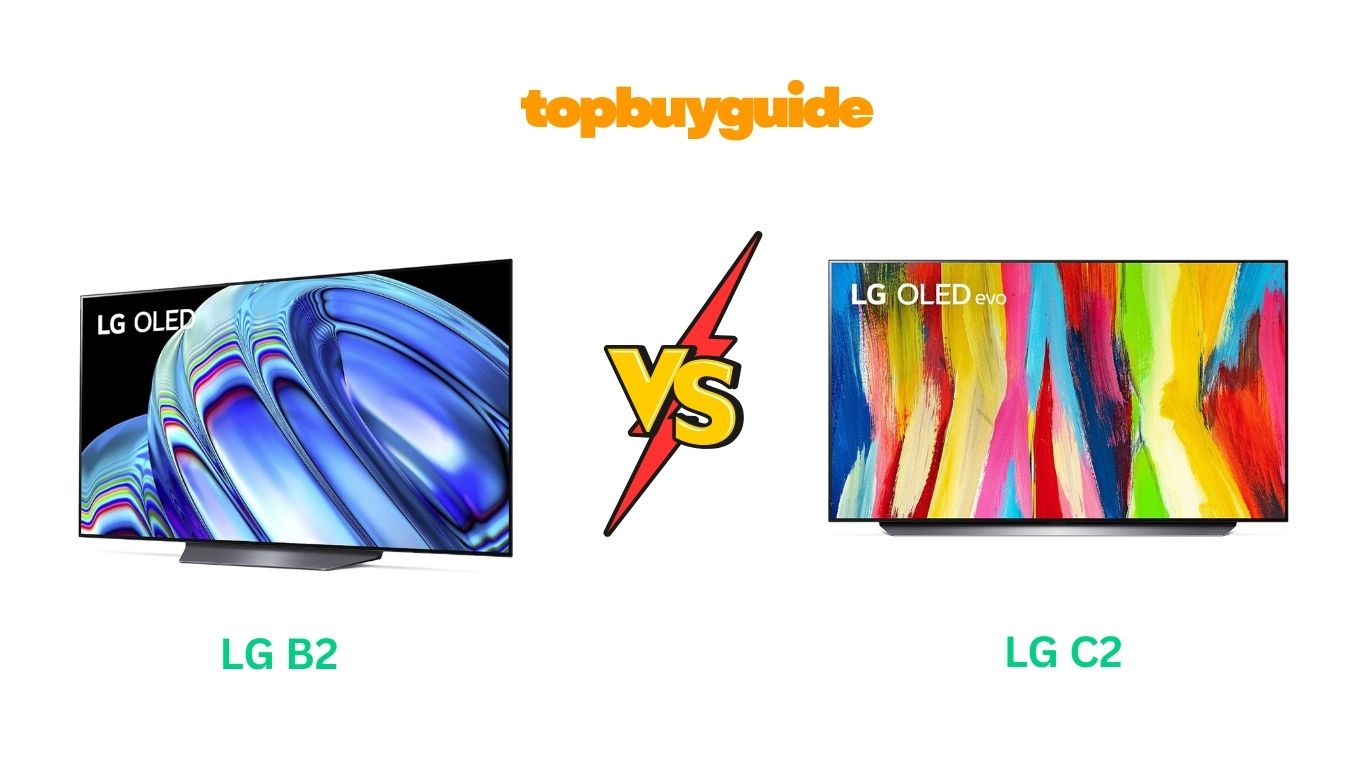
Choosing between the LG B2 and C2 can be tough, as both are fantastic OLED TVs. However, if you’re looking for the best overall performance and future-proofing, the LG C2 is the clear winner. Its brighter display and more powerful processor deliver a superior viewing experience that justifies the extra cost for most users. Ready to see why? Let’s dive in.
Why Do I Recommend The LG C2?
While the LG B2 is an excellent entry-level OLED, I recommend the LG C2 for its significant upgrades in key performance areas. Here’s a breakdown of why the C2 stands out:
- Processor Power: The LG C2 is equipped with the advanced α9 Gen 5 AI Processor 4K. This is a substantial step up from the α7 Gen 5 AI Processor in the B2. The result is better upscaling of lower-resolution content, more refined picture adjustments, and enhanced object enhancement, making everything you watch look sharper and more lifelike.
- Superior Brightness: The C2 features LG’s OLED Evo panel technology, which incorporates a Brightness Booster. This allows the C2 to get significantly brighter than the B2, especially in small, bright areas of the screen (specular highlights). This makes HDR content pop with more vibrant colors and impactful highlights, offering a more dynamic and impressive picture.
- Lighter, Sleeker Design: The LG C2 is constructed with a composite fiber material, making it noticeably lighter than the B2. This not only makes wall-mounting easier but also gives it a more premium feel. The bezels are also thinner on the C2, providing a more immersive, all-picture look.
- More Size Options: Versatility is a major advantage for the C2, which is available in a wider range of sizes, from a desk-friendly 42-inch model all the way up to a massive 83-inch screen. In contrast, the LG B2 is only offered in 55, 65, and 77-inch options, limiting its suitability for different room sizes and use cases.
- Better Sound Processing: With the α9 Gen 5 processor, the LG C2 can up-mix 2-channel audio into virtual 7.1.2 channel surround sound. The B2’s α7 processor, while still good, only supports virtual 5.1.2 channel up-mixing. This gives the C2 a slight edge in creating a more immersive built-in audio experience.
- Enhanced Picture Detail: The C2 uses Dynamic Tone Mapping Pro, which analyzes over 5,000 individual blocks on the screen to optimize HDR for each frame. The B2 uses the standard Dynamic Tone Mapping, which is less granular. This means the C2 delivers more nuanced and accurate detail in both bright and dark scenes.
- Full HDMI 2.1 Bandwidth: All four HDMI ports on the LG C2 support the full 48Gbps bandwidth of HDMI 2.1. While the LG B2 also has four HDMI 2.1 ports, two of them are limited to 40Gbps. For hardcore gamers wanting to push multiple next-gen devices to their absolute limit, the C2 offers more robust connectivity.
Side By Side Comparison Chart (LG B2 vs C2)
| Feature | LG B2 | LG C2 |
| Processor | α7 Gen 5 AI Processor 4K | α9 Gen 5 AI Processor 4K |
| Panel Technology | Standard OLED | OLED Evo with Brightness Booster |
| Brightness | Standard OLED Brightness | Higher Peak and Sustained Brightness |
| Design | Heavier build, standard bezels | Lighter build, ultra-thin bezels |
| Sound Processing | Virtual 5.1.2 Surround Sound | Virtual 7.1.2 Surround Sound |
| Tone Mapping | Dynamic Tone Mapping | Dynamic Tone Mapping Pro |
| HDMI Ports | 2x HDMI 2.1 (48Gbps), 2x HDMI 2.1 (40Gbps) | 4x HDMI 2.1 (48Gbps) |
| Available Sizes | 55″, 65″, 77″ | 42″, 48″, 55″, 65″, 77″, 83″ |
| Weight (55″) | 56.3 lbs | 45.9 lbs |
What Common (LG B2 vs C2) Can Do?
Despite their differences, the LG B2 and LG C2 share a host of premium features that make them both excellent choices for a 4K OLED TV.
Both models are built on LG’s cutting-edge OLED technology. This means they don’t require a backlight, as each of the 8 million pixels is self-lit. This allows for what is known as “infinite contrast,” providing perfect black levels because pixels can turn off completely. The result is a stunning picture where colors appear more vibrant and details in dark scenes are preserved without the “blooming” or “halo” effects common on LED TVs. You get a crisp, clean image from virtually any viewing angle.
For an immersive home cinema experience, both the B2 and C2 support the most advanced HDR formats, including Dolby Vision IQ. This technology intelligently adjusts the picture settings based on the ambient light in your room, ensuring you always get the best possible HDR picture. They also feature Dolby Atmos audio, which creates a three-dimensional soundscape, placing you right in the middle of the action. Additionally, Filmmaker Mode on both TVs disables post-processing effects so you can watch movies exactly as the directors intended.
Gaming is another area where both TVs excel. They boast a native 120Hz refresh rate for incredibly smooth motion, essential for fast-paced action games. Both support key gaming features like Auto Low Latency Mode (ALLM), which automatically switches the TV to its fastest mode when a console is detected, and Variable Refresh Rate (VRR) to prevent screen tearing. NVIDIA G-SYNC and AMD FreeSync Premium compatibility are also included, making them perfect companions for both PC and console gaming on the PS5 and Xbox Series X.
Finally, both the LG B2 and C2 run on LG’s webOS 22 smart platform. This user-friendly interface provides easy access to all your favorite streaming services like Netflix, Prime Video, Disney+, and HBO Max. They also come with the LG Magic Remote, which allows for intuitive point-and-click navigation and voice commands via built-in Alexa and Google Assistant.
Common Features of LG B2 vs C2
| Feature | LG B2 | LG C2 |
| Display Technology | OLED | OLED |
| Resolution | 4K UHD | 4K UHD |
| Refresh Rate | 120Hz | 120Hz |
| HDR Support | Dolby Vision IQ, HDR10, HLG | Dolby Vision IQ, HDR10, HLG |
| Audio Support | Dolby Atmos | Dolby Atmos |
| Gaming Features | G-SYNC, FreeSync Premium, VRR, ALLM | G-SYNC, FreeSync Premium, VRR, ALLM |
| Smart Platform | webOS 22 | webOS 22 |
| Voice Assistants | Alexa, Google Assistant | Alexa, Google Assistant |
| Filmmaker Mode | Yes | Yes |
A Detailed Comparison Of the LG B2 vs C2
Processor and Picture Performance
The single biggest difference between these two TVs is the processor. The LG B2 uses the α7 Gen 5 AI Processor 4K, a very capable chip that delivers excellent picture quality. It handles upscaling and motion well, providing the deep blacks and rich colors you expect from an OLED. It’s a fantastic processor for an entry-to-mid-range OLED.
However, the LG C2 steps it up with the α9 Gen 5 AI Processor 4K. This more advanced processor provides tangible benefits, especially with object enhancement and tone mapping. The C2’s Dynamic Tone Mapping Pro analyzes thousands of zones on the screen to fine-tune HDR, whereas the B2’s standard Dynamic Tone Mapping is less precise. This results in the C2 displaying a more detailed and nuanced image, with better separation between light and dark objects.
Brightness and Panel Technology
Brightness is where the LG C2 truly pulls away from the B2. The C2 features LG’s OLED Evo panel, which is engineered to be more efficient and therefore brighter than the standard OLED panel found in the B2. This is further enhanced by a “Brightness Booster” feature that pushes peak brightness levels even higher. In practice, HDR content on the C2 has more impact, with highlights that shine more intensely and colors that appear more vibrant and saturated. This makes a noticeable difference in well-lit rooms and with high-quality 4K content.
The LG B2 is by no means a dim TV; it delivers a beautiful picture that will impress anyone coming from an LED TV. Its brightness is more than adequate for viewing in dark or moderately lit environments. But when placed side-by-side, the C2’s ability to produce a brighter, punchier image is undeniable and represents a key reason to opt for the higher-end model if your budget allows.
Design and Build Quality
At a glance, both TVs look sleek and modern. However, LG used different materials in their construction, leading to a significant difference in weight and feel. The LG C2 is made with a composite fiber material that makes it remarkably lightweight for its size. For example, the 55-inch C2 is over 10 pounds lighter than the 55-inch B2. This makes it easier to unbox, set up, and wall-mount. The C2 also features razor-thin bezels, creating a more immersive, nearly borderless picture.
The LG B2, while still a well-designed TV, is bulkier and heavier due to its more conventional construction. The bezels are slightly thicker than the C2’s, which is a minor aesthetic point but one that enthusiasts might notice. The choice of stand also differs; the C2 has a compact central stand, while the B2 uses wide-set feet, which might require a wider media console.
Gaming Features
Both TVs are gaming powerhouses, offering a 120Hz refresh rate and support for VRR, ALLM, NVIDIA G-SYNC, and AMD FreeSync Premium. This ensures a smooth, tear-free, and responsive gaming experience on next-gen consoles and PCs. You’ll find the LG Game Optimizer menu on both, which conveniently gathers all game-related settings in one place.
The main difference lies in the HDMI ports. The LG C2 provides four HDMI 2.1 ports that all support the full 48Gbps bandwidth. This is ideal for gamers with multiple high-end devices, like a PS5, Xbox Series X, and a gaming PC. The LG B2 also has four HDMI 2.1 ports, but only two of them offer the full 48Gbps bandwidth; the other two are capped at 40Gbps. While this won’t be a limitation for most users today, the C2 is slightly more future-proof for hardcore gamers.
Conclusion
So, LG B2 vs C2: which should you buy? If you’re on a tighter budget but still want the incredible contrast and gaming performance of an OLED, the LG B2 is a phenomenal choice that won’t disappoint. It offers a premium experience at a more accessible price point.
However, for those who can stretch their budget, the LG C2 is the superior television. Its brighter OLED Evo panel, more powerful α9 processor, and sleeker, lighter design deliver a noticeable upgrade in picture quality and overall user experience. It’s the better TV for bright rooms, HDR movies, and for gamers wanting the most robust connectivity.
FAQs
- Is the LG C2 much brighter than the B2?
Yes, the LG C2 is noticeably brighter thanks to its OLED Evo panel and Brightness Booster technology. This makes HDR content look more vibrant and improves visibility in well-lit rooms. - Are both TVs good for gaming on PS5 and Xbox Series X?
Absolutely. Both the LG B2 and C2 are excellent for gaming, with 120Hz refresh rates, VRR, ALLM, and low input lag. The C2 has a slight edge with four full-bandwidth HDMI 2.1 ports, compared to the B2’s two. - What is the main difference between the α7 and α9 processors?
The α9 Gen 5 processor in the C2 offers better picture processing, including more advanced object enhancement and superior Dynamic Tone Mapping Pro. This results in a sharper, more detailed, and lifelike image compared to the α7 processor in the B2. - Can both the LG B2 and C2 be wall-mounted?
Yes, both models can be wall-mounted using a standard VESA mount. The C2 is significantly lighter, which can make the wall-mounting process easier and less stressful. - Do I need a soundbar with the LG B2 or C2?
While both TVs have decent built-in speakers with Dolby Atmos support, a dedicated soundbar or surround sound system will provide a much more immersive and powerful audio experience, especially for movies and gaming. - What is Filmmaker Mode?
Filmmaker Mode is a picture setting available on both TVs that disables certain post-processing effects like motion smoothing. This allows you to view movies and shows with the original aspect ratio, colors, and frame rates intended by the creators. - Does the C2 come in more sizes than the B2?
Yes. The LG C2 series offers a wider range of sizes, including 42-inch and 48-inch models that are popular for use as PC monitors. The B2 series is more limited, typically starting at 55 inches. - Is there a risk of burn-in with these OLED TVs?
OLED burn-in is a possibility but is rare with modern TVs like the B2 and C2 under normal viewing conditions. Both include features like Pixel Cleaning and Screen Move to mitigate the risk of permanent image retention.

Alex Turner is a dedicated product researcher and reviewer at TopBuyGuide.com, known for his clear, honest, and data-driven insights. He spends countless hours testing, comparing, and analyzing products to help readers make confident and informed buying decisions.