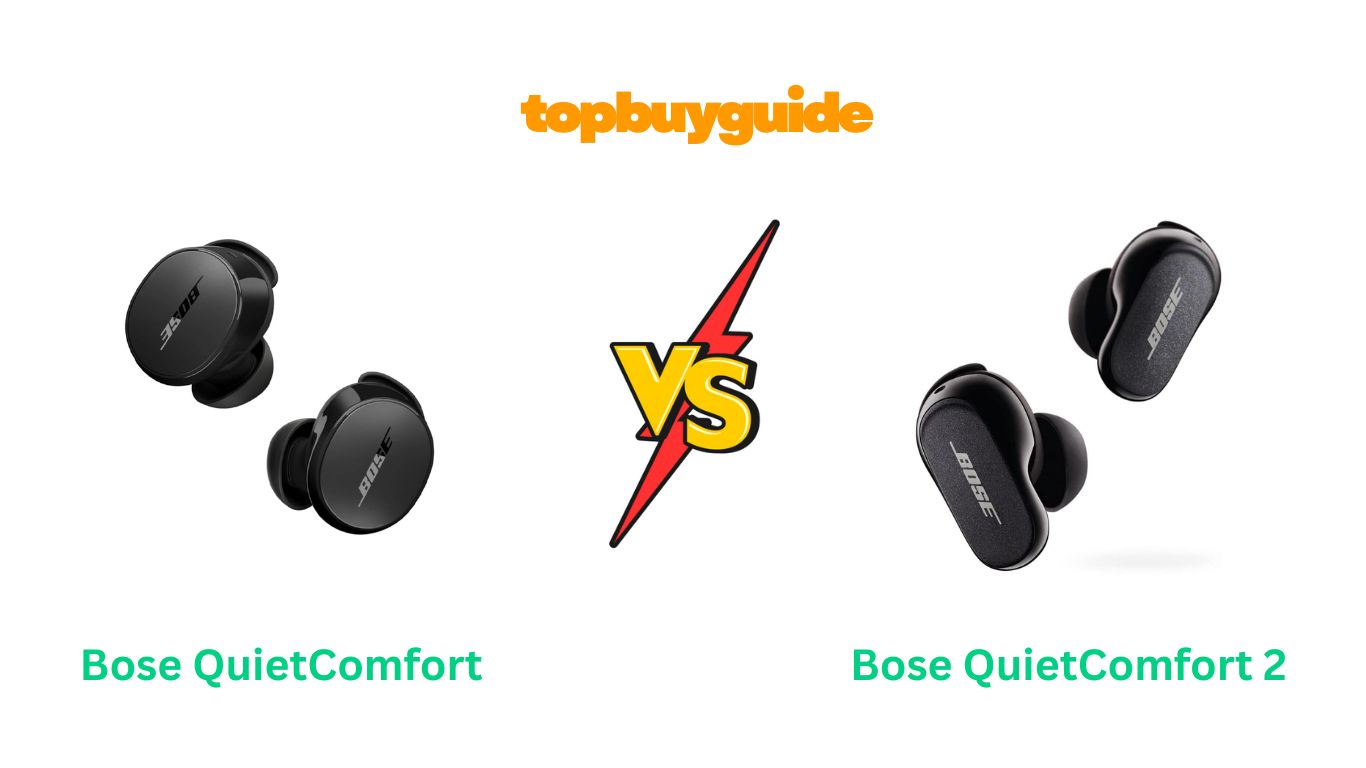
Choosing between the Bose QuietComfort and QuietComfort II earbuds? I recommend the Bose QuietComfort Earbuds (the original model). While the QC IIs have some advanced tech, the originals offer better battery life and a more stable user experience for a lower price. For most people, they deliver the core Bose quality you expect without the connectivity frustrations reported with the newer model. This makes them the smarter, more reliable choice.
Why Do I Recommend The Bose QuietComfort Earbuds?
While the QuietComfort Earbuds II introduce personalized sound, the original Bose QuietComfort Earbuds deliver a more consistent and reliable experience, making them my top recommendation. They balance core features, performance, and value exceptionally well, proving that the latest model isn’t always the best choice for everyone. Here are the key reasons why the originals stand out.
- Bose QuietComfort Earbuds boast a longer battery life of up to 8.5 hours on a single charge. In contrast, the QuietComfort Earbuds II only offer up to 6 hours, which is a significant step down for users who need all-day listening without interruption.
- The original QuietComfort Earbuds have a more established track record for stable connectivity, according to a significant number of user reviews. On the other hand, the QuietComfort Earbuds II have faced widespread complaints about frequent Bluetooth dropouts and pairing issues, which can be a major source of frustration.
- The original model provides a secure and comfortable fit with its combined eartip and stability wing design, which many users have found to be very effective. The QuietComfort Earbuds II separate the eartips and stability bands, creating a more complex two-piece system that some users find less intuitive and secure.
- While the QuietComfort Earbuds II are lighter and smaller, the original model’s slightly larger size contributes to its more robust battery. For many users, the trade-off of a slightly bulkier design for over two extra hours of playback is a worthwhile compromise.
- The charging case for the original QuietComfort Earbuds can be charged wirelessly, a convenient feature that was surprisingly removed from the standard QuietComfort Earbuds II case. This means the newer model requires you to stick with wired charging unless you purchase an additional accessory.
- The original earbuds provide a fantastic out-of-the-box sound experience that has been widely praised for its balance and clarity. Conversely, the QuietComfort Earbuds II rely heavily on the CustomTune technology, which, while innovative, has delivered inconsistent results for some users.
- Priced lower than their successor, the original QuietComfort Earbuds offer better value for money. They deliver the premium noise cancellation and audio quality Bose is known for, but without the premium price tag and reported issues of the newer model.
Side By Side Comparison Chart: Bose QuietComfort vs Bose QuietComfort 2
| Feature | Bose QuietComfort Earbuds | Bose QuietComfort Earbuds II |
| Battery Life (Earbuds) | Up to 8.5 hours | Up to 6 hours |
| Total Battery (with Case) | Up to 28.5 hours | Up to 24 hours |
| Wireless Charging | Yes, case supports it | No (requires separate accessory) |
| Fit System | One-piece eartip and stability wing | Two-piece: separate eartips and stability bands |
| Custom Sound Tech | No (Standard Bose sound profile) | CustomTune technology for personalized sound |
| Bluetooth Version | Bluetooth 5.3 | Bluetooth 5.3 |
| Multipoint Pairing | Yes | Yes (added via firmware update) |
| Size & Weight | Larger and heavier | Smaller and lighter |
| User-Reported Stability | Generally more stable connectivity | Frequent reports of connectivity issues |
| Price | More affordable | More expensive |
What Common Features Can the Bose QuietComfort vs Bose QuietComfort 2 Do?
Despite their differences, both the Bose QuietComfort Earbuds and the QuietComfort Earbuds II share a foundational commitment to high-quality audio and an immersive listening experience. They are built on the same principles of delivering world-class noise cancellation and premium sound, ensuring that whichever model you choose, you’re getting a product rooted in Bose’s audio expertise. These shared features are what make both earbuds stand out in a crowded market.
Active Noise Cancellation (ANC)
Both models are equipped with Bose’s legendary Active Noise Cancellation technology, which is widely considered the industry benchmark. This feature uses microphones to detect external sounds and generates an opposing signal to cancel them out before they reach your ears. Whether you are on a noisy commute, in a busy office, or on an airplane, both sets of earbuds excel at creating a quiet bubble for you to enjoy your music, podcasts, or simply some peace. Both also feature an “Aware Mode” that allows you to hear your surroundings without removing the earbuds, which is perfect for staying safe while walking on busy streets or listening for announcements.
High-Fidelity Audio
At their core, both the QuietComfort and QuietComfort II are designed to deliver rich, clear, and immersive sound. They feature high-performance drivers and exclusive acoustic architecture that produce deep, powerful bass and crisp, detailed highs. Both models also benefit from Bose’s Volume-optimized Active EQ technology, which automatically adjusts the frequency response to ensure your music sounds balanced and full at any volume. This means you don’t lose the richness of the bass or the clarity of the treble, even when listening at low levels.
Secure and Comfortable Fit
Bose understands that a good fit is crucial for both comfort and performance, especially for noise cancellation and audio quality. Both the original QuietComfort Earbuds and the QC Earbuds II come with a “Bose Fit Kit.” This kit includes multiple sizes of soft silicone eartips and stability bands (or wings) designed to conform to the unique shape of your ears. This ensures a secure, comfortable fit that won’t fall out during workouts or daily activities, while also creating a solid seal that enhances passive noise isolation.
Bluetooth Connectivity
Both generations of QuietComfort earbuds utilize advanced Bluetooth technology to provide a strong and reliable wireless connection to your devices. The Bose QuietComfort and QuietComfort II both use Bluetooth 5.3, which offers improved efficiency and signal stability. This ensures your music or calls won’t drop out, even when your phone is in your pocket or a nearby bag. Both models also support multipoint pairing, allowing you to connect to two devices at once and seamlessly switch between them—for instance, from a video on your laptop to a call on your phone.
Touch Controls and Bose Music App
Interaction with both sets of earbuds is managed through simple touch controls on the outer surface of each bud. You can play or pause music, skip tracks, answer calls, and adjust noise cancellation levels with a series of taps and swipes. Furthermore, both earbuds are compatible with the Bose Music app, which unlocks a deeper level of customization. Through the app, you can adjust the equalizer (EQ) settings to tailor the sound to your preferences, customize the touch controls, manage your Bluetooth connections, and receive firmware updates that can add new features and improve performance over time.
Common Features of Bose QuietComfort vs Bose QuietComfort 2
| Feature | Bose QuietComfort Earbuds | Bose QuietComfort Earbuds II |
| Active Noise Cancellation | Yes (World-Class) | Yes (World-Class) |
| Aware Mode | Yes | Yes |
| High-Fidelity Audio | Yes | Yes |
| Volume-Optimized Active EQ | Yes | Yes |
| Secure Fit Kit | Yes (3 sizes) | Yes (3 sizes) |
| Touch Controls | Yes | Yes |
| Bose Music App Support | Yes | Yes |
| Sweat & Water Resistance | IPX4 | IPX4 |
| Clear Calls | Yes | Yes |
A Detailed Comparison Of the Bose QuietComfort vs Bose QuietComfort 2
While both earbuds share the prestigious Bose name, a deeper look reveals significant differences in their technology, design, and user experience. Here, we break down how the Bose QuietComfort Earbuds and the QuietComfort Earbuds II stack up against each other across the most important categories.
Battery Life and Charging
When it comes to staying power, the original Bose QuietComfort Earbuds have a clear advantage, offering up to 8.5 hours of listening time on a single charge. The charging case provides an additional 2.5 charges, bringing the total playback time to a very respectable 28.5 hours. A standout feature for this model is its support for wireless charging, allowing you to simply place the case on a Qi-certified charging pad for a convenient, cable-free power-up.
In contrast, the Bose QuietComfort Earbuds II offer a shorter battery life of up to 6 hours per charge. While the case provides three additional charges for a total of 24 hours, the individual listening sessions are significantly shorter. A major step back for the QC II is the lack of wireless charging in the standard case. If you want that convenience, you’ll need to purchase a separate wireless charging case cover, adding to the overall cost.
Design, Comfort, and Fit
The Bose QuietComfort Earbuds II are noticeably smaller and lighter than their predecessors, a change many users will appreciate for long-term comfort. Bose redesigned the fit system, separating the eartips from the stability bands. This allows for more mix-and-match combinations to find a truly personalized fit. However, this two-piece system can be more fiddly to manage, and some users find it less secure than the original’s integrated design.
The original Bose QuietComfort Earbuds, while bulkier, feature a one-piece StayHear™ Max tip design that combines the eartip and stability wing. Many users find this system incredibly simple and effective, providing a secure seal that feels locked in place without much adjustment. Though they are larger, they are still comfortable for most users, but their size might be a concern for those with smaller ears or who prefer a more discreet look.
Sound Performance and Technology
Here lies the most significant technological divergence. The Bose QuietComfort Earbuds II introduce CustomTune technology, which analyzes the unique acoustic properties of your ear canal and calibrates the audio and noise cancellation performance specifically for you. When it works, the result is an incredibly immersive and personalized sound stage. However, this automated process is out of the user’s control, and some have reported that the resulting sound profile can feel overly processed or less natural.
The original Bose QuietComfort Earbuds deliver Bose’s signature sound profile right out of the box—rich, balanced, and powerful. While it lacks the personalization of CustomTune, it offers a consistently high-quality listening experience that has been widely praised. For those who prefer a reliable and proven audio profile without automated adjustments, the original model provides a more predictable and satisfying sound that doesn’t require any guesswork.
Noise Cancellation
Both earbuds offer phenomenal active noise cancellation, but the Bose QuietComfort Earbuds II claim to have the “world’s best noise cancellation.” This is largely thanks to the CustomTune technology, which optimizes the ANC for the specific seal in your ear. This can result in a more effective and nuanced reduction of ambient sound, especially for inconsistent noises like conversations.
The original Bose QuietComfort Earbuds, however, are no slouch. They set the standard for noise-canceling earbuds and still provide an incredibly effective and immersive quiet. The difference between the two is marginal for most everyday situations. While the QC IIs might have a slight edge in certain environments, the originals still block out the vast majority of distractions, from the roar of a jet engine to the chatter of a busy café.
Connectivity and Stability
User feedback highlights a crucial difference in real-world performance. The original Bose QuietComfort Earbuds have a reputation for being reliable, with generally stable Bluetooth connectivity and fewer bugs. Since they have been on the market longer, most of the initial software kinks have been ironed out through firmware updates, including the addition of multipoint pairing.
The Bose QuietComfort Earbuds II have been plagued by user reports of connectivity issues. These include random disconnections, difficulty pairing with devices, and problems with one earbud failing to connect. While Bose has released firmware updates to address these issues (and to add features like multipoint pairing post-launch), the user experience remains less consistent compared to the original model, making them a potentially frustrating choice for some.
Conclusion
After a detailed comparison, my recommendation goes to the original Bose QuietComfort Earbuds. They provide a superior balance of features, reliability, and value. With an impressive 8.5 hours of battery life and the convenience of wireless charging, they are better equipped for all-day use. More importantly, they offer a more stable and bug-free user experience, avoiding the connectivity frustrations frequently reported with the QC Earbuds II. While the newer model is smaller and has innovative personalization tech, the original QuietComfort Earbuds deliver the legendary Bose sound and noise cancellation you expect at a more affordable price, making them the smarter purchase.
FAQs
- Are the Bose QuietComfort Earbuds II more comfortable than the originals?
The Bose QuietComfort Earbuds II are smaller and lighter, which many users find more comfortable for extended wear. Their two-piece fit system offers more customization, but some people may prefer the simpler, secure feel of the original’s one-piece design.
- Is the noise cancellation on the QC Earbuds II noticeably better?
The noise cancellation on the QC Earbuds II is slightly more advanced due to CustomTune technology, which personalizes it to your ear. However, the original QuietComfort Earbuds are still top-tier in ANC, and the difference may be subtle for most everyday users.
- Do both models support connecting to multiple devices at once?
Yes, both the Bose QuietComfort Earbuds and the QC Earbuds II support multipoint Bluetooth pairing. This feature allows you to stay connected to two devices simultaneously and switch between them seamlessly. Note that this was added to both models via a firmware update.
- Can I use a single earbud with both models?
Yes, both models allow for single-earbud use. You can use either the left or right earbud independently for music or calls, which is convenient for staying aware of your surroundings or extending battery life by alternating between the buds.
- Which model is better for working out?
Both models have an IPX4 rating for sweat and water resistance, making them suitable for workouts. The choice comes down to fit. The original’s one-piece wing design is very secure, while the QC II’s lighter design may feel less intrusive during intense activity.
- Is the CustomTune technology in the QC Earbuds II worth the extra cost?
CustomTune technology personalizes sound and noise cancellation to your ear’s unique shape. While innovative, its benefits can be subjective. If you prefer a proven, consistent audio profile without automatic adjustments, the original QuietComfort Earbuds offer better value.
- Do the Bose QuietComfort Earbuds II have wireless charging?
No, the standard charging case for the Bose QuietComfort Earbuds II does not support wireless charging. You must purchase a separate wireless charging case cover. The original QuietComfort Earbuds, however, come with a wirelessly chargeable case as standard.
- Have the connectivity issues with the QC Earbuds II been fixed?
Bose has released several firmware updates to address the connectivity problems reported with the QC Earbuds II, and many users have seen improvements. However, some users still report occasional glitches, making the original model a more consistently reliable option.

Alex Turner is a dedicated product researcher and reviewer at TopBuyGuide.com, known for his clear, honest, and data-driven insights. He spends countless hours testing, comparing, and analyzing products to help readers make confident and informed buying decisions.