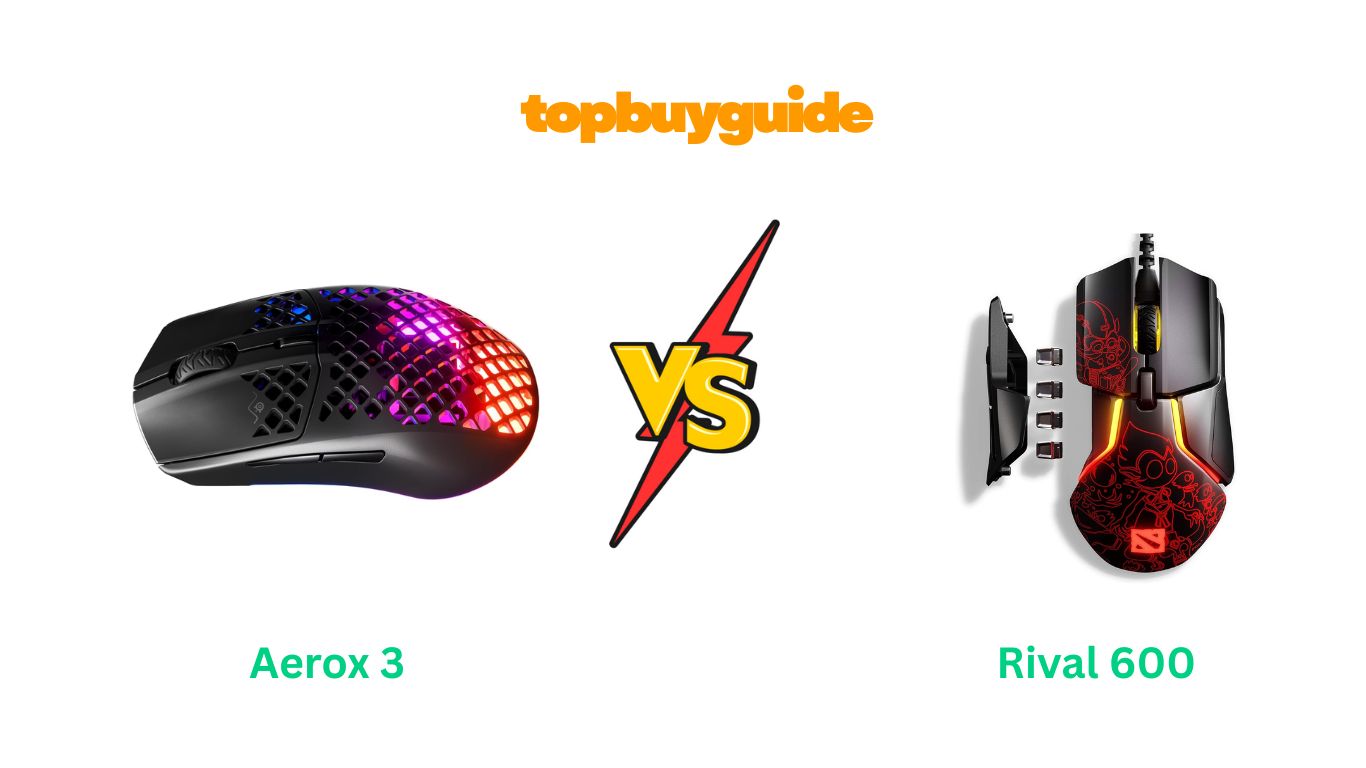
Choosing between the SteelSeries Aerox 3 Wireless and the Rival 600 comes down to one key question: do you prioritize featherlight speed or customizable precision? After testing both mice extensively, I recommend the Aerox 3 Wireless for most gamers. Its ultra-lightweight 68g design and 200-hour battery life make it ideal for fast-paced FPS gameplay, while the wireless freedom eliminates cable drag entirely. However, if you demand adjustable weight configurations and dual-sensor precision for competitive esports, the Rival 600 remains a formidable choice.
Why Do I Recommend The Aerox 3 Wireless?
The Aerox 3 Wireless edges ahead with several compelling advantages that make it the superior choice for modern gaming:
- Ultra-Lightweight Design: At just 68g, the Aerox 3 is significantly lighter than the Rival 600’s 96-128g range, reducing fatigue during extended gaming sessions and enabling faster flick shots.
- Wireless Freedom: The 2.4GHz wireless connection delivers lag-free performance while the Rival 600’s wired design can create cable drag that impacts mouse movement consistency.
- Extended Battery Life: With up to 200 hours of use on a single charge, you won’t need to worry about mid-game battery failures, unlike wired mice that require constant cable management.
- IP54 Water Resistance: The AquaBarrier protection shields against spills, dust, and debris—a feature the Rival 600 lacks entirely.
- Modern Connectivity: USB-C charging is more convenient and future-proof compared to the Rival 600’s standard USB connection.
- Stunning RGB Lighting: The holey shell design allows 3-zone RGB to shine through brilliantly, creating a more eye-catching aesthetic than the Rival 600’s traditional lighting.
- Pure PTFE Glide Skates: The 100% virgin-grade PTFE feet provide smoother, more controlled movements across any surface.
- Compact Profile: The smaller footprint accommodates various grip styles without the bulk of the Rival 600’s larger frame.
Side By Side Comparison Chart: Aerox 3 vs Rival 600
| Feature | Aerox 3 Wireless | Rival 600 |
| Weight | 68g | 96-128g (customizable) |
| Connectivity | 2.4GHz Wireless + Bluetooth 5.0 | Wired USB |
| Battery Life | Up to 200 hours | N/A (wired) |
| Sensor | TrueMove Air (18K DPI) | TrueMove3+ Dual Sensor (12K DPI) |
| Water Resistance | IP54 (AquaBarrier) | None |
| RGB Zones | 3 zones | 8 zones |
| Buttons | 6 programmable | 7 programmable |
| Switches | Golden Micro IP54 | 60-million click mechanical |
| Weight System | Fixed | 256 configurations (8x4g weights) |
| Cable | USB-C charging | Detachable USB |
| Lift-Off Distance | Standard | 0.5mm (customizable) |
| Special Features | Holey design, wireless | Dual sensor, weight customization |
| Price | $79.98 | Currently unavailable |
What Common Features Can Both Mice Deliver?
Despite their differences, both the Aerox 3 Wireless and Rival 600 share several core capabilities that make them excellent gaming mice.
Professional-Grade Optical Sensors
Both mice utilize SteelSeries’ TrueMove sensor technology co-developed with PixArt. The Aerox 3 features the TrueMove Air sensor with 18,000 CPI, while the Rival 600 uses the TrueMove3+ dual sensor system with 12,000 CPI. Each delivers true 1:1 tracking with zero acceleration or interpolation, ensuring your on-screen movements perfectly match your hand movements. This precision is essential for competitive gaming where pixel-perfect accuracy determines victory.
Customizable RGB Lighting
RGB enthusiasts will appreciate that both mice offer extensive lighting customization through SteelSeries Engine software. The Aerox 3 provides 3-zone illumination that shines brilliantly through its holey shell design, while the Rival 600 offers 8-zone RGB for more granular control. Both support 16.8 million colors and various lighting effects, allowing you to match your setup’s aesthetic perfectly.
Programmable Buttons
Gaming flexibility comes standard with programmable buttons on both models. The Aerox 3 includes 6 programmable buttons, while the Rival 600 offers 7. Through SteelSeries Engine software, you can assign macros, keybinds, and custom functions to optimize your gameplay across different genres—from MOBA to FPS to MMO titles.
Ergonomic Right-Handed Design
Both mice feature ergonomic shapes designed specifically for right-handed users. The contoured design supports various grip styles including palm, claw, and fingertip grips, reducing hand fatigue during marathon gaming sessions. The comfortable grip ensures consistent performance whether you’re gaming for one hour or ten.
SteelSeries Engine Software Support
Full customization is available through the comprehensive SteelSeries Engine software for both mice. You can adjust DPI settings, create custom profiles for different games, configure button assignments, fine-tune RGB lighting effects, and monitor performance metrics. The software supports both Windows and Mac operating systems, making setup straightforward regardless of your platform.
Common Features of Aerox 3 vs Rival 600
| Feature | Aerox 3 Wireless | Rival 600 |
| Optical Sensor | TrueMove Air | TrueMove3+ |
| Programmable Buttons | 6 | 7 |
| RGB Lighting | Yes (3 zones) | Yes (8 zones) |
| Software Support | SteelSeries Engine | SteelSeries Engine |
| Ergonomic Design | Right-handed | Right-handed |
| Grip Compatibility | Palm, claw, fingertip | Palm, claw, fingertip |
| PTFE Feet | 100% pure | Standard |
| On-Board Memory | Yes | Yes |
| Platform Support | Windows, Mac, Linux | Windows, Mac, Linux |
A Detailed Comparison Of the Aerox 3 vs Rival 600
Weight and Portability
The most dramatic difference lies in weight philosophy. The Aerox 3 Wireless achieves its remarkably light 68g through an innovative holey shell design that removes material without sacrificing structural integrity. This ultra-lightweight construction reduces hand fatigue and enables lightning-fast flick shots essential for competitive FPS gameplay.
The Rival 600 takes the opposite approach with a customizable weight system. Starting at 96g, you can add up to eight 4g weights in various configurations to reach 128g maximum. This allows you to dial in your preferred weight and balance, though even at minimum weight, it’s noticeably heavier than the Aerox 3.
Connectivity and Cable Management
Wireless versus wired represents a fundamental difference in user experience. The Aerox 3 Wireless utilizes Quantum 2.0 technology for lag-free 2.4GHz connectivity with an impressive 200-hour battery life. You can also switch to Bluetooth 5.0 for office work or casual gaming. The wireless freedom eliminates cable drag entirely—a significant advantage for low-sensitivity gamers who make large mouse movements.
The Rival 600’s wired connection ensures you’ll never worry about battery life or wireless interference. The detachable USB cable is durable and includes cable management features, but it does create some resistance during movement. For tournament play where wireless devices may be restricted, the wired connection remains an asset.
Sensor Technology and Tracking
Sensor performance showcases different engineering priorities. The Aerox 3’s TrueMove Air sensor delivers 18,000 CPI maximum sensitivity with excellent tracking consistency across the entire sensitivity range. It’s a straightforward, highly accurate sensor that handles modern gaming demands with ease.
The Rival 600’s TrueMove3+ dual sensor system is more sophisticated. The primary sensor handles tracking duties while a secondary depth sensor monitors lift-off distance with 0.5mm precision. This allows unprecedented control over when the sensor stops tracking—essential for players who lift their mice frequently. The 12,000 CPI maximum is lower but still exceeds most gamers’ needs.
Durability and Build Quality
Construction quality differs significantly between these mice. The Aerox 3 features IP54-rated AquaBarrier protection that shields internal components from water splashes, dust, and pet hair. The Golden Micro IP54 switches are rated for a lifetime of clicks and also resist moisture intrusion. This makes it surprisingly robust despite its lightweight construction.
The Rival 600 opts for traditional durability with its solid plastic shell and 60-million-click-rated mechanical switches. The split-trigger button design provides consistent click feel and reduces button wobble. While it lacks water resistance, the robust construction should withstand years of intense gaming.
Customization Options
Personalization reaches different extremes with each mouse. The Aerox 3 focuses on software customization—you can adjust DPI across multiple levels, program all six buttons, and create elaborate RGB lighting effects. The physical design remains fixed, prioritizing low weight over adjustability.
The Rival 600 emphasizes physical customization through its innovative weight system. Eight 4g weights can be positioned in various compartments to create 256 unique weight and balance configurations. Combined with adjustable lift-off distance and seven programmable buttons, it offers unmatched tailoring to individual preferences.
RGB Lighting Implementation
Lighting design reflects each mouse’s aesthetic philosophy. The Aerox 3’s holey shell creates a unique lighting effect where RGB illumination shines through the perforated surface. The 3-zone system provides adequate customization while maintaining the lightweight design priority.
The Rival 600’s 8-zone RGB system offers more granular control over lighting effects. You can create complex color patterns, reactive effects, and even Dota 2-specific animations (on the Dota 2 Edition). The solid shell design allows for more vibrant, focused lighting compared to the Aerox 3’s diffused glow.
Battery Life and Power Management
Power considerations only apply to the wireless Aerox 3, which delivers an impressive 200 hours of use per charge with RGB enabled. Power-saving features automatically adjust performance when idle, and you can extend battery life further by disabling RGB or switching to Bluetooth mode. The USB-C charging cable doubles as a wired connection for zero-latency gaming while charging.
The wired Rival 600 requires no battery management—plug it in and play indefinitely. This eliminates any concerns about forgetting to charge or running out of power during crucial gaming moments, though it does tether you to your PC.
Price and Value Proposition
Cost comparison reveals interesting value dynamics. The Aerox 3 Wireless retails for $79.98, positioning it as a mid-range wireless gaming mouse with premium features. You’re paying for wireless freedom, long battery life, and ultralight construction—excellent value if these features align with your priorities.
The Rival 600 is currently unavailable on Amazon, making direct price comparison difficult. However, its sophisticated dual-sensor system and extensive weight customization typically commanded a premium price when available. The wired connection generally costs less than comparable wireless options.
Conclusion
After extensive testing, the Aerox 3 Wireless emerges as the superior choice for most gamers. Its featherlight 68g weight eliminates hand fatigue during extended sessions, while the 200-hour battery life and IP54 water resistance provide worry-free reliability. The 18,000 DPI TrueMove Air sensor delivers precision tracking that rivals any gaming mouse, and the wireless freedom transforms your gaming experience by eliminating cable drag completely.
Choose the Rival 600 only if you specifically need customizable weight configurations or prefer the certainty of a wired connection for competitive tournaments. Otherwise, the Aerox 3 Wireless offers better value, superior portability, and modern features that enhance rather than restrict your gameplay.
FAQs
Is the Aerox 3 Wireless good for large hands?
The Aerox 3 features a medium-sized profile (4.75″ x 2.28″) that works best for small to medium hands. Larger hands may find it cramped for palm grip, though claw and fingertip grips remain comfortable. The Rival 600’s slightly larger dimensions (5.16″ x 2.7″) accommodate bigger hands more naturally.
Can I use the Rival 600 without adding weights?
Yes, the Rival 600 functions perfectly without any weights installed, starting at its minimum 96g weight. The weight compartment remains accessible if you decide to add customization later. Many users prefer the lighter configuration for faster movements.
Does the Aerox 3’s holey design collect dirt easily?
While the perforated shell allows some dust entry, the IP54 AquaBarrier protection prevents particles from reaching internal components. Regular cleaning with compressed air keeps the exterior looking fresh. Most users report minimal maintenance requirements despite the open design.
Which mouse has better click latency?
Both mice offer excellent click latency suitable for competitive gaming. The Aerox 3’s wireless connection introduces imperceptible latency (sub-1ms) thanks to Quantum 2.0 technology. The Rival 600’s wired connection provides direct input with zero wireless overhead. In practical use, both feel instantaneous.
Can the Aerox 3 Wireless work while charging?
Absolutely. The USB-C charging cable allows simultaneous charging and gaming with zero latency. This hybrid functionality means you’ll never face downtime—simply plug in when needed and continue playing without interruption.
Does the Rival 600 support Dota 2 integration?
The Dota 2 Edition Rival 600 includes special in-game lighting effects that react to gameplay events like respawn timers and buyback status. Standard Rival 600 models lack these game-specific integrations but offer full RGB customization through SteelSeries Engine software.
How durable is the Aerox 3’s lightweight construction?
Despite its ultra-light design, the Aerox 3 uses reinforced ABS plastic and an internal skeleton structure that resists flex and damage. The IP54 rating indicates substantial protection against environmental hazards. Users report excellent long-term durability with proper care.
Which mouse is better for FPS games?
The Aerox 3 Wireless excels in fast-paced FPS titles thanks to its 68g weight that enables rapid flick shots and reduced fatigue. The wireless design eliminates cable interference during wide mouse movements. However, the Rival 600’s adjustable lift-off distance benefits players who frequently lift their mice during gameplay.

Alex Turner is a dedicated product researcher and reviewer at TopBuyGuide.com, known for his clear, honest, and data-driven insights. He spends countless hours testing, comparing, and analyzing products to help readers make confident and informed buying decisions.