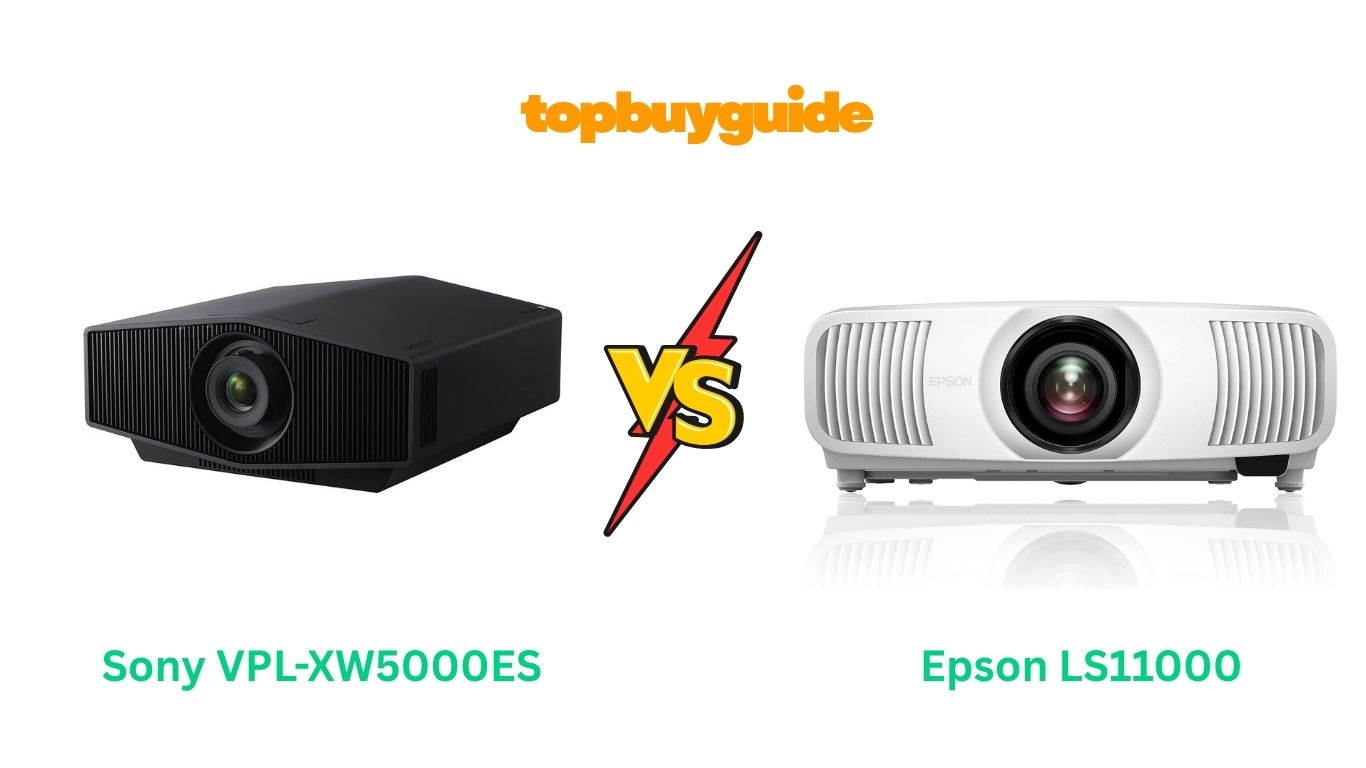
When investing in a high-end laser projector, you’re looking for a breathtaking cinematic experience that justifies the premium price. While both the Sony VPL-XW5000ES and Epson Home Cinema LS11000 are exceptional contenders, I recommend the Sony VPL-XW5000ES for the ultimate home theater purist. Its true native 4K resolution delivers a level of detail and clarity that pixel-shifting technology simply can’t match. But is that the deciding factor for you? Let’s dive in.
Why Do I Recommend The Sony VPL-XW5000ES?
The Sony VPL-XW5000ES stands out by delivering a true, uncompromised 4K experience. It is engineered for movie lovers who prioritize pristine image fidelity above all else. While the Epson LS11000 is a fantastic, feature-rich machine, the Sony excels in its core mission: displaying a picture with spectacular detail and realism. Here’s why it gets my top recommendation.
- True Native 4K Resolution: The Sony VPL-XW5000ES features a native 4K (3840 x 2160) SXRD panel, meaning it displays all 8.3 million pixels without any digital manipulation. This results in an incredibly sharp, detailed, and film-like image that is visibly superior in clarity. In contrast, the Epson LS11000 uses 4K PRO-UHD technology, which is a sophisticated pixel-shifting method that flashes its 1080p chips four times to create a 4K image. While excellent, it doesn’t achieve the same pixel-for-pixel precision as Sony’s native panel.
- Flagship-Level Image Processing: Sony has equipped the VPL-XW5000ES with its acclaimed X1 Ultimate for Projector processor. This advanced processor, adapted from its high-end BRAVIA TVs, excels at object-based HDR remastering, dynamic contrast enhancement, and superior motion handling. This results in an image with more depth, texture, and realism. Conversely, while the Epson Picture Processor is powerful, Sony’s X1 Ultimate is widely regarded as one of the best in the industry for cinematic image reproduction.
- Wider Color Gamut: The Sony projector boasts an impressive 95% DCI-P3 color gamut coverage, thanks to its TRILUMINOS PRO algorithm and Wide Dynamic Range Optics. This allows it to reproduce a broader spectrum of colors, resulting in more vibrant and lifelike images that are closer to the director’s original intent. The Epson LS11000, while offering excellent color, does not specify DCI-P3 coverage and focuses on 100% of the RGB signal, but the Sony’s wider gamut is a key advantage for movie enthusiasts.
- Superior Contrast and Black Levels: Native 4K SXRD panels are renowned for their ability to produce deep, inky blacks. The Sony VPL-XW5000ES provides outstanding contrast, giving the image a rich, three-dimensional quality, especially in dark scenes. While the Epson LS11000 has an impressive dynamic contrast ratio of 1,200,000:1, many videophiles find that the native contrast and black floor of the Sony are more natural and compelling for a true cinema feel.
- Compact and Lighter Design: For a projector of its class, the Sony VPL-XW5000ES is surprisingly compact. It is about 20% smaller in volume and 30% lighter than its direct predecessor (VPL-VW915ES). This makes it easier to handle and provides more flexibility for ceiling mounting compared to the larger and heavier Epson LS11000.
- Proven Laser Light Engine: Both projectors use a laser light source, but Sony has been a pioneer in this area for home cinema. The Z-Phosphor laser in the VPL-XW5000ES is rated for 20,000 hours of maintenance-free operation, ensuring consistent brightness and color performance over the projector’s lifespan without the need for lamp replacements.
- Silent Operation: Customer reviews consistently praise the Sony VPL-XW5000ES for its quiet fan noise. In a dedicated home theater, low operational noise is crucial for an immersive experience, and the Sony excels here. The Epson is also quiet, but the Sony is often cited as being whisper-quiet, ensuring you only hear the movie’s soundtrack.
Side By Side Comparison Chart: Sony VPL-XW5000ES vs Epson Home Cinema LS11000
| Feature | Sony VPL-XW5000ES | Epson Home Cinema LS11000 |
| Resolution Technology | Native 4K (3840 x 2160) SXRD | 4K PRO-UHD (Pixel Shifting) |
| Brightness | 2,000 Lumens | 2,500 Lumens |
| Image Processor | X1 Ultimate for Projector | Epson Picture Processor |
| Contrast Ratio | Not specified (High native contrast) | Dynamic: 1,200,000:1 |
| Color Gamut | 95% DCI-P3 | Full 100% RGB Color Signal |
| HDR Support | HDR10, HLG | HDR10, HLG, HDR10+ |
| Lens Control | Manual Zoom, Shift, Focus | Motorized Zoom, Shift, Focus |
| Gaming Refresh Rate | 4K/60Hz, 1080p/120Hz | 4K/120Hz, 1080p/120Hz |
| Input Lag | ~21ms (4K/60Hz), ~13ms (1080p/120Hz) | <20ms |
| 3D Support | No | No |
| Connectivity | 2x HDMI (2.1 compatible, 4K/60) | 2x HDMI 2.1 (4K/120Hz support) |
| Dimensions (W x H x D) | 18.1″ x 8.3″ x 18.6″ | 20.5″ x 7.6″ x 17.6″ |
| Weight | 28.7 lbs | 28 lbs |
What Common Features Can Sony VPL-XW5000ES vs Epson Home Cinema LS11000 Do?
Despite their core technology differences, these two projectors share a host of premium features that place them at the top of the market. Both are designed for serious home cinema enthusiasts and deliver an experience that far surpasses entry-level or mid-range projectors.
A cornerstone of both models is the long-lasting laser light source. Both the Sony VPL-XW5000ES and the Epson LS11000 are rated for up to 20,000 hours of use. This effectively eliminates the cost and hassle of lamp replacements that are common with older projector technologies. It also ensures consistent brightness and color performance over many years, with near-instant on/off capabilities. You can enjoy thousands of movies without worrying about the lamp dimming over time.
Both projectors offer full 4K on-screen resolution, although they achieve it through different means. Whether it’s Sony’s native 4K or Epson’s PRO-UHD pixel shifting, the result is a massive, detailed image with over 8 million pixels. This allows you to see incredible texture and fine detail in your favorite films. Both also support High Dynamic Range (HDR), which dramatically expands the range of contrast and color. This means you get brighter highlights, deeper shadows, and more vibrant, true-to-life colors for a more impactful and immersive viewing experience.
For gamers, both projectors are excellent choices, offering low input lag and high refresh rates. The Sony VPL-XW5000ES can handle 1080p content at 120Hz with a lag under 13ms, while the Epson LS11000 supports a full 4K signal at 120Hz with a lag under 20ms. This makes them both highly responsive for fast-paced gaming on next-generation consoles like the PlayStation 5 and Xbox Series X, delivering a smooth, big-screen gaming experience that few TVs can rival.
Common Features of Sony VPL-XW5000ES vs Epson Home Cinema LS11000
| Feature | Sony VPL-XW5000ES | Epson Home Cinema LS11000 |
| Light Source | Laser Diode | Laser Array |
| Light Source Life | Up to 20,000 Hours | Up to 20,000 Hours |
| On-Screen Resolution | 3840 x 2160 (8.3 million pixels) | 3840 x 2160 (8.3 million pixels) |
| HDR Support | HDR10, HLG | HDR10, HLG, HDR10+ |
| High Refresh Rate | 1080p @ 120Hz | 4K & 1080p @ 120Hz |
| Low Input Lag | Yes (<21ms) | Yes (<20ms) |
| 3-Chip Display | Yes (SXRD) | Yes (3LCD) |
| Lens Shift | Yes (Vertical & Horizontal) | Yes (Vertical & Horizontal) |
| 3D Support | No | No |
A Detailed Comparison Of the Sony VPL-XW5000ES vs Epson Home Cinema LS11000
Let’s break down the key differences to help you understand which projector is the right fit for your specific needs and priorities.
Resolution and Image Processing
The Sony VPL-XW5000ES uses a true native 4K SXRD panel, which means it has 8.3 million individual pixels that are displayed directly on the screen. This technology is the gold standard for home cinema, producing an image with unparalleled sharpness, clarity, and a smooth, film-like texture without any visible pixel structure. Coupled with the X1 Ultimate processor, the Sony excels at upscaling lower-resolution content and optimizing HDR for breathtaking realism. The detail is so fine you can see pores on an actor’s face, as one user noted.
The Epson Home Cinema LS11000, on the other hand, utilizes 4K PRO-UHD, a very advanced form of pixel-shifting. It starts with three 1080p LCD chips and uses a precision glass plate that shifts pixels four times per frame to create a 4K image. While this is one of the best pixel-shifting implementations on the market and produces an incredibly sharp picture, a side-by-side comparison with a native 4K image reveals the Sony has a slight edge in ultimate detail and purity.
Brightness
Here, the Epson Home Cinema LS11000 has a clear advantage on paper, offering 2,500 lumens of both color and white brightness compared to the Sony VPL-XW5000ES’s 2,000 lumens. This extra brightness makes the Epson more versatile, as it can better handle rooms with some ambient light. If your home theater is a multi-purpose living room rather than a dedicated, light-controlled “bat cave,” the Epson’s brightness will help the image pop and look less washed out during the day or with lamps on.
While the Sony VPL-XW5000ES is rated at a lower 2,000 lumens, it is still very bright for a dedicated theater projector. Its new Wide Dynamic Range Optics are designed to maximize the laser light source’s potential, delivering a punchy and vibrant image on large screens. For users with proper light control, 2,000 lumens is more than sufficient to produce a spectacular HDR image, and some reviewers even find it appears brighter in practice than its specs suggest due to its excellent contrast and color processing.
HDR and Color
The Sony VPL-XW5000ES covers 95% of the DCI-P3 color space, which is the standard used in commercial digital cinemas. This wide color gamut, powered by its TRILUMINOS PRO technology, allows it to display a stunning range of rich, natural colors. Its X1 Ultimate processor provides Dynamic HDR Enhancer, which analyzes each scene to optimize contrast and make HDR content look its best. The result is an image with incredible depth and true-to-life colors.
The Epson Home Cinema LS11000 also delivers an impressive HDR performance and is notable for its support of HDR10+, a format the Sony lacks. HDR10+ adds dynamic metadata that can adjust brightness and tone mapping on a scene-by-scene basis, which can improve the viewing experience on compatible content. Epson’s 3-chip 3LCD engine ensures there are no “rainbow artifacts” and that color brightness matches white brightness, but its color gamut is not as wide as the Sony’s DCI-P3 coverage.
Lens and Installation Flexibility
The Epson Home Cinema LS11000 is the hands-down winner for convenience and flexibility. It features a fully motorized lens with powered zoom, focus, and generous lens shift. This makes setup incredibly easy, as you can make all adjustments from your seat using the remote. Crucially, it also offers lens memory, which allows you to save and recall different aspect ratios. This is a must-have feature for enthusiasts with a 2.35:1 CinemaScope screen who want to switch between widescreen movies and 16:9 TV content without black bars.
The Sony VPL-XW5000ES, in a move to cut costs, features a fully manual lens. This means you will need to physically access the projector to adjust the zoom, focus, and lens shift dials. While it still offers a good range of shift and zoom for flexible placement, the lack of motorization and lens memory is a significant drawback. It’s particularly inconvenient for those with a CinemaScope screen, as switching aspect ratios would require manual readjustment every time.
Gaming
For gamers, the choice is a tough one as both projectors are top performers. The Epson Home Cinema LS11000 has a slight edge by being one of the few projectors on the market to support a full 4K signal at a 120Hz refresh rate via its HDMI 2.1 ports. This is the holy grail for high-end PC and console gaming, offering incredibly smooth motion and sharp visuals. Its input lag is also exceptionally low, at under 20ms.
The Sony VPL-XW5000ES is also an outstanding gaming projector. While its HDMI ports are limited to 4K/60Hz, it can accept a 1080p signal at 120Hz with an even lower input lag of under 13ms. For competitive gamers who prioritize the fastest response times, this 1080p/120Hz mode is superb. For most console gamers, 4K/60Hz is still the most common high-performance mode, and the Sony handles it beautifully with a lag of around 21ms.
Conclusion
After a thorough comparison, the Sony VPL-XW5000ES remains my top recommendation for the cinema purist who demands the absolute best image quality. Its native 4K SXRD panel and superior X1 Ultimate processor deliver a level of sharpness, detail, and naturalism that is simply unmatched at this price point. If you have a dedicated, light-controlled theater room and your priority is a film-like, breathtakingly detailed picture, the Sony is the projector to get.
However, the Epson Home Cinema LS11000 is an incredible value and the more practical choice for many users. Its higher brightness makes it more suitable for multi-purpose rooms, and its fully motorized lens with memory is a game-changing convenience feature, especially for CinemaScope screen owners. Furthermore, its support for 4K/120Hz gaming makes it the technical winner for next-gen gamers. If you value flexibility, gaming features, and brightness over the final ounce of image purity, the Epson LS11000 is an outstanding choice that will not disappoint and saves you a significant amount of money.
Ultimately, you can’t go wrong with either. If your wallet allows and your goal is the pinnacle of cinematic fidelity, the Sony VPL-XW5000ES awaits. If you want a feature-packed powerhouse that is more flexible and better for gaming, click to get the Epson Home Cinema LS11000 and enjoy an amazing home theater experience.
FAQs
- Is native 4K on the Sony really that much better than Epson’s 4K PRO-UHD?
For most viewers, both will look incredibly sharp. However, in a side-by-side comparison, videophiles often notice that the Sony’s native 4K image is slightly more detailed and has a more natural, film-like texture. Epson’s pixel-shifting is excellent but can’t perfectly replicate the precision of 8.3 million distinct pixels. - Which projector is better for a room with some ambient light?
The Epson Home Cinema LS11000 is the better choice for rooms with ambient light. Its 2,500 lumens of brightness will produce a punchier, more watchable image in conditions that are less than perfectly dark, whereas the Sony’s 2,000 lumens perform best in a dedicated, light-controlled theater. - I have a 2.35:1 CinemaScope screen. Which projector should I get?
You should get the Epson Home Cinema LS11000. Its motorized lens with memory makes it effortless to switch between different aspect ratios (like 16:9 for TV and 2.35:1 for movies) with the press of a button. The Sony VPL-XW5000ES has a manual lens, which would require you to physically readjust the projector each time. - Are these projectors good for next-gen gaming on PS5 and Xbox Series X?
Both are excellent for gaming. The Epson LS11000 has a slight edge as it supports 4K gaming at 120Hz. The Sony VPL-XW5000ES supports 4K at 60Hz and 1080p at 120Hz. Both have very low input lag (<21ms), making them highly responsive for fast-paced games. - Do I need to worry about replacing the lamp?
No, both projectors use a long-lasting laser light source rated for up to 20,000 hours. This is equivalent to watching a two-hour movie every single day for over 27 years, so you will likely never need to perform any maintenance on the light engine. - Does the Sony’s manual lens make setup difficult?
Setup is a one-time process, but the Sony’s manual lens makes it more hands-on. You will need to physically access the projector to adjust zoom, focus, and shift. While not overly difficult, it is less convenient than the Epson’s remote-controlled motorized lens, which allows for adjustments from your seat. - Why is the Epson’s dynamic contrast ratio so high, while Sony’s isn’t specified?
Epson advertises a very high dynamic contrast ratio (1,200,000:1) achieved by modulating the laser’s brightness. Sony tends to focus on its high native contrast, which is the contrast the panel can produce without digital or laser manipulation. Videophiles often prefer high native contrast for more natural black levels. - Which projector is quieter?
Both projectors are known for being very quiet, especially compared to lamp-based models. However, multiple reviews and user reports have specifically praised the Sony VPL-XW5000ES for being almost silent in operation, which is a significant advantage for an immersive home theater experience.

Alex Turner is a dedicated product researcher and reviewer at TopBuyGuide.com, known for his clear, honest, and data-driven insights. He spends countless hours testing, comparing, and analyzing products to help readers make confident and informed buying decisions.