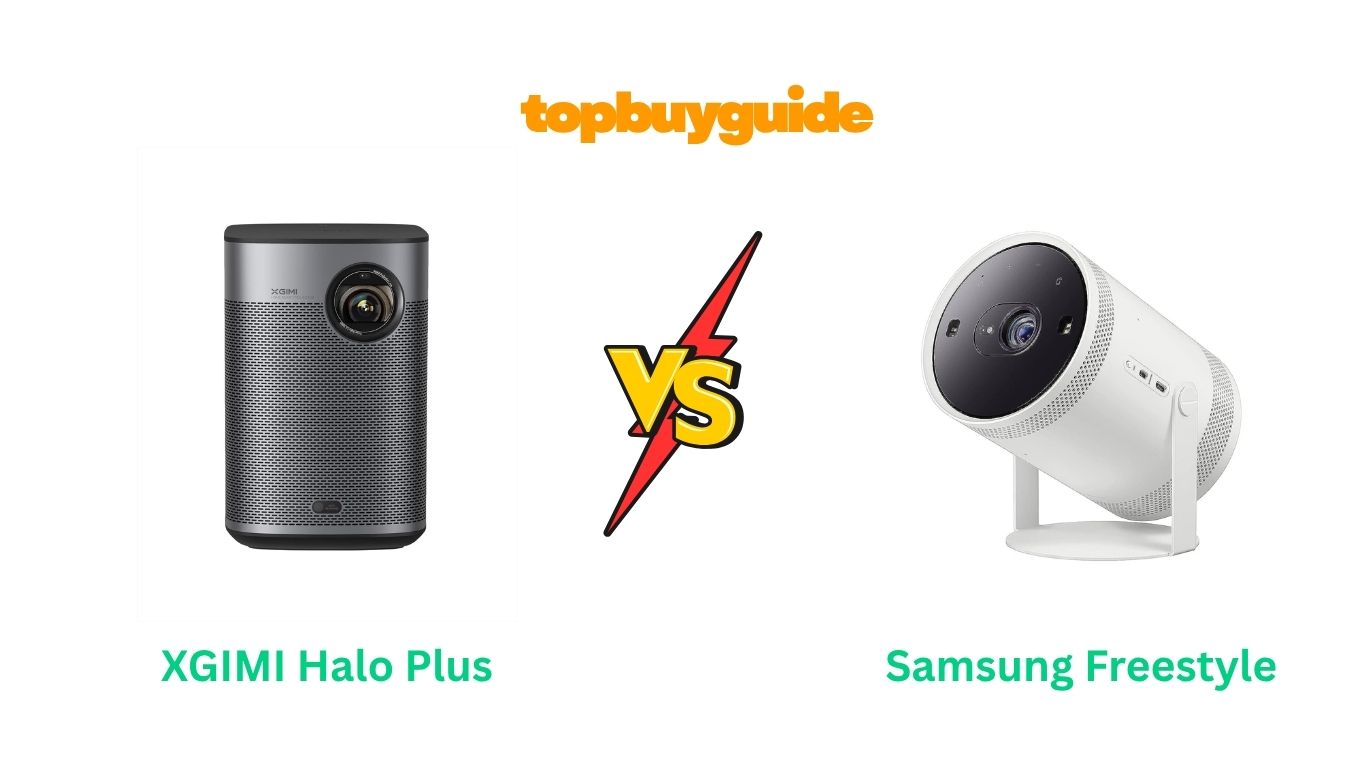
When choosing a portable projector, you want a device that’s easy to set up, delivers a great picture, and is genuinely convenient to take on the go. While both the XGIMI Halo Plus and Samsung Freestyle are top contenders, I recommend the XGIMI Halo Plus for most people. It offers superior brightness and a built-in battery, making it a truly versatile and powerful portable cinema. But is it the right fit for your needs? Let’s find out.
Why Do I Recommend The XGIMI Halo Plus?
The XGIMI Halo Plus pulls ahead of the Samsung Freestyle by focusing on the core features that matter most in a portable projector: brightness, convenience, and a truly all-in-one design. It’s built for those who want a premium viewing experience anywhere, without needing to carry extra gear.
- Significantly Brighter Picture: The Halo Plus boasts 700 ISO Lumens, which is a noticeable step up from the Samsung Freestyle’s brightness. This means the XGIMI delivers a more vibrant and watchable image, especially in rooms with some ambient light. While the Freestyle struggles in anything but a completely dark room, the Halo Plus performs admirably, making it more versatile for different viewing environments.
- True Portability with a Built-in Battery: This is the Halo Plus’s biggest advantage. It comes equipped with a 59.454Wh battery that provides up to 2.5 hours of playtime. You can take it camping, to the backyard, or to a friend’s house without worrying about finding an outlet. In contrast, the Samsung Freestyle has no internal battery; it must be plugged into a wall or a powerful, separately sold external battery pack, which adds extra cost and bulk.
- Superior Sound Quality: The Halo Plus features two 5W Harman Kardon speakers that deliver clean, room-filling sound with impressive bass for its size. Many users find the audio quality so good that an external speaker isn’t necessary. On the other hand, while the Freestyle’s 360-degree sound is decent, it can sound tinny at higher volumes and lacks the rich depth of the Harman Kardon system.
- Advanced Intelligent Screen Adaption (ISA): XGIMI’s ISA technology is a comprehensive suite of features that makes setup effortless. This includes not only auto keystone correction and autofocus (which the Freestyle also has) but also Intelligent Obstacle Avoidance and Intelligent Screen Alignment. The projector will automatically resize its screen to avoid things like light switches or photo frames and perfectly fit it into a projector screen. The Freestyle lacks this level of environmental awareness.
- Built-in Kickstand: It’s a simple feature, but the integrated kickstand on the Halo Plus is incredibly useful. It allows for easy angle adjustments without needing to prop the projector up on books or buy a separate stand. The Samsung Freestyle relies entirely on its 180-degree cradle, which offers great flexibility but can be less stable on uneven surfaces.
- Android TV 10.0 for More App Flexibility: The Halo Plus runs on Android TV 10.0, giving you access to over 5,000 apps via the Google Play Store. This offers a wider range of applications and a more familiar interface for many users. The Samsung Freestyle uses its proprietary Tizen OS, which is fast and includes major streaming apps, but the app selection is more limited compared to the Google Play ecosystem.
- Better for Gaming: With a dedicated Game Mode that lowers latency to around 26.5ms, the Halo Plus is a solid choice for casual gaming. You can plug in a Nintendo Switch or another console and enjoy a responsive big-screen experience. The Freestyle is not optimized for gaming and can exhibit more noticeable input lag.
Side By Side Comparison Chart: XGIMI Halo Plus vs Samsung Freestyle
| Feature | XGIMI Halo Plus | Samsung Freestyle |
| Brightness | 700 ISO Lumens | 230 ANSI Lumens (approx. 550 LED Lumens) |
| Resolution | 1920 x 1080 (Full HD) | 1920 x 1080 (Full HD) |
| Built-in Battery | Yes (up to 2.5 hours) | No (Requires external power) |
| Speakers | 2 x 5W Harman Kardon | 5W 360-degree Speaker |
| Operating System | Android TV 10.0 | Tizen OS |
| Auto Setup | Keystone, Focus, Obstacle Avoidance, Screen Alignment | Keystone, Focus, Leveling |
| Stand | Built-in Kickstand | 180-degree Cradle Stand |
| Weight | 3.5 lbs (1.6 kg) | 1.8 lbs (0.83 kg) |
| Latency (Game Mode) | ~26.5ms | Not Specified (higher) |
| Native Netflix App | No (Workaround needed) | Yes |
What Common Features Can XGIMI Halo Plus vs Samsung Freestyle Do?
Despite their differences, both projectors are leaders in the portable market because they share some excellent, cutting-edge features. They are designed to eliminate the usual hassles of projector setup, allowing you to start watching in seconds.
Automatic Image Correction is a key feature for both. The XGIMI Halo Plus and Samsung Freestyle are equipped with sensors that automatically correct the geometry of the picture (auto keystone) and sharpen the image (autofocus) as soon as you point them at a surface. This means you don’t have to manually fiddle with settings to get a perfect, rectangular image. The Freestyle also includes an auto-leveling feature to ensure the picture is always parallel to the ground. This “point and play” capability is what makes them so appealing for on-the-go use or for people who frequently move their projector around.
Both projectors deliver a Full HD (1920 x 1080) resolution, ensuring a sharp and detailed picture that’s great for movies, TV shows, and presentations. They are also smart devices with built-in operating systems—Android TV for the Halo+ and Tizen for the Freestyle. This gives you direct access to a world of entertainment without needing to plug in an external device. You can stream from popular services like Prime Video, Disney+, and YouTube, and use voice assistants (Google Assistant for XGIMI, Alexa for Samsung) to search for content or control playback.
Common Features of XGIMI Halo Plus vs Samsung Freestyle
| Feature | XGIMI Halo Plus | Samsung Freestyle |
| Resolution | 1920 x 1080 (Full HD) | 1920 x 1080 (Full HD) |
| HDR Support | Yes (HDR10, HLG) | Yes (HDR) |
| Auto Keystone | Yes (Vertical & Horizontal) | Yes (All-directional) |
| Autofocus | Yes | Yes |
| Smart OS | Yes (Android TV 10.0) | Yes (Tizen OS) |
| Voice Control | Yes (Google Assistant) | Yes (Alexa Built-in) |
| Connectivity | Wi-Fi, Bluetooth 5.0, HDMI, USB | Wi-Fi, Bluetooth 5.2, Micro-HDMI, USB-C |
A Detailed Comparison Of the XGIMI Halo Plus vs Samsung Freestyle
Let’s dig deeper into the head-to-head features to see where each projector truly shines and where it falls short.
Design and Portability
The Samsung Freestyle is the clear winner in terms of a compact and stylish design. It’s incredibly lightweight at just 1.8 lbs and has a unique, sleek cylindrical shape that looks more like a spotlight than a projector. Its 180-degree cradle stand is a brilliant piece of engineering, allowing you to easily aim the projection anywhere, including the ceiling, without needing a separate tripod. It is undeniably the more portable and aesthetically pleasing device to look at.
However, the XGIMI Halo Plus, while larger and heavier at 3.5 lbs, offers true portability. Its built-in battery means you can use it anywhere without being tethered to a power source. This functional advantage outweighs the Freestyle’s smaller size for anyone planning to use their projector outdoors or in rooms without convenient outlets. The Halo Plus also feels incredibly robust and durable, and its integrated kickstand adds a layer of practical stability that the Freestyle sometimes lacks on softer surfaces.
Picture Quality and Brightness
The XGIMI Halo Plus delivers a significantly superior viewing experience thanks to its 700 ISO Lumens. In a dimly lit or even a moderately lit room, the image is vibrant, colorful, and engaging. It can project a clear image up to 200 inches, though it looks best around 100-120 inches. This higher brightness makes it a much more practical device for everyday use, as you don’t need perfect, pitch-black conditions to enjoy it.
The Samsung Freestyle struggles in this department. Its brightness, rated around 230 ANSI lumens, is only suitable for very dark rooms. Any ambient light will cause the image to look washed out and faint. While the picture is sharp and colors are accurate in ideal conditions, its usability is severely limited. For anyone wanting to watch a movie during the day or with a lamp on, the Freestyle will likely be a disappointment.
Audio Performance
Here again, the XGIMI Halo Plus comes out on top with its dual 5-watt speakers tuned by Harman Kardon. The sound is surprisingly powerful and well-balanced for such a small device, offering clear dialogue and a respectable amount of bass. The audio is immersive enough that most users won’t feel the need to connect an external Bluetooth speaker, which adds to its all-in-one convenience.
The Samsung Freestyle features a single 5-watt speaker designed to radiate sound in 360 degrees. This is a clever idea that helps fill a small room with sound, but the quality itself is just average. It lacks the bass and richness of the Halo Plus’s system, and at higher volumes, the audio can become distorted. It’s functional, but it doesn’t deliver the same “wow” factor as the XGIMI’s audio.
Smart Features and Software
Both projectors are smart, but they take different approaches. The Samsung Freestyle runs on Tizen, the same OS found on Samsung’s smart TVs. It’s a fast, polished interface with built-in support for major apps, including Netflix, which is a big plus. It also has Alexa built-in for voice commands and integrates well with other Samsung devices through SmartThings.
The XGIMI Halo Plus uses Android TV 10.0, which provides access to the vast Google Play Store. This offers a greater variety of apps and games. Its Intelligent Screen Adaption (ISA) technology is more advanced, with obstacle avoidance and screen alignment that the Freestyle lacks. The main drawback is the lack of a native Netflix app, which requires a workaround. However, for users who value a broader app ecosystem and more advanced automatic setup, the Halo Plus has the edge.
Conclusion
After this detailed comparison, the XGIMI Halo Plus stands out as the better overall portable projector. Its superior brightness, powerful Harman Kardon sound, and true portability thanks to a built-in battery make it a more versatile and capable device. It provides a genuine big-screen experience you can enjoy in various settings without needing extra equipment. If you want the best possible performance and convenience in a portable package, the Halo Plus is well worth the investment.
The Samsung Freestyle is an excellent choice for those who prioritize design, extreme portability (in size and weight), and ease of use, especially for projecting onto ceilings. If you primarily plan to use it in a very dark room and near a power source, its sleek form factor and simple Tizen OS make it a compelling option. However, its low brightness and lack of a battery are significant limitations. For a truly go-anywhere cinema experience, the XGIMI Halo Plus is the clear winner.
FAQs
- Which projector is better for outdoor movie nights?
The XGIMI Halo Plus is much better for outdoor use. Its built-in 2.5-hour battery means you don’t need to run an extension cord, and its higher brightness (700 ISO Lumens) will provide a more visible picture after sunset compared to the Samsung Freestyle. - Can I watch Netflix on the XGIMI Halo Plus?
The XGIMI Halo Plus does not have an officially licensed Netflix app. However, you can use a workaround by installing a specific version of the app or, more easily, by plugging in a streaming stick like an Amazon Fire TV Stick or Roku into the HDMI port. - Is the Samsung Freestyle bright enough for a living room?
The Samsung Freestyle is not very bright and performs best in a completely dark room. In a typical living room with ambient light from windows or lamps, the picture will appear very washed out and difficult to see. It is not recommended for daytime viewing. - Which projector has better sound?
The XGIMI Halo Plus has better sound. Its dual 5W Harman Kardon speakers produce clearer, richer, and more powerful audio with better bass than the Freestyle’s single 5W 360-degree speaker. - Do I need to buy a separate stand for these projectors?
No, neither projector requires a separate stand for basic use. The XGIMI Halo Plus has a small built-in kickstand for angling it upwards, while the Samsung Freestyle has an innovative 180-degree cradle stand that allows for a wide range of projection angles. - Which one is easier to set up?
Both are very easy to set up thanks to automatic picture adjustments. However, the XGIMI Halo Plus has more advanced features like Obstacle Avoidance and Screen Alignment, which can make setup even more seamless in cluttered environments. - Can I use these projectors for gaming?
The XGIMI Halo Plus is the better option for gaming. It has a dedicated “Game Mode” that reduces input lag to around 26.5ms, making it suitable for casual console gaming. The Samsung Freestyle does not have a low-latency mode and is not ideal for gaming. - Is the Samsung Freestyle completely wireless?
No, the Samsung Freestyle is not wireless. It does not have a built-in battery and must be connected to a power outlet via its USB-C cable or to a compatible external battery pack (sold separately) to function.

Alex Turner is a dedicated product researcher and reviewer at TopBuyGuide.com, known for his clear, honest, and data-driven insights. He spends countless hours testing, comparing, and analyzing products to help readers make confident and informed buying decisions.