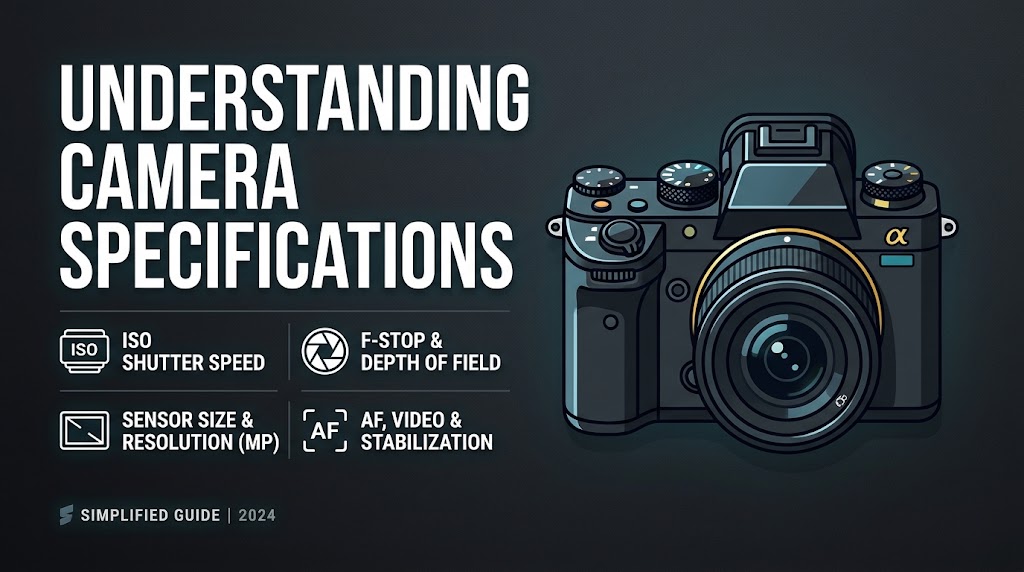
Stepping into the world of digital photography and videography can feel like learning a foreign language. If you have ever stared at a spec sheet filled with terms like “APS-C backside-illuminated CMOS,” “10-bit 4:2:2 internal recording,” and “hybrid phase-detection autofocus with deep learning,” you are not alone. Camera manufacturers love throwing technical jargon around, making it difficult to distinguish between genuine technological leaps and clever marketing hype.
Whether you are upgrading from a smartphone to your first interchangeable-lens camera or transitioning from an older DSLR to a modern mirrorless powerhouse, knowing how to read and interpret camera specifications is the ultimate superpower. It saves you from overspending on features you do not need while ensuring you don’t compromise on the tools critical to your creative workflow.
In this comprehensive guide, we will break down every major camera specification, explain what the numbers actually mean in the real world, highlight common pitfalls to avoid, and give you a clear framework for evaluating your next camera purchase.
1. The Foundation: Camera Sensor Size and Resolution (Megapixels)
At the heart of every digital camera lies its sensor. If the camera body is the body of a car, the sensor is the engine. Yet, many buyers fixate solely on the number of megapixels while ignoring the physical dimensions of the sensor itself.
Sensor Formats Explained
Camera sensors come in various physical sizes, which directly dictate light-gathering capability, field of view, and depth of field control:
-
Full-Frame ($36 \times 24\text{ mm}$): The gold standard for professional landscape, portrait, and low-light photography. It matches the size of traditional 35mm film, offering exceptional dynamic range, shallow depth of field, and superior high-ISO performance.
-
APS-C ($23.5 \times 15.6\text{ mm}$ typically): Found in many enthusiast and entry-level mirrorless/DSLR cameras. It features a crop factor (usually $1.5\times$ or $1.6\times$), which means lenses have a narrower field of view. Modern APS-C sensors punch well above their weight, offering a fantastic balance of portability, price, and image quality.
-
Micro Four Thirds ($17.3 \times 13\text{ mm}$): Features a $2\times$ crop factor. While smaller sensors capture less light than full-frame equivalents, they allow for exceptionally compact camera bodies and smaller, lighter telephoto lenses—making them a favorite for travel and wildlife shooters.
Pro Tip: Do not judge image quality by sensor size alone. Modern backside-illuminated (BSI) APS-C sensors outperform older full-frame sensors in almost every metric. Always look at the sensor architecture alongside its physical dimensions.
The Megapixel Myth: Why More Isn’t Always Better
A megapixel represents one million pixels on a sensor. While a 45-megapixel sensor sounds vastly superior to a 24-megapixel sensor, higher resolution comes with hidden trade-offs:
-
File Sizes: Larger files eat up storage space rapidly and bog down your computer during editing.
-
Low-Light Performance: Cramming more pixels onto the same physical surface area makes individual pixels smaller, reducing their ability to capture light and increasing digital noise in dim environments.
-
Lens Demands: Ultra-high-resolution sensors demand ultra-sharp, expensive lenses to resolve fine detail; otherwise, you are just recording softer images at a larger file size.
2. Mastering Autofocus Systems and Processing Power
Years ago, capturing a fast-moving subject meant mastering manual tracking or relying on sluggish focus systems. Today, modern mirrorless cameras feature sophisticated autofocus (AF) algorithms driven by dedicated AI processing units.
Phase Detection vs. Contrast Detection
-
Contrast Detection AF: Evaluates contrast levels directly on the sensor, shifting the lens back and forth until maximum contrast is achieved. It is accurate but notoriously slow and prone to hunting in low light.
-
Phase Detection AF (PDAF): Splits incoming light into pairs of images and compares them to calculate distance and direction instantly. Modern sensors embed thousands of phase-detection points across the entire frame, delivering instantaneous lock-on speeds.
Subject Tracking and Eye-AF
When evaluating a modern camera spec sheet, pay close attention to AI-assisted subject recognition. Look for tracking capabilities tailored to your niche:
-
Human/Animal/Bird Eye-AF: Crucial for portrait, wedding, and wildlife photography. The camera locks onto the subject’s eye and tracks it relentlessly, even when they turn away or move behind obstacles.
-
Vehicle Tracking: Essential for motorsports, aviation, and action videography.
Example: Imagine shooting a fast-moving basketball game. A camera with advanced deep-learning phase detection will maintain crisp focus on the player’s face as they sprint down the court, even through a forest of opposing players, letting you focus entirely on composition and timing.
3. Exposure, ISO, and Shutter Mechanics
Controlling light is the bedrock of photography. Understanding how a camera’s hardware handles exposure parameters will dictate what environments you can comfortably shoot in.
Dynamic Range and Base ISO
Dynamic range measures the ratio between the brightest highlights and deepest shadows a sensor can capture in a single frame without clipping. Measured in stops, high dynamic range allows you to recover shadow details in post-processing when shooting high-contrast scenes like sunsets.
ISO represents the sensor’s amplification of light.
-
Base ISO (typically ISO 100) delivers the cleanest image quality, maximum dynamic range, and lowest noise.
-
Native High ISO Limits: Modern sensors use dual-gain architecture to switch circuits at higher ISOs (e.g., ISO 6400), suppressing noise and keeping low-light footage remarkably clean.
Mechanical vs. Electronic Shutters
-
Mechanical Shutter: Uses physical curtains moving across the sensor. It provides authentic physical feedback and avoids artifacts, but is limited by moving parts (often capping out at 10–15 frames per second).
-
Electronic Shutter: Reads data electronically line-by-line. It allows for silent shooting and blazing-fast burst rates (up to 30–40+ fps). However, cheaper electronic shutters suffer from the rolling shutter effect, where vertical lines appear warped during rapid camera panning or fast-moving action. Look for stacked CMOS sensors if you need high-speed electronic shooting without distortion.
4. Video Capabilities: Resolution, Frame Rates, and Codecs
If you plan on shooting video alongside photography, camera specifications become infinitely more complex. A great stills camera can sometimes be a mediocre video tool due to thermal limits or aggressive cropping.
Resolution: 4K, 6K, and Beyond
-
4K UHD ($3840 \times 2160$): The current industry standard for high-definition content delivery across YouTube, streaming platforms, and client work. Look for cameras that shoot oversampled 4K (rendering 4K from a 6K or 8K sensor readout) for immaculate sharpness.
-
6K/8K: Ideal for filmmakers who need extreme cropping flexibility, advanced stabilization in post-production, or archival-grade fidelity.
Bit Rates, Color Depth, and Compression
-
Color Depth (8-bit vs. 10-bit): 8-bit video captures 16.7 million colors, while 10-bit captures over 1 billion colors. If you plan to color grade your footage or shoot high-contrast scenes, 10-bit internal recording is a non-negotiable specification.
-
Codecs and Compression: Formats like H.264, H.265 (HEVC), and Apple ProRes dictate how data is packaged. ProRes and All-Intra codecs preserve maximum detail and are easier for computers to edit, whereas heavily compressed Long-GOP codecs save storage space at the cost of processing strain.
5. Common Pitfalls and Mistakes When Reading Camera Specs
Even experienced creators fall into traps when analyzing spec sheets. Here are the most frequent errors to avoid:
-
Falling for the Megapixel Trap: Assuming a high-megapixel count guarantees superior image quality while ignoring sensor size, glass quality, and processor speed.
-
Overlooking the Lens Ecosystem: Buying a camera body purely based on specs without checking the availability, weight, and cost of native lenses. Remember: You marry the lens mount, not just the body.
-
Ignoring Thermal Limits: Many hybrid mirrorless cameras boast impressive 8K or 4K/60p video specs on paper, but will overheat within 20 minutes during real-world recording. Always research real-world sustained performance, not just lab specifications.
-
Disregarding In-Body Image Stabilization (IBIS): Assuming optical stabilization in lenses is enough. A robust IBIS system combined with lens stabilization allows for buttery-smooth handheld video and handheld slow-shutter photography.
6. Frequently Asked Questions (FAQs)
Do I need a full-frame camera to shoot professional photos?
No. While full-frame cameras offer advantages in low-light performance and shallow depth of field, many professional wildlife, macro, sports, and commercial photographers deliberately use APS-C or Micro Four Thirds systems for their reach, portability, and depth-of-field control. Skill, lighting, and glass matter far more than sensor format.
What is dynamic range and why does it matter?
Dynamic range is a camera’s ability to retain detail in both bright highlights (like a bright sky) and deep shadows (like a shaded forest floor) simultaneously. High dynamic range gives you immense flexibility when editing RAW files, preventing blown-out highlights or crushed, noisy shadows.
How many megapixels are enough for large prints and professional work?
For billboard-sized prints viewed from a distance, or professional fine-art photography requiring aggressive cropping, 45 to 60+ megapixels are beneficial. However, for standard client work, large wall art up to $24 \times 36$ inches, and digital displays, 24 megapixels is more than sufficient and yields smaller, more manageable file sizes.
Is In-Body Image Stabilization (IBIS) essential?
If you shoot handheld video or frequently work in low-light environments with slow shutter speeds, IBIS is an absolute game-changer. It stabilizes the sensor physically to compensate for micro-shakes, saving you from carrying a tripod everywhere.
Conclusion & Call to Action
Decoding camera specifications does not have to be an intimidating guessing game. By looking past marketing buzzwords and focusing on the core components that matter to your specific creative goals—whether that is robust autofocus for fast sports, 10-bit color for cinematic video, or a lightweight compact sensor for travel—you can make an informed, confident investment.

Alex Turner is a dedicated product researcher and reviewer at TopBuyGuide.com, known for his clear, honest, and data-driven insights. He spends countless hours testing, comparing, and analyzing products to help readers make confident and informed buying decisions.