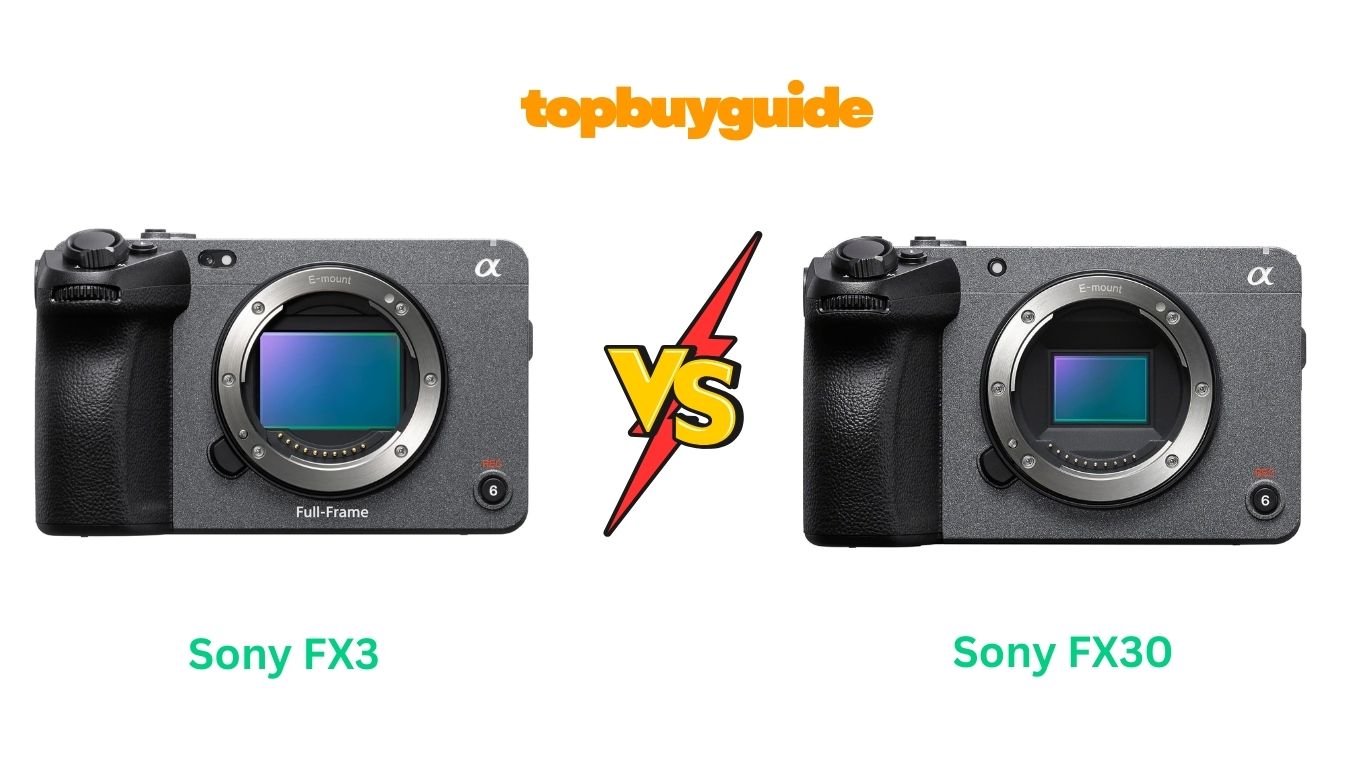
Choosing between the Sony FX3 and FX30 depends heavily on your specific filmmaking needs and budget. While both are exceptional cameras, I recommend the Sony FX30 for most aspiring and independent filmmakers. It delivers nearly all the professional cinematic features of its bigger sibling, like 10-bit 4:2:2 recording and a compact form factor, at a fraction of the price. This allows you to invest the savings into crucial gear like lenses and lighting.
Why Do I Recommend The Sony FX30?
The Sony FX30 stands out as the best value proposition in the entry-level cinema camera market. It cleverly packages professional-grade features into a more accessible and affordable body. Here’s a breakdown of why it’s my top recommendation when compared to the formidable Sony FX3.
- Exceptional Value for Money: The most compelling reason to choose the Sony FX30 is its price. It costs significantly less than the FX3, yet it inherits the majority of its professional features. This cost-saving allows filmmakers, especially those on a tighter budget, to allocate more funds toward high-quality lenses, lighting, and audio equipment, which are just as critical for achieving a cinematic look.
- 6K Oversampled 4K Video: The FX30 uses its 26.1MP APS-C sensor to capture 6K footage and then downsamples it to produce an incredibly sharp and detailed 4K image. This process results in a cleaner, richer video with fewer artifacts. While the Sony FX3 produces beautiful native 4K from its full-frame sensor, the oversampled image from the FX30 is a standout feature at its price point.
- Dual Base ISO for Great Low-Light Flexibility: The FX30 features Dual Base ISO (800 and 2500), which provides two native sensitivity levels for capturing clean, low-noise footage in different lighting conditions. Although the Sony FX3 is the undisputed king in extreme low-light situations with its much higher ISO range, the FX30’s performance is more than sufficient for most scenarios and a massive step up from typical mirrorless cameras.
- Wider Lens Selection and Affordability: The APS-C sensor format of the FX30 opens up a vast ecosystem of affordable and high-quality E-mount lenses designed for this sensor size. These lenses are often smaller, lighter, and more budget-friendly than their full-frame equivalents. In contrast, leveraging the full potential of the Sony FX3’s full-frame sensor requires investing in more expensive full-frame glass.
- Identical Professional Body and Ergonomics: The FX30 shares the exact same body design as the FX3. This means you get the same compact, cage-free design with multiple ¼”-20 mounting points, a comfortable grip, and the option to use the same XLR top handle for professional audio. You sacrifice nothing in terms of handling and usability, which is remarkable for a camera at this price.
- Powerful Autofocus System: The FX30 is equipped with Sony’s renowned autofocus technology, offering 495 phase-detection points. It delivers fast, reliable, and sticky subject tracking, including Real-time Eye AF for humans and animals. The Sony FX3 has a slightly more advanced AF system with 627 points, but in real-world use, the FX30’s performance is nearly indistinguishable and highly dependable for solo shooters and dynamic scenes.
- Effective In-Body Image Stabilization (IBIS): Both cameras feature 5-axis in-body image stabilization with an “Active Mode” for smoother handheld shots. The FX30’s stabilization is highly effective, reducing the need for a gimbal in many run-and-gun situations. This is a crucial feature for indie filmmakers and content creators who need to stay mobile.
- Professional Cinema-Line Features: The FX30 isn’t just a hybrid camera with good video specs; it’s a true cinema camera. It includes essential filmmaking tools like Cine EI mode for maximum dynamic range, the ability to load custom LUTs, and shutter angle control. These features, once reserved for high-end cameras, are fully implemented in the FX30, offering a professional workflow that is identical to the more expensive Sony FX3.
Side By Side Comparison Chart: Sony FX3 vs FX30
| Feature | Sony FX3 | Sony FX30 |
| Sensor Size | Full-Frame (35mm) | APS-C (Super 35) |
| Resolution | 12.1MP | 26.1MP |
| Video Resolution | 4K UHD up to 120p | 4K UHD up to 120p (with 1.6x crop) |
| Low-Light ISO | Dual Base: 800 / 12,800 | Dual Base: 800 / 2500 |
| Max ISO | 409,600 (Expanded) | 32,000 (Expanded) |
| Dynamic Range | 15+ Stops | 14+ Stops |
| Autofocus Points | 627 Phase-Detection Points | 495 Phase-Detection Points |
| Image Stabilization | 5-Axis Sensor-Shift (Active Mode) | 5-Axis Sensor-Shift (Active Mode) |
| Form Factor | Compact, cage-free design | Identical compact, cage-free design |
| Audio | Optional XLR Handle Unit | Optional XLR Handle Unit |
| Price | Approx. $3,900 USD | Approx. $2,200 USD |
What Can Sony FX3 and FX30 Do?
Both the Sony FX3 and FX30 are part of Sony’s esteemed Cinema Line, designed to bridge the gap between compact mirrorless cameras and high-end cinema rigs. They share a core philosophy: deliver professional cinematic capabilities in a small, user-friendly package.
High-Quality 10-bit 4:2:2 Recording
A standout feature for both cameras is their ability to record internally in 10-bit 4:2:2 color depth. This allows for far greater flexibility in post-production compared to the standard 8-bit video found in many hybrid cameras. With 10-bit color, you can push and pull your colors, adjust exposure, and apply heavy color grades without the footage falling apart or showing signs of banding. This is essential for achieving a polished, professional look and delivering content for high-quality distribution platforms.
S-Cinetone Color Science
Both cameras come equipped with Sony’s S-Cinetone picture profile, inherited from their high-end VENICE cinema camera. S-Cinetone is designed to produce a beautiful, cinematic look straight out of the camera. It offers natural mid-tones, soft colors, and a pleasing roll-off to highlights, which is especially flattering for skin tones. For filmmakers who need a quick turnaround and don’t want to spend hours color grading, S-Cinetone delivers a ready-to-use, professional-looking image with minimal effort.
Log Shooting Modes for Maximum Dynamic Range
For those who prefer to have complete control over their final image, both the FX3 and FX30 offer robust Log shooting modes, including S-Log3. Shooting in S-Log3 captures the maximum amount of dynamic range the sensor can offer—over 15 stops for the FX3 and over 14 for the FX30. This flat, low-contrast image retains immense detail in both the highlights and shadows, giving colorists the ultimate flexibility to craft a specific look in post-production. The inclusion of Cine EI (Exposure Index) mode further simplifies the process of shooting in Log, ensuring consistent and optimized results.
Compact and Ergonomic Cinema Body
The physical design of the FX3 and FX30 is identical and purpose-built for video creators. The body is compact and lightweight, making it ideal for gimbal work, drone mounting, or handheld shooting. Unlike many hybrid cameras, the body features multiple ¼”-20 threaded mounting points, allowing you to attach accessories like monitors and microphones directly without a cage. The button layout is intuitive, with customizable buttons and tally lamps that clearly indicate when the camera is recording.
Active Cooling for Uninterrupted Recording
One of the most critical shared features is the built-in cooling fan. Overheating has long been a problem for compact cameras shooting high-resolution video for extended periods. The active cooling system in both the FX3 and FX30 ensures they can record 4K/60p continuously without shutting down. This reliability is a game-changer for professionals shooting long interviews, events, or documentary scenes where a camera failure is not an option.
Common Features of Sony FX3 vs FX30
| Feature | Sony FX3 | Sony FX30 |
| Video Codecs | XAVC S, XAVC S-I, XAVC HS | XAVC S, XAVC S-I, XAVC HS |
| Color Profiles | S-Cinetone, S-Log3, HLG | S-Cinetone, S-Log3, HLG |
| LUT Support | Yes, monitor and embed | Yes, monitor and embed |
| In-Body Image Stabilization | 5-Axis with Active Mode | 5-Axis with Active Mode |
| Cooling System | Built-in active cooling fan | Built-in active cooling fan |
| Audio Inputs | 3.5mm Mic, XLR via Top Handle | 3.5mm Mic, XLR via Top Handle |
| Memory Card Slots | Dual CFexpress Type A / SDXC | Dual CFexpress Type A / SDXC |
| Screen | 3.0″ Vari-Angle Touchscreen | 3.0″ Vari-Angle Touchscreen |
| Body Design | Compact with multiple mounting points | Identical to FX3 |
A Detailed Comparison Of the Sony FX3 vs Sony FX30
Sensor Size and Image Quality
The most significant difference between these two cameras is the sensor. The Sony FX3 boasts a full-frame 12.1MP sensor, which excels in gathering light and producing a shallow depth of field. This larger sensor size is the primary reason for its incredible low-light performance and the creamy, out-of-focus backgrounds (bokeh) that are characteristic of full-frame cinematography. Its image is clean, with a distinct professional polish, especially in challenging lighting.
In contrast, the Sony FX30 features a smaller APS-C (Super 35) 26.1MP sensor. While it can’t match the FX3 in extreme low-light conditions, it uses its higher resolution to its advantage by oversampling 6K footage to create exceptionally sharp 4K video. This results in a very detailed image that holds up well on large screens. For most daylight and well-lit scenes, the image quality is stunning and comes very close to its full-frame counterpart.
Low-Light Performance
This is where the Sony FX3 truly justifies its higher price. With a Dual Base ISO of 800 and 12,800, and a maximum expandable ISO of 409,600, it is a low-light monster. It can practically see in the dark, producing usable, clean footage in conditions where most other cameras would fail. This makes it the ideal choice for documentary filmmakers, event shooters, or anyone who frequently works in uncontrolled and dimly lit environments.
The Sony FX30, with its Dual Base ISO of 800 and 2500, is still a very capable low-light performer, far surpassing older APS-C cameras. It delivers clean images at its native ISOs and remains usable at higher sensitivities. However, it cannot compete with the FX3 at the extreme end of the ISO range. For filmmakers who typically control their lighting or shoot in brighter conditions, the FX30’s performance is more than adequate.
Autofocus System
Both cameras feature Sony’s industry-leading autofocus technology, but there are subtle differences. The Sony FX3 is equipped with a more dense AF system, featuring 627 phase-detection points covering 94% of the sensor. This provides incredibly robust and reliable tracking, locking onto subjects with tenacity and precision. It’s a system you can trust implicitly, even in the most demanding shooting scenarios.
The Sony FX30 has a slightly less dense system with 495 phase-detection points. While it has fewer points, in practice, its performance is nearly identical to the FX3 for most applications. It supports Real-time Eye AF for humans, animals, and birds, and its tracking is sticky and dependable. For the vast majority of users, including solo creators who rely on autofocus, the FX30’s system is a top-tier performer that will not disappoint.
Price and Value
Price is the ultimate deciding factor for many. The Sony FX3 is a professional tool with a professional price tag, sitting at around $3,900. This investment gets you one of the best full-frame cinema cameras on the market, with unmatched low-light capabilities and a premium image. It’s for filmmakers who need the absolute best performance and whose business can justify the cost.
The Sony FX30 is the champion of value. At approximately $2,200, it offers an almost identical feature set and user experience to the FX3. The savings of over $1,500 can be invested in a high-quality lens, a professional audio setup, or a lighting kit—all of which will have a massive impact on your final product. For this reason, the FX30 presents an almost unbeatable package for aspiring filmmakers and budget-conscious professionals.
Conclusion
So, which camera should you buy? If your work absolutely demands the best-in-class low-light performance and the distinct look of a full-frame sensor, and your budget allows for it, the Sony FX3 is an unbeatable choice. It’s a top-tier professional camera that will deliver stunning results in any condition.
However, for the vast majority of creators, the Sony FX30 is the smarter buy. It delivers 90% of the FX3’s performance and features for nearly half the price. The image quality is exceptional, the autofocus is reliable, and it shares the same professional body and workflow. By choosing the FX30, you’re not just getting a great camera; you’re making a wise investment in your entire filmmaking kit.
FAQs
- Is the Sony FX3 better than the FX30 for professional work?
Both cameras are “Netflix-approved” and capable of professional work. The FX3 is superior in extreme low-light situations due to its full-frame sensor. However, the FX30 delivers comparable image quality in most other scenarios, making it a professional tool in its own right. - Do I need full-frame lenses for the Sony FX30?
You can use both full-frame (FE) and APS-C (E) lenses on the FX30. Using APS-C lenses is often more cost-effective and results in a lighter setup. You can also use full-frame lenses, which will give you a cropped field of view equivalent to 1.5x the focal length. - Does the Sony FX30 overheat?
No, like the FX3, the FX30 has a built-in cooling fan that allows for continuous 4K recording without overheating. This is a significant advantage over many hybrid mirrorless cameras that are prone to shutting down during long takes. - Can the Sony FX30 shoot in 4K at 120fps?
Yes, the FX30 can shoot 4K at 120fps, but it does so with a 1.6x crop on the sensor. This means your image will be more “zoomed in” at this frame rate. The FX3 is also capable of 4K/120fps, but with a much smaller 1.1x crop. - Is the depth of field noticeably different between the FX3 and FX30?
Yes. The full-frame sensor on the FX3 will produce a shallower depth of field (more background blur) than the APS-C sensor on the FX30 when using lenses of the same focal length and aperture. To achieve a similar look on the FX30, you would need to use a lens with a wider aperture. - Which camera is better for photography?
Neither camera is primarily designed for photography, as they lack a dedicated viewfinder and have lower megapixel counts compared to photo-centric cameras. However, the FX30 has a higher resolution sensor (26.1MP vs. 12.1MP), which gives it an edge for still images, providing more detail and cropping flexibility. - Can I use the same batteries and accessories for both cameras?
Yes. The FX3 and FX30 use the same Sony NP-FZ100 batteries. They also share the same body, so cages, top handles, and other body-specific accessories are interchangeable, which is a huge benefit for users who might own or rent both. - If I am a beginner, which camera should I start with?
For a beginner, the Sony FX30 is the clear winner. It provides a professional feature set that you can grow into, but at a more accessible price point. The money saved can be used to learn and invest in other essential filmmaking tools like lenses and lighting.

Alex Turner is a dedicated product researcher and reviewer at TopBuyGuide.com, known for his clear, honest, and data-driven insights. He spends countless hours testing, comparing, and analyzing products to help readers make confident and informed buying decisions.