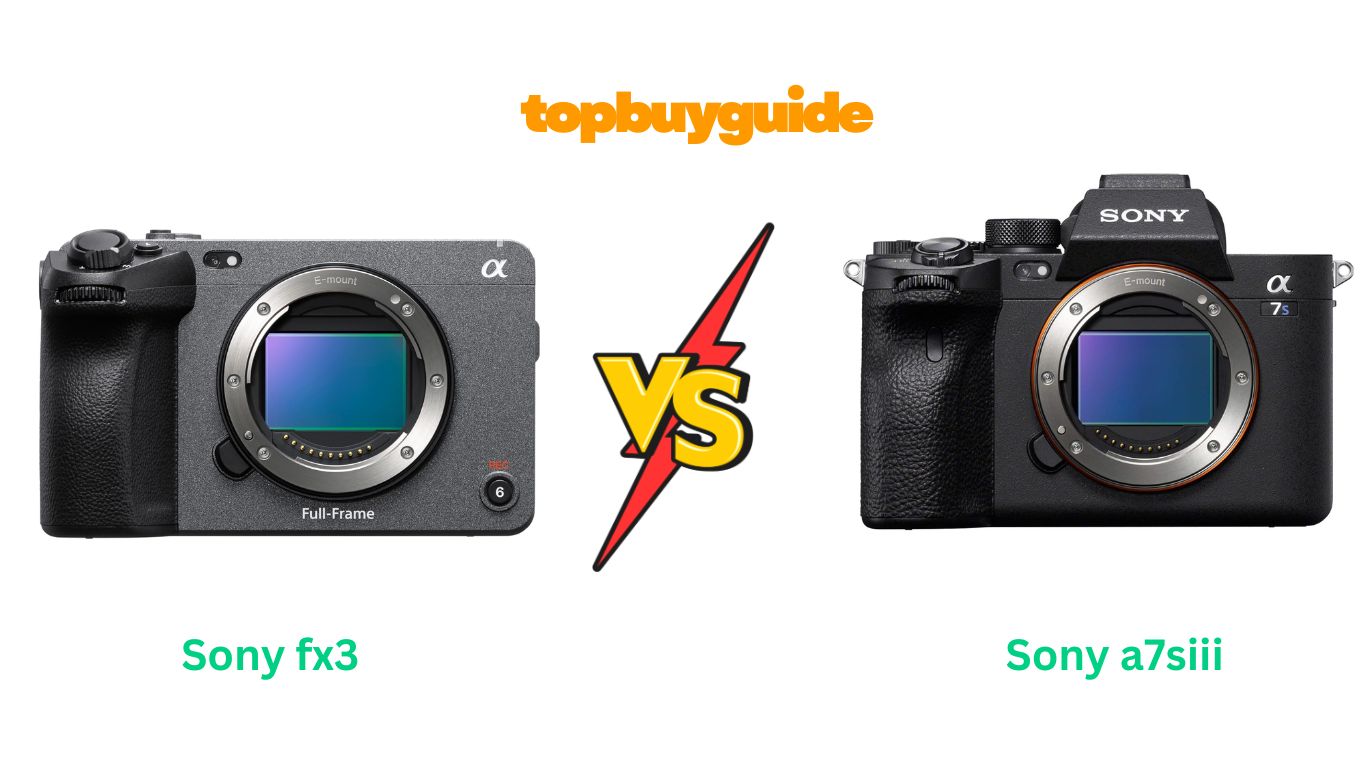
Choosing between the Sony FX3 and the A7SIII is a filmmaker’s dilemma. Both cameras share the same groundbreaking sensor and processor. They deliver identical, stunning image quality. For most filmmakers, however, I recommend the Sony FX3. Its cinema-focused design, superior cooling, and included XLR handle make it a more practical, ready-to-shoot tool for professional video work, providing better value right out of the box.
Why Do I Recommend The Sony FX3?
The Sony FX3 takes the revolutionary core of the A7SIII and places it into a body designed purely for filmmakers. While the image quality is identical, the FX3’s design and included accessories make it the superior choice for video production. Here’s why it’s my top pick.
- Dedicated Cinema Body: The FX3 is built for rigging. It features multiple ¼”-20 mounting points directly on the body. This “cage-free” design allows you to attach monitors, handles, and microphones without needing an extra cage. In contrast, the A7SIII requires a cage for similar mounting options, adding bulk and cost.
- Active Cooling System: The FX3 includes a built-in cooling fan. This is a crucial feature that allows for virtually unlimited 4K 60p recording without overheating. While the A7SIII has improved heat dissipation, it can still overheat during long takes in warm conditions, a problem the FX3 solves.
- Included XLR Top Handle: Out of the box, the FX3 comes with a top handle that provides two full-sized XLR inputs for professional audio. This is a significant value-add, as purchasing a similar XLR adapter for the A7SIII costs hundreds of dollars. This makes the FX3 a more complete audio solution from the start.
- Filmmaker-First Ergonomics: The FX3’s button layout is optimized for video. It has a front-facing tally lamp and a more accessible, top-mounted record button. The zoom rocker is also perfect for controlling compatible power zoom lenses. These are small but vital details that the photography-first A7SIII lacks.
- Clearer On-Camera Status: The FX3 features prominent red tally lights on the front and back. These provide a clear, unambiguous signal that the camera is recording. This is essential for both the operator and the talent on set, a feature absent on the A7SIII.
- Cine EI Mode: With a firmware update, the FX3 gained Cine EI (Exposure Index) mode, a feature from Sony’s high-end cinema line. This helps you capture the maximum dynamic range by shooting at the camera’s native ISOs and adjusting the monitoring LUT. This advanced tool is not available on the A7SIII.
- Designed for a Streamlined Workflow: The sum of these features—built-in mounts, cooling fan, and XLR handle—means the FX3 is ready for professional work with less setup time and less additional gear. It’s a more integrated and efficient tool for solo shooters and small crews.
Side By Side Comparison Chart: Sony FX3 vs A7SIII
| Feature | Sony FX3 | Sony A7SIII |
| Primary Design | Cinema Camera | Hybrid Photo/Video |
| Built-in Cooling Fan | Yes | No |
| Included Audio Unit | XLR Top Handle | No (requires add-on) |
| Body Mounting Points | Yes (5x ¼”-20) | No |
| Electronic Viewfinder | No | Yes (9.44m-dot OLED) |
| Tally Lamps | Yes (Front and Rear) | No |
| Exposure Mode Dial | No (Replaced by zoom rocker) | Yes |
| Cine EI Mode | Yes (via firmware) | No |
| Weight (Body Only) | 715g (with battery & card) | 699g (with battery & card) |
| Dimensions | 129.7 x 77.8 x 84.5 mm | 128.9 x 96.9 x 80.8 mm |
What Common Features Can Sony FX3 vs A7SIII Do?
At their heart, the Sony FX3 and A7SIII are twins. They are built around the same incredible technology, offering identical image performance that has set a new industry standard. This shared DNA means they both excel in the areas that matter most to filmmakers.
12.1MP Full-Frame Exmor R BSI CMOS Sensor
Both cameras use the same 12.1-megapixel back-illuminated sensor. This lower megapixel count is a purposeful design choice. It results in larger individual pixels that gather more light, leading to extraordinary low-light performance and a cleaner image with minimal noise. The sensor’s design also enables a full-frame readout with no pixel binning, ensuring maximum image quality from corner to corner.
BIONZ XR Image Processor
Powering both cameras is the advanced BIONZ XR processor. This engine is up to 8x more powerful than previous generations. It is responsible for the cameras’ incredible speed, enabling high-frame-rate recording, fast autofocus calculations, and responsive menu performance. This processing power is key to handling the massive data loads of 4K 120p video and reducing processing-related artifacts like rolling shutter.
4K 120p and 10-bit 4:2:2 Internal Recording
A standout feature for both the FX3 and A7SIII is the ability to record stunning 4K video at up to 120 frames per second. This is perfect for creating silky-smooth slow motion. Furthermore, they can capture this internally in a rich 10-bit 4:2:2 color depth. This provides over a billion shades of color, offering immense flexibility for color grading in post-production compared to 8-bit footage.
S-Cinetone Picture Profile
Inherited from Sony’s high-end VENICE cinema camera, S-Cinetone is available on both models. This picture profile is designed to produce beautiful, cinematic color straight out of the camera. It delivers natural-looking skin tones, soft color roll-offs, and pleasing highlights. For creators who need a fast turnaround, S-Cinetone provides a professional look with minimal need for color grading.
Fast Hybrid Autofocus System
Both cameras are equipped with Sony’s industry-leading autofocus system. It features 759 phase-detection points covering 92% of the sensor. The real-time Eye AF and Real-time Tracking are incredibly reliable for both humans and animals. It latches onto a subject’s eye or face and holds focus tenaciously, even as they move around the frame. This makes solo operation and tracking fast-moving subjects incredibly easy.
5-Axis SteadyShot INSIDE Image Stabilization
To ensure smooth handheld footage, both cameras feature 5-axis in-body image stabilization (IBIS). This system compensates for camera shake across five different axes. For even smoother results, an “Active Mode” is available, which adds digital stabilization for a near-gimbal-like effect. This is a game-changer for run-and-gun shooting where using a gimbal isn’t practical.
Common Features of Sony FX3 vs A7SIII
| Feature | Sony FX3 | Sony A7SIII |
| Sensor | 12.1MP Full-Frame CMOS | 12.1MP Full-Frame CMOS |
| Processor | BIONZ XR | BIONZ XR |
| Max Video Resolution | 4K UHD at 120fps | 4K UHD at 120fps |
| Internal Bit Depth | 10-Bit 4:2:2 | 10-Bit 4:2:2 |
| ISO Range (Video) | 80 – 409,600 (Extended) | 80 – 409,600 (Extended) |
| Picture Profiles | S-Cinetone, S-Log3, HLG | S-Cinetone, S-Log3, HLG |
| Autofocus | 759-Point Fast Hybrid AF | 759-Point Fast Hybrid AF |
| Stabilization | 5-Axis In-Body (IBIS) | 5-Axis In-Body (IBIS) |
| LCD Screen | 3.0″ Vari-Angle Touchscreen | 3.0″ Vari-Angle Touchscreen |
| Memory Card Slots | Dual CFexpress Type A / SD | Dual CFexpress Type A / SD |
| RAW Video Output | Yes (16-bit via HDMI) | Yes (16-bit via HDMI) |
A Detailed Comparison Of the Sony FX3 vs A7SIII
Body Design and Handling
The Sony FX3 is purpose-built for video. Its compact, silver-toned body is covered in mounting points, which eliminates the need for a cage for most setups. The lack of a traditional mode dial is replaced by a zoom rocker and more direct-access buttons, reinforcing its identity as a cinema tool. This design makes rigging up monitors, microphones, or handles a simple and quick process.
Conversely, the Sony A7SIII maintains the classic Alpha series mirrorless body style. It’s primarily designed for hybrid shooters who switch between stills and video. The inclusion of a physical mode dial makes it faster to switch to photography modes. However, for serious video work, its lack of mounting points means you will almost certainly need to invest in a camera cage.
Audio Capabilities
This is one of the most significant differences. The Sony FX3 comes with a detachable top handle that includes two full-size XLR inputs and a 3.5mm input. This handle provides comprehensive audio controls for phantom power and input switching, making it a professional audio interface out of the box. It attaches securely to the camera’s multi-interface shoe, providing a complete, high-quality audio solution for narrative films, interviews, and documentaries.
The Sony A7SIII has a standard 3.5mm microphone input and headphone jack. To get XLR inputs, you must purchase Sony’s XLR-K3M adapter separately, which costs a significant amount. While this adapter provides the same functionality as the FX3’s handle, the fact that it is an included accessory with the FX3 makes the cinema camera a far better value for anyone who needs professional audio.
Overheating and Recording Limits
The Sony FX3’s standout feature is its internal cooling fan. Positioned next to the sensor and processor, this fan actively dissipates heat, allowing for virtually uninterrupted 4K recording sessions even at high frame rates and in warm environments. For event videographers, documentary filmmakers, or anyone shooting long interviews, this feature provides crucial reliability and peace of mind.
The Sony A7SIII features a passive heat-dissipation design, a major improvement over previous Sony models. It can record for long periods under most conditions without issue. However, in direct sunlight or warm rooms, especially when recording at 4K 60p or 120p, it can eventually overheat and shut down. For professional work where a missed shot is not an option, the active cooling of the FX3 is a clear advantage.
Viewfinder and Monitoring
Here, the Sony A7SIII has a clear advantage for certain users. It includes a superb 9.44 million-dot OLED electronic viewfinder (EVF). This EVF is incredibly large, sharp, and bright, making it one of the best on the market. It is invaluable for shooting stills in bright daylight and for hybrid photographers who are accustomed to looking through a viewfinder.
To achieve its compact, video-centric form factor, the Sony FX3 completely omits the electronic viewfinder. All framing must be done using the rear articulating LCD screen. For filmmakers who exclusively use external monitors or rely on the LCD screen, this is not an issue. However, for hybrid shooters or those who prefer an EVF for stability and focus, its absence is a major consideration.
Conclusion
The Sony FX3 and A7SIII are both phenomenal cameras that deliver identical, class-leading image quality. The choice between them comes down to ergonomics and intended use. If you are a hybrid shooter who values photography as much as videography, the Sony A7SIII is the better choice. Its superior electronic viewfinder and traditional mode dial make it a more flexible tool for both disciplines.
However, for anyone focused primarily on filmmaking, the Sony FX3 is the undeniable winner. The built-in cooling fan provides professional reliability, the included XLR handle is a massive value-add for audio, and the “cage-free” design with multiple mounting points makes it a more efficient and streamlined cinema tool. It is built from the ground up for video production, and for a small price difference, it gives you a more complete filmmaking package right out of the box.
FAQs
- Is the Sony FX3 better than the A7SIII for low light?
No, their low-light performance is identical. Both cameras share the same 12.1MP sensor and dual native ISOs (800 and 12,800 in S-Log3), resulting in equally clean and stunning images in low-light conditions. - Can the Sony FX3 take photos?
Yes, the Sony FX3 can take 12.1MP photos, just like the A7SIII. It has a mechanical shutter and can shoot in RAW. However, its lack of a viewfinder and photography-focused dials makes it less ergonomic for photographers. - Does the FX3’s fan make noise that the microphone picks up?
The fan is extremely quiet. In most shooting scenarios, especially with the microphone positioned away from the camera body, the fan noise is inaudible. You can also set the fan to “Min” or “Off during Rec” to eliminate any risk of noise during a take. - Why is the A7SIII’s viewfinder so important?
An electronic viewfinder (EVF) is crucial for many photographers, especially in bright sunlight where an LCD screen can be difficult to see. It also provides a third point of contact (eye, two hands) for better stability when shooting handheld. - Do I need to buy expensive CFexpress Type A cards for these cameras?
No. While you need CFexpress Type A cards for the highest quality slow-motion modes (like 4K 120p in S&Q mode), both cameras can record excellent 10-bit 4K video at up to 60fps on standard V90 SD cards, which are more affordable. - Which camera is better for a solo filmmaker?
The Sony FX3 is arguably better for a solo filmmaker. The built-in mounting points, included XLR handle, and tally lights mean you can build a compact, efficient rig without extra components. The reliable autofocus on both cameras makes either a great choice, but the FX3’s design simplifies the process. - Does the Sony A7SIII overheat?
The A7SIII is much improved over older Sony cameras, but it can overheat during very long takes (over an hour) of 4K 60p, or faster in direct sun or hot environments. The Sony FX3’s fan almost completely eliminates this problem. - If the image is the same, why is the FX3 more expensive?
The initial price difference is because the FX3 includes the XLR audio handle (a several-hundred-dollar value), has an active cooling fan, and features a more specialized body design with threaded mounting points. For videographers, it often represents better overall value.

Alex Turner is a dedicated product researcher and reviewer at TopBuyGuide.com, known for his clear, honest, and data-driven insights. He spends countless hours testing, comparing, and analyzing products to help readers make confident and informed buying decisions.