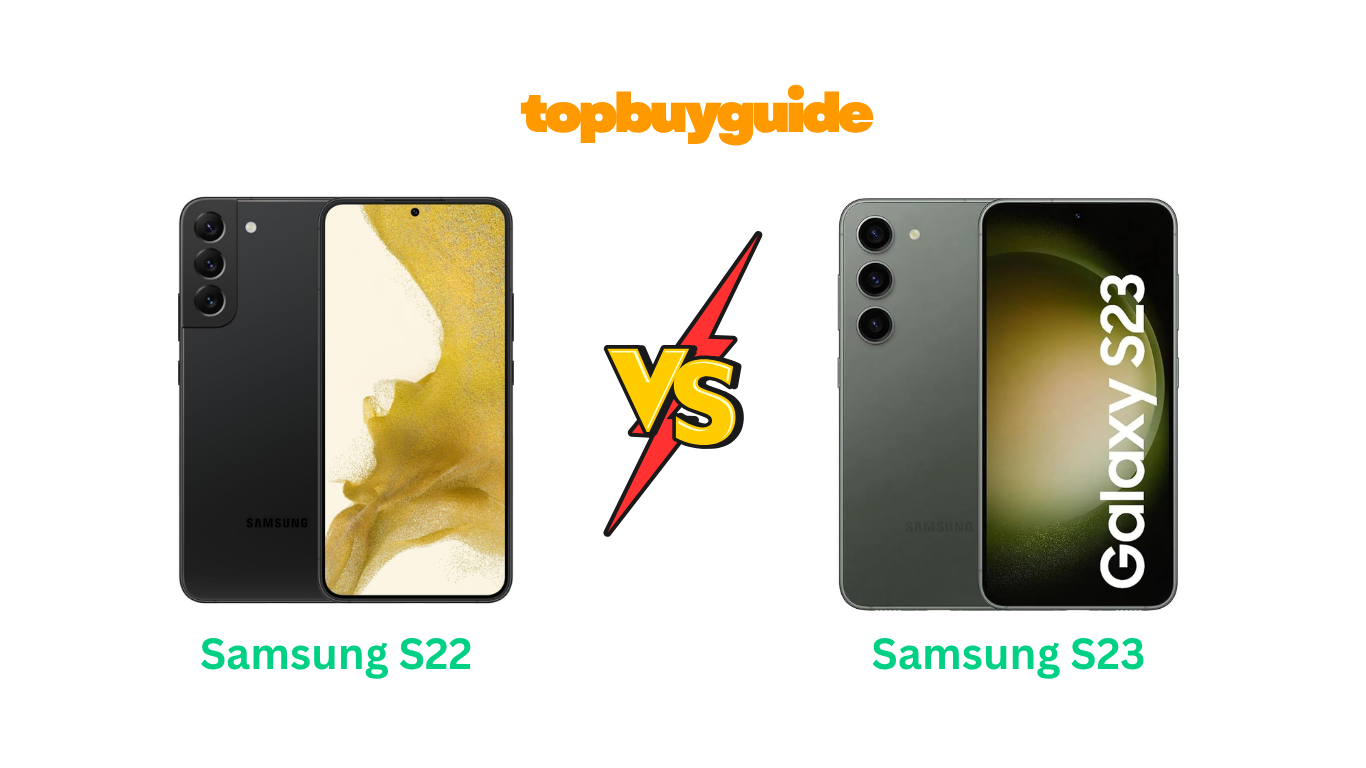
Deciding between Samsung Galaxy S22 and S23 requires understanding their key differences. I recommend the Galaxy S23 for most buyers. The Snapdragon 8 Gen 2 processor delivers significantly better performance than the S22’s Snapdragon 8 Gen 1 chip. Additionally, the S23’s improved battery life easily lasts through the day, while the S22 struggles to last half a day without charging.
Why Do I Recommend The Samsung Galaxy S23?
The Galaxy S23 delivers meaningful upgrades that justify choosing it over the S22:
- Superior Processor Performance: The S23 uses the exclusive Snapdragon 8 Gen 2 for Galaxy, offering higher performance than the standard chip. Meanwhile, the S22 uses the older Snapdragon 8 Gen 1 or Exynos 2200, creating noticeable performance gaps during intensive gaming and multitasking.
- Dramatically Better Battery Life: The S23 includes an extra 200mAh battery capacity that makes a significant difference, easily lasting through the day and possibly until next morning. Conversely, the S22 suffered from poor battery life, hardly lasting half a day without being charged in real-world testing.
- Enhanced Display Brightness: The S23 achieves 1,750 nits peak brightness compared to the S22’s 1,300 nits rating. This 450-nit advantage provides significantly better outdoor visibility during bright sunlight conditions for navigation, photography, and general use throughout the day.
- Improved Glass Protection: The S23 uses Gorilla Glass Victus 2 on front and back, instead of Gorilla Glass Victus Plus like the S22. The newer glass material offers better drop protection and scratch resistance, reducing repair costs and maintaining pristine appearance longer.
- Unified Processor Availability: The S23 comes with one Snapdragon chip globally, while the S22 is sold in Snapdragon and Exynos variants for different markets. This standardization eliminates confusion about performance variations and ensures consistent camera processing and battery performance regardless of purchase location.
- Faster Storage Technology: The S23 includes UFS 4.0 storage chip in the 256GB version, basically doubling the read and write speeds compared to the S22’s UFS 3.1. This enhancement increases overall snappiness when loading apps, transferring files, and accessing photos or videos stored on the device.
- Cleaner Design Aesthetic: The S23 features individual metal rings around camera lenses for a cleaner look, while the S22 has a metal slab over cameras fused to the frame. The simplified design aligns better with Samsung’s premium Ultra lineup and creates a more cohesive visual identity across models.
- Wi-Fi 6E Connectivity: All three S23 Galaxy models use Wi-Fi 6E technology, whereas Wi-Fi 6E is only available on the S22 Ultra and S22+, not the base S22. This upgrade provides faster wireless speeds, lower latency, and better performance in congested network environments at home or office.
Side By Side Comparison Chart – Samsung S22 vs S23
| Feature | Samsung S22 | Samsung S23 |
| Processor (US) | Snapdragon 8 Gen 1 | Snapdragon 8 Gen 2 for Galaxy |
| Processor (Global) | Exynos 2200 / Snapdragon | Snapdragon 8 Gen 2 only |
| Display Size | 6.1 inches | 6.1 inches |
| Peak Brightness | 1,300 nits | 1,750 nits |
| Glass Protection | Gorilla Glass Victus Plus | Gorilla Glass Victus 2 |
| Battery Capacity | 3,700 mAh | 3,900 mAh |
| Battery Life (Video) | 7h 26min | 8h 6min |
| Storage Type | UFS 3.1 | UFS 3.1 (128GB) / UFS 4.0 (256GB) |
| Storage Options | 128GB, 256GB | 128GB, 256GB |
| RAM | 8GB | 8GB |
| Wi-Fi Standard | Wi-Fi 6 | Wi-Fi 6E |
| Camera Design | Rectangular bump | Individual lenses |
| Weight | 167g (5.89 oz) | 168g (5.93 oz) |
| Colors | 5 options | 4 standard + 4 online exclusive |
| Launch Price | $799 | $799 |
| Current Price (2025) | ~$400-500 | ~$700 |
What Common Features Can Samsung S22 vs S23 Do?
Identical Camera Hardware Configuration
The S23 reuses the S22’s camera hardware, which isn’t a problem since the S22 performed fine from that standpoint. Both phones feature a 50MP primary lens, 12MP ultrawide camera, and 10MP telephoto with 3x optical zoom. Samsung’s hardware and experience, especially with telephoto processing, puts the Galaxy S series among the best smartphones for taking pictures. The identical sensor configuration means photo quality remains consistent between generations, benefiting from Samsung’s continued software optimization and processing improvements.
Outstanding 5G Network Support
The Galaxy S22 was one of the best 5G phones due to great network support and performance, and the S23 is no different. Both devices support Sub-6GHz and mmWave 5G bands across all major US carriers including T-Mobile, Verizon, and AT&T. Both phones deliver fast download and upload speeds in 5G coverage areas. The comprehensive network compatibility ensures reliable connectivity whether traveling domestically or internationally across different carrier networks.
Premium IP68 Water Resistance
The S23 continues to carry an IP68 dust and water resistance rating like its predecessor. Both phones survive submersion in up to 1.5 meters of fresh water for 30 minutes without damage. This protection guards against accidental drops in pools, rain exposure, and everyday spills. Both devices handle beach environments and dusty conditions equally well. Users enjoy peace of mind knowing their investment remains protected during various weather conditions and outdoor activities.
Consistent Display Specifications
The displays on the Galaxy S23 and Galaxy S22 offer the same FHD resolution (1080 x 2340) and 48Hz to 120Hz adaptive refresh rate. Both screens have a 6.1-inch diagonal with 19.5:9 aspect ratio and 425 PPI pixel density. The adaptive refresh rate technology automatically adjusts between 48Hz and 120Hz depending on content type for optimal battery efficiency. Both displays deliver smooth scrolling through social media, vibrant colors, and deep blacks characteristic of Samsung’s AMOLED technology.
Stereo Speaker Audio Quality
Both models include stereo speakers tuned by AKG that deliver immersive audio experiences during media consumption. The dual-speaker configuration provides balanced sound output with clear dialogue in videos and decent bass response. Both phones support Dolby Atmos for enhanced spatial audio with compatible streaming content. Neither device includes a traditional headphone jack, requiring users to utilize USB-C audio adapters or Bluetooth wireless solutions.
Fast Charging Support Standards
Both the S22 and S23 support 25W fast wired charging that delivers quick power restoration during brief charging sessions. Neither phone includes a charger in the box, requiring separate purchase of compatible power adapters. Both devices also support 15W wireless charging for cable-free convenience using Qi-compatible charging pads. Reverse wireless charging enables both phones to charge accessories like Galaxy Buds or smartwatches directly from the phone’s battery.
Comprehensive Software Update Commitment
Samsung has pledged 4 years of software support for its flagships and 5 years of ongoing security updates. The Galaxy S22 will get Android 16 and call it quits in early 2026, while the S23 should receive Android 17 and then be done. Both phones currently run Android 13 with Samsung’s One UI interface providing consistent user experiences. The extended support timeline ensures both devices remain secure and receive feature updates well into the future.
Ultrasonic Fingerprint Scanning Technology
Both models feature ultrasonic in-display fingerprint scanners that work accurately and quickly for device unlocking. The ultrasonic technology operates reliably even with wet or slightly dirty fingers compared to optical sensors. Both phones also include face recognition via the front camera for alternative authentication methods. The dual biometric options provide flexibility for users preferring different security approaches. Both systems balance security with convenient access speeds.
Common Features Chart – Samsung S22 vs S23
| Feature | Samsung S22 | Samsung S23 |
| Main Camera | 50MP | 50MP |
| Ultra-wide Camera | 12MP | 12MP |
| Telephoto Camera | 10MP (3x optical) | 10MP (3x optical) |
| Front Camera | 10MP | 10MP |
| 5G Support | Yes (all bands) | Yes (all bands) |
| Water Resistance | IP68 | IP68 |
| Display Size | 6.1 inches | 6.1 inches |
| Display Resolution | 1080 x 2340 (FHD+) | 1080 x 2340 (FHD+) |
| Refresh Rate | 48-120Hz adaptive | 48-120Hz adaptive |
| Display Technology | Dynamic AMOLED 2X | Dynamic AMOLED 2X |
| RAM | 8GB | 8GB |
| Stereo Speakers | Yes (AKG tuned) | Yes (AKG tuned) |
| Dolby Atmos | Yes | Yes |
| Fast Charging | 25W wired | 25W wired |
| Wireless Charging | 15W | 15W |
| Reverse Charging | Yes | Yes |
| Fingerprint | Ultrasonic in-display | Ultrasonic in-display |
| Android Updates | 4 years | 4 years |
| Security Updates | 5 years | 5 years |
A Detailed Comparison Of the Samsung S22 vs S23
Processor Performance and Efficiency
The Galaxy S22 used the best available Android chipset at launch, the Snapdragon 8 Gen 1, though users outside the US got the Exynos 2200 chip which couldn’t quite match up to the Snapdragon version. The 8 Gen 1 offers adequate performance but battery life suffered significantly in real-world use. The dual-chip strategy created confusion about actual device performance and camera capabilities.
The Galaxy S23 uses the Snapdragon 8 Gen 2 for Galaxy exclusively, a higher performance version unique to Samsung that should theoretically outperform even other Android phones with the Gen 2 chip. The 8 Gen 2 offers noticeable performance and battery life improvements that translate into real-life use. The unified processor eliminates regional performance variations and ensures consistent experiences globally.
Battery Life and Endurance
The Galaxy S22 suffered from poor battery life, hardly lasting half a day without being charged in typical usage scenarios. The 3,700 mAh battery combined with the inefficient Snapdragon 8 Gen 1 processor created frustrating daily charging requirements. Users frequently experienced battery anxiety when leaving home without full charges or carrying portable chargers constantly.
Samsung gave the S23 more juice with an extra 200mAh capacity that makes a big difference despite seeming minimal. Starting at 100%, the Galaxy S23 can easily last through the day and possibly until the next morning, getting around six hours of screen-on time. Users appreciate not needing to charge halfway through the day or when leaving home.
Display Brightness Capabilities
The Galaxy S22 was rated for 1,300 nits peak brightness, adequate for most indoor and moderate outdoor conditions. However, users occasionally struggled with screen visibility during bright summer days or direct sunlight exposure. The lower brightness sometimes necessitated seeking shade or cupping hands around screens to view content clearly during outdoor activities.
The max brightness of the Galaxy S23 is now rated at 1,750 nits, the same as the Galaxy S23 Plus and Galaxy S22 Plus. This 450-nit improvement provides substantially better outdoor readability during sunny conditions. Users comfortably navigate maps, capture photos, and read messages without visibility struggles even in challenging lighting environments throughout various seasons.
Design Language Evolution
The Galaxy S22 had cameras joined together in a rectangular camera block fused to the phone’s metal frame, looking cool and fresh but distinctly different from the S22 Ultra. The contoured camera module created a unique visual identity for the standard S22 model. Some users appreciated the cohesive integrated design that flowed naturally from the phone’s body.
The S23 has its cameras separated on its back with only individual lenses protruding from a flush back panel, eliminating the camera bump. This cleaner look matches the Galaxy S22 Ultra design with only metal rings around camera lenses. The simplified aesthetic creates visual consistency across Samsung’s flagship lineup, though some find it less distinctive.
Glass Protection Technology
The Galaxy S22 uses Gorilla Glass Victus Plus on its front and back panels for excellent scratch and drop protection. The glass technology provides reliable durability for everyday use and minor accidents. Most users experience minimal scratching during typical ownership periods without screen protectors or cases applied immediately.
The Galaxy S23 uses Gorilla Glass Victus 2 on its front and back, an upgraded material over Victus Plus. Corning claims its latest material can withstand drops of up to 1 meter onto concrete surfaces. The improved glass reduces the likelihood of screen damage during accidental drops and maintains better appearance over extended ownership periods.
Storage Speed Technology
The Galaxy S22 utilizes UFS 3.1 storage technology across all storage configurations including 128GB and 256GB options. This storage standard provides solid read and write speeds adequate for typical smartphone operations. Most users find the performance perfectly acceptable for app loading, photo access, and file transfers during regular use.
The Galaxy S23 comes with UFS 4.0 storage chip if you choose the 256GB version, though 128GB is still UFS 3.1 like the Galaxy S22. UFS 4.0 basically doubles the read and write speeds of the phone, which will additionally increase snappiness. Power users notice faster app launches, quicker photo loading, and improved overall responsiveness.
Wireless Connectivity Standards
The base Galaxy S22 includes Wi-Fi 6 connectivity providing adequate wireless speeds for most home and office environments. The standard Wi-Fi 6 technology handles streaming, video calls, and downloads competently. However, users in congested wireless environments occasionally experience slower speeds during peak usage times when multiple devices compete for bandwidth.
All three S23 Galaxy models use Wi-Fi 6E technology, whereas Wi-Fi 6E is only available on the S22 Ultra and S22+, not the base S22. The Wi-Fi 6E standard accesses additional 6GHz spectrum providing faster speeds and reduced interference. Users benefit from improved wireless performance particularly in crowded network environments with many connected devices.
Camera Processing Differences
The Galaxy S22’s pictures are bright and detailed, not overly dramatic with contrast or colors, producing softer, more natural images. The S22 performed admirably in low-light situations with images and video, even competing with the Pixel 7. The processing style favors realistic color reproduction and natural-looking photographs that appeal to users preferring understated aesthetics.
Samsung appears to have made processing changes that drastically changed the S23’s output, with photos showing punched up contrast and much more detail but perhaps too much sharpness. The S23 doesn’t appear to overexpose as much, but S22 images appear brighter overall indoors and in low-light situations. The processing differences reflect Samsung’s evolving computational photography approach.
Color Options and Availability
The Galaxy S22 is offered in Phantom Black, Phantom White, Green, Pink Gold, and Bora Purple, providing diverse options for personal expression. The vibrant color palette appeals to users wanting phones that reflect their personality and style preferences. The glossy finishes create eye-catching appearances that stand out in various settings.
The Galaxy S23 can be bought in Phantom Black, Cream, Green, or Lavender as standard options. Some online-exclusive colors include Graphite, Cream, Violet, and Sky Blue available directly from Samsung. The color selection leans toward sophisticated, muted tones rather than bold, vibrant options that characterized previous generations.
Weight and Dimensions
The Galaxy S22 weighs 167 grams (5.89 ounces), creating a lightweight handheld experience during extended usage periods. The compact dimensions make the phone comfortable for one-handed operation and easy pocket carrying. The balanced weight distribution prevents top-heaviness that can cause fatigue during lengthy phone calls or gaming sessions.
The Galaxy S23 weighs 168 grams (5.93 ounces), virtually identical to the S22 with only a 1-gram difference. The S23 and S22 share extremely similar design with just a fraction of an inch separating the two in terms of width and height. Users transitioning between models won’t notice meaningful differences in hand feel or pocketability during everyday carrying.
Long-Term Value Proposition
The Galaxy S22 is completely frozen out and hard to find unless shopping second hand or refurbished in 2024-2025. The discontinued status means limited color and storage options when purchasing new units. However, the S22 represents excellent value for budget-conscious buyers willing to accept previous-generation technology at significantly reduced prices.
The S23 is now available at a $100 discount in limited variant options after the S24 family launched. The reduced pricing makes the S23 more competitive while still offering relatively current technology. The phone provides several additional years of software support compared to the S22, justifying the premium for users prioritizing longevity.
Conclusion
The Samsung Galaxy S23 emerges as the smarter purchase for most buyers in 2025. The extra 200mAh battery enables all-day usage compared to the S22’s half-day endurance. The Snapdragon 8 Gen 2 for Galaxy delivers superior performance and efficiency over the S22’s older chip. The 1,750-nit peak brightness crushes the S22’s 1,300-nit display for outdoor visibility. At around $700, the S23 justifies its premium through meaningful battery, performance, and display improvements worth experiencing daily.
FAQs
Q: Is the battery life really that much better on the S23?
Yes, the S23 easily lasts through the day and possibly until next morning, while the S22 can hardly last half a day without charging. The extra 200mAh capacity combined with the efficient Snapdragon 8 Gen 2 makes a significant difference. Users no longer experience battery anxiety when leaving home with partial charges.
Q: Are the cameras identical between S22 and S23?
The S23 reuses the S22’s camera hardware with the same 50MP main, 12MP ultrawide, and 10MP telephoto lenses. However, Samsung made processing changes that drastically altered output, with the S23 showing punched up contrast and more detail. The hardware remains identical but software processing differs meaningfully between generations.
Q: Should I buy a used S22 or new S23?
The S23 offers better long-term value with improved battery life, newer processor, and additional years of software support remaining. The S22 will receive updates until early 2026, while the S23 continues through 2027. If budget allows, the S23’s improvements justify the price premium over discounted S22 units.
Q: Does the S23 have better performance than S22?
The S23’s Snapdragon 8 Gen 2 for Galaxy is a higher performance version unique to Samsung that theoretically outperforms other Android phones. Samsung also promises the world’s fastest mobile graphics, so the S23 should be better for gaming. Real-world performance differences become noticeable during intensive tasks and sustained gaming sessions.
Q: Is the screen brighter on the S23?
Yes, the S23 achieves 1,750 nits peak brightness compared to the S22’s 1,300 nits. This 450-nit improvement significantly enhances outdoor visibility during sunny conditions. Users comfortably view content in direct sunlight without seeking shade or struggling with screen readability throughout various outdoor activities.
Q: Why did Samsung eliminate the Exynos chip in S23?
Samsung went all in on Snapdragon chips globally for the S23, eliminating the Exynos variant that caused confusion. The two chips processed camera imagery differently and showed different battery performance, leading to confusion online. The unified Snapdragon approach ensures consistent global performance and eliminates regional discrepancies entirely.
Q: Is UFS 4.0 storage worth getting on S23?
UFS 4.0 basically doubles read and write speeds, which will additionally increase snappiness compared to UFS 3.1. However, only the 256GB S23 version includes UFS 4.0, while 128GB models use UFS 3.1 like the S22. Power users benefit from the faster storage during file transfers and app loading operations.

Alex Turner is a dedicated product researcher and reviewer at TopBuyGuide.com, known for his clear, honest, and data-driven insights. He spends countless hours testing, comparing, and analyzing products to help readers make confident and informed buying decisions.