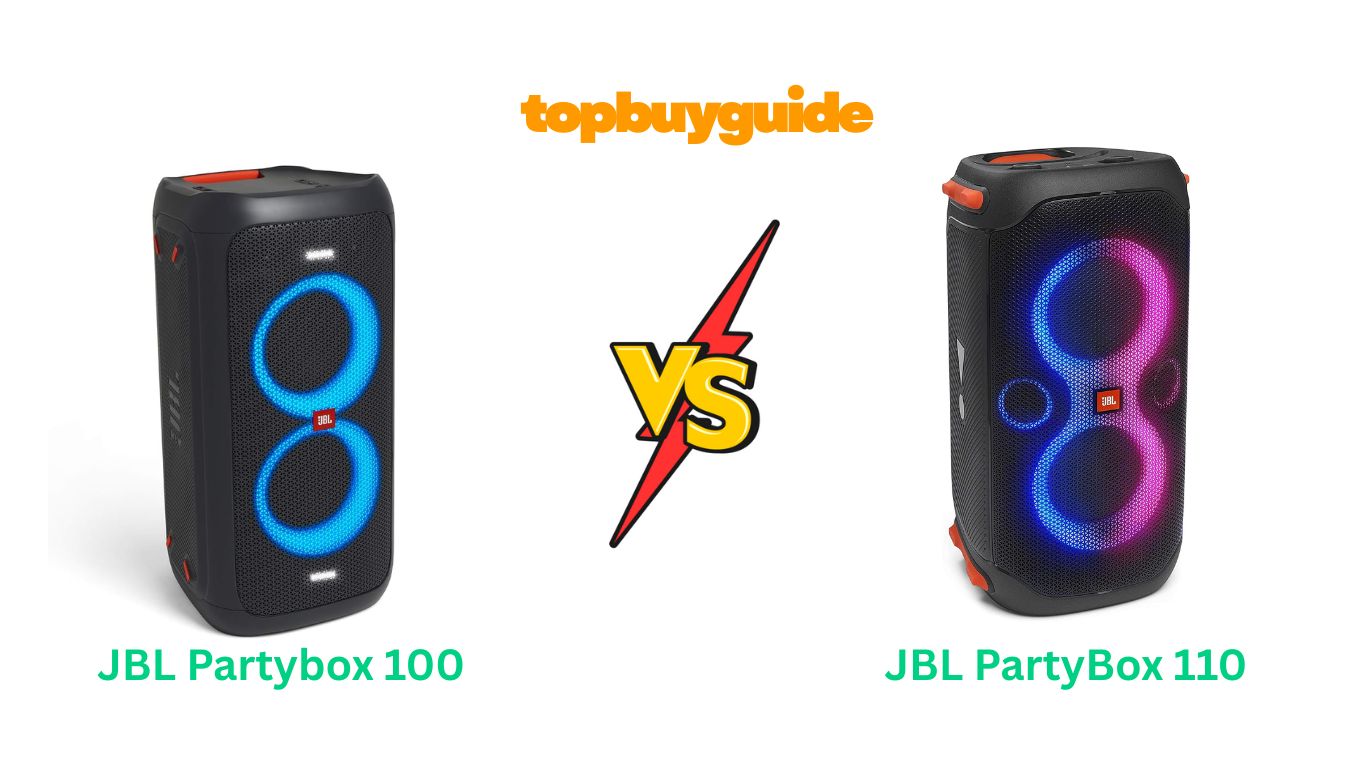
Choosing between the JBL PartyBox 100 and 110 can challenge anyone seeking the ultimate party speaker. Both deliver powerful 160-watt sound with impressive light shows, yet they offer distinct advantages. I recommend the JBL PartyBox 110 for most users wanting advanced party features and convenience. The PartyBox 110 offers IPX4 splashproof protection and dedicated mobile app control for complete customization. These modern upgrades make the 110 the superior choice for outdoor parties and tech-savvy users.
Why Do I Recommend The JBL PartyBox 110?
The JBL PartyBox 110 stands out as the superior choice for several compelling reasons:
- IPX4 Splashproof Protection: The PartyBox 110 features IPX4 splashproof certification, protecting against water splashes from any direction. This weatherproofing allows safe use near pools, beaches, and during unexpected rain showers. Conversely, the PartyBox 100 lacks any water resistance rating, making it vulnerable to moisture damage.
- Dedicated JBL PartyBox App Control: The 110 integrates with the JBL PartyBox app for comprehensive remote control and customization. You can adjust EQ settings, control lights, add sound effects, and manage firmware updates seamlessly. The PartyBox 100 offers no mobile app support whatsoever, limiting control to physical buttons only.
- Advanced Dynamic LED Light Rings: The PartyBox 110 showcases unique circular LED light rings that create stunning 360-degree visual effects. These full-spectrum lights offer 5 distinct modes including Flash, Rock, Flow, Cross, and Ripple patterns. The PartyBox 100 uses simpler dual vertical LED light strips with fewer customization options available.
- Enhanced Sound Effects Library: The 110 includes built-in sound effects like horn, clapping, cheering, booing, DJ scratching, and dog barking. These fun additions enhance DJ sets and party entertainment through the app interface. The PartyBox 100 provides no sound effects capabilities, offering only music playback and basic controls.
- Improved Frequency Response Range: The PartyBox 110 extends its frequency response to 45 Hz – 20 kHz for fuller audio. The higher treble response (20 kHz vs 18 kHz) delivers crisper, more detailed high frequencies. While the PartyBox 100 reaches 45 Hz – 18 kHz, it misses the extended clarity.
- Modern TWS Pairing Through App: The 110 allows True Wireless Stereo pairing through both hardware buttons and app control. The app enables switching between stereo and dual mono modes for flexible speaker placement options. The PartyBox 100 offers basic TWS functionality but lacks the app’s advanced pairing controls.
- Superior Light Show Customization: The 110 lets you customize light colors, select specific patterns, and control strobe effects individually. You can save favorite lighting configurations for different party moods through the app. The PartyBox 100 provides limited light pattern cycling without granular customization or color selection.
- Bluetooth 5.1 Connectivity: The PartyBox 110 utilizes Bluetooth 5.1 for more stable wireless connections and improved range. This newer protocol reduces audio dropouts and provides better multi-device handling capabilities. The PartyBox 100 uses older Bluetooth 4.2, which offers less reliable connectivity overall.
Side By Side Comparison Chart – JBL PartyBox 100 vs 110
| Feature | JBL PartyBox 100 | JBL PartyBox 110 |
| Water Resistance | None | IPX4 Splashproof |
| Mobile App Support | No app control | JBL PartyBox App |
| LED Light Design | Dual vertical strips | Circular light rings |
| Light Modes | 3 basic patterns | 5 modes (Flash, Rock, Flow, Cross, Ripple) |
| Light Color Control | No customization | Full color customization |
| Built-in Sound Effects | None | Yes (horn, clapping, barking, etc.) |
| Bluetooth Version | Bluetooth 4.2 | Bluetooth 5.1 |
| Frequency Response | 45 Hz – 18 kHz | 45 Hz – 20 kHz |
| EQ Control | None | 3-band EQ via app |
| TWS Mode Switching | Hardware only | Hardware + app control |
| Firmware Updates | Not available | Via app |
| Remote Volume Control | No | Yes (via app) |
| Pole Mount Adapter | Yes (3/4″ socket) | Yes (3/4″ socket) |
| Weight | 21.3 lbs (9.7 kg) | 23.8 lbs (10.8 kg) |
| Horizontal Orientation | No | Yes (wedge-style positioning) |
| Battery Indicator | LED bars | LED bars + app percentage |
What Common Features Do JBL PartyBox 100 and 110 Share?
Powerful 160-Watt Audio Output
Both speakers deliver impressive 160 watts of JBL signature sound for room-filling audio performance. This substantial power output ensures your music projects clearly across large indoor and outdoor spaces. The wattage remains consistent whether you’re using battery power or AC connection for flexibility. Both models handle peak volumes without significant distortion or audio degradation during extended use. The power output makes either speaker suitable for parties hosting 50-100 people comfortably. Neither speaker requires external amplification to achieve professional-level sound pressure levels for gatherings.
Identical Driver Configuration
Both the PartyBox 100 and 110 feature two 5.25-inch woofers for powerful bass response. Two 2.25-inch tweeters complement the woofers, delivering clear mid-range and high-frequency reproduction. This four-driver configuration creates balanced audio with impressive stereo separation despite the compact design. The rear-ported bass reflex system on both models enhances low-frequency output and punch significantly. The drivers work together to handle diverse music genres from electronic to rock effectively. Both speakers use premium components designed for durability and consistent performance over extended usage periods.
Extended 12-Hour Battery Life
Both speakers provide up to 12 hours of continuous playback on a single battery charge. This marathon runtime ensures uninterrupted entertainment throughout day-long events and evening gatherings without recharging. Actual battery life varies based on volume levels, light show usage, and audio content. Both models feature rechargeable lithium-ion batteries that power the speaker and accessories independently. You can continue using either speaker while plugged into AC power for unlimited playtime. The substantial battery capacity eliminates range anxiety during outdoor events far from electrical outlets.
Bass Boost Functionality
Both speakers include a dedicated Bass Boost button for enhanced low-frequency impact and thump. Activating this feature increases bass response instantly, making it perfect for bass-heavy music genres. The bass enhancement works independently of other audio settings and can be toggled on/off. Both models allow you to customize sound intensity based on musical preferences and venue acoustics. The Bass Boost function proves especially effective during outdoor use where bass naturally dissipates. Neither speaker requires complex EQ adjustments to achieve satisfying low-end performance with this feature.
Mic and Guitar Inputs
Both the PartyBox 100 and 110 provide dedicated 1/4-inch inputs for microphones and guitars. Independent volume controls for each input allow proper gain staging for karaoke and live performances. The microphone input includes echo/reverb effects to enhance vocal presentations and singing quality naturally. Guitar players can use either speaker as a practice amp or performance amplifier effectively. Both inputs accept professional-grade dynamic microphones and standard instrument cables without additional adapters. This versatility transforms party speakers into legitimate PA systems for announcements and live entertainment.
True Wireless Stereo Pairing
Both speakers support TWS technology, allowing you to pair two identical units for stereo sound. The wireless connection between speakers creates true left-right channel separation for immersive audio experiences. Pairing requires simply pressing the TWS button on both speakers until they connect automatically. You can also connect speakers using a 3.5mm aux cable for wired stereo pairing. TWS pairing doubles your overall sound output for larger venues requiring more volume coverage. Both models maintain synchronized audio without noticeable delay between paired speakers during playback.
Comprehensive Connectivity Options
Both speakers offer Bluetooth wireless streaming, USB playback, and 3.5mm aux input connections simultaneously. The USB port supports MP3, WMA, and WAV file playback from USB flash drives. The 5V/2.1A USB output on both models charges smartphones and tablets during music playback. Aux input accommodates devices without Bluetooth capability or when wired connections are preferred. The 3.5mm aux output allows daisy-chaining multiple speakers or connecting external recording devices easily. Both speakers handle seamless switching between different audio sources without requiring complex menu navigation.
Tripod Mounting Capability
Both the PartyBox 100 and 110 include a standard 3/4-inch pole mount socket underneath. This mounting option elevates the speaker for better sound projection and audience coverage at events. Compatible speaker stands and tripods allow positioning at ideal ear level for optimal listening experiences. The mounting socket accommodates standard PA speaker stands readily available from most audio retailers. Elevated placement reduces floor vibration absorption and improves overall sound clarity in large venues. Both speakers remain stable when properly mounted, even with vigorous bass response during playback.
Common Features of JBL PartyBox 100 vs 110
| Feature | JBL PartyBox 100 | JBL PartyBox 110 |
| Audio Output Power | 160W RMS | 160W RMS |
| Driver Configuration | 2x 5.25″ woofers + 2x 2.25″ tweeters | 2x 5.25″ woofers + 2x 2.25″ tweeters |
| Battery Life | Up to 12 hours | Up to 12 hours |
| Rechargeable Battery | ✓ Yes (Li-ion) | ✓ Yes (Li-ion) |
| Bass Boost Function | ✓ Yes | ✓ Yes |
| RGB LED Light Show | ✓ Yes | ✓ Yes |
| Light On/Off Toggle | ✓ Yes | ✓ Yes |
| Microphone Input | ✓ Yes (1/4″ with volume) | ✓ Yes (1/4″ with volume) |
| Guitar Input | ✓ Yes (1/4″ with gain) | ✓ Yes (1/4″ with gain) |
| Echo/Reverb Effect | ✓ Yes (for mic) | ✓ Yes (for mic) |
| Bluetooth Connectivity | ✓ Yes | ✓ Yes |
| USB Playback | ✓ Yes (MP3/WMA/WAV) | ✓ Yes (MP3/WMA/WAV) |
| USB Charging Port | ✓ Yes (5V/2.1A) | ✓ Yes (5V/2.1A) |
| 3.5mm Aux Input | ✓ Yes | ✓ Yes |
| 3.5mm Aux Output | ✓ Yes | ✓ Yes |
| True Wireless Stereo (TWS) | ✓ Yes | ✓ Yes |
| Pole Mount Socket | ✓ Yes (3/4″ standard) | ✓ Yes (3/4″ standard) |
| AC Power Operation | ✓ Yes (100-240V) | ✓ Yes (100-240V) |
| Built-in Handles | ✓ Yes (dual handles) | ✓ Yes (dual handles) |
| Bass Reflex Port | ✓ Yes (rear-ported) | ✓ Yes (rear-ported) |
A Detailed Comparison Of the JBL PartyBox 100 vs 110
Water and Weather Protection
The PartyBox 110 features IPX4 splashproof certification, providing protection against water splashes from all directions. This rating allows safe use near swimming pools, at beach parties, and during light rain. The splashproof design protects internal electronics from moisture damage during typical outdoor party conditions. You can confidently bring the 110 to waterside venues without constant worry about accidental splashes.
The PartyBox 100 lacks any official water resistance rating or splashproof protection whatsoever. Exposure to moisture, rain, or water splashes can potentially damage the speaker’s internal components permanently. Users must exercise extreme caution when using the 100 near water sources or in weather. This limitation makes the PartyBox 100 better suited exclusively for protected indoor environments only.
Mobile App Control and Features
The PartyBox 110 integrates seamlessly with the dedicated JBL PartyBox app available for iOS and Android. The app provides comprehensive control including volume adjustment, 3-band EQ tuning, light customization, and sound effects. You can view precise battery percentage, manage firmware updates, and save custom lighting configurations remotely. The app unlocks advanced TWS mode switching between stereo and dual mono speaker configurations.
The PartyBox 100 offers no mobile app support or smartphone integration capabilities of any kind. All controls operate exclusively through physical buttons located on the top control panel. Users cannot access EQ adjustments, detailed battery information, or advanced settings beyond basic functions. This limitation restricts the PartyBox 100 to straightforward plug-and-play operation without modern smart features.
LED Light Show Design and Capabilities
The PartyBox 110 showcases innovative circular LED light rings that create stunning 360-degree visual displays. The full-spectrum lighting offers five distinct modes: Flash, Rock, Flow, Cross, and Ripple patterns. Through the app, you can customize individual light colors, adjust strobe intensity, and synchronize lights. The light rings respond dynamically to music’s bass frequencies, creating immersive audiovisual party experiences.
The PartyBox 100 features dual vertical LED light strips positioned centrally behind the speaker grille. These basic strips offer three preset light patterns that cycle through colors automatically. The light customization options remain limited to on/off toggle and pattern cycling via hardware button. While visually appealing, the PartyBox 100’s lights lack the sophistication and programmability of the 110’s system.
Bluetooth Version and Connectivity Stability
The PartyBox 110 utilizes modern Bluetooth 5.1 technology for superior wireless performance and stability. This advanced protocol provides extended range, faster device pairing, and more reliable connections overall. Bluetooth 5.1 reduces audio dropouts and interference from other wireless devices in crowded environments. The improved connectivity handles multiple paired devices more efficiently during transition between audio sources.
The PartyBox 100 operates on older Bluetooth 4.2, which still provides adequate wireless connectivity. However, the older protocol offers shorter wireless range and potentially less stable connections overall. Users may experience occasional dropouts when distance increases or interference from other Bluetooth devices occurs. While functional, Bluetooth 4.2 represents outdated technology compared to current wireless standards available today.
Frequency Response and Audio Range
The PartyBox 110 delivers an extended frequency response spanning 45 Hz to 20 kHz. The higher treble extension to 20 kHz provides noticeably crisper, more detailed high-frequency reproduction. This expanded range captures subtle audio details in cymbals, vocals, and acoustic instruments more accurately. The full-spectrum response creates a more balanced and natural sound signature across all genres.
The PartyBox 100 offers a frequency response of 45 Hz to 18 kHz, which remains respectable. The 18 kHz upper limit means the speaker misses some of the highest frequency details. Most listeners won’t notice this difference with typical party music and casual listening scenarios. However, audiophiles and those playing acoustic music may detect the reduced high-frequency sparkle and airiness.
Sound Effects and Entertainment Features
The PartyBox 110 includes a built-in sound effects library accessible through the mobile app interface. Effects include horn sounds, clapping and cheering, booing, DJ scratching, dog barking, and more options. These fun additions enhance DJ sets, party hosting, and interactive entertainment value significantly. The sound effects integrate seamlessly with music playback, triggered instantly through the app controls.
The PartyBox 100 provides no sound effects capabilities or entertainment enhancements beyond music playback. The speaker focuses purely on audio reproduction without additional party-oriented features or fun additions. Users seeking basic music playback won’t miss these effects, but party hosts may find opportunities. The absence of sound effects represents one clear limitation for interactive party entertainment purposes.
Speaker Positioning and Orientation Options
The PartyBox 110 supports both vertical upright positioning and horizontal wedge-style orientation flexibility. The horizontal placement angles sound upward toward the audience, improving coverage in certain venues. This versatility allows optimal positioning based on room acoustics, stage setup, and audience arrangement. The 110’s design accommodates various mounting and placement scenarios without compromising stability or performance.
The PartyBox 100 is designed primarily for vertical upright orientation on the floor or stands. While the speaker physically can be laid horizontally, this orientation isn’t officially recommended or optimized. The vertical design works well for most applications but limits positioning flexibility compared to the 110. Users who need versatile placement options may find the PartyBox 100’s single-orientation design restrictive.
Conclusion
The JBL PartyBox 110 emerges as the clear winner for modern party entertainment needs. The IPX4 splashproof protection enables worry-free use near water, expanding venue possibilities significantly beyond indoor spaces. Advanced mobile app control unlocks comprehensive customization including EQ tuning, light shows, and sound effects unavailable on the 100. The innovative circular LED light rings create more impressive visual displays than the 100’s basic strips. Bluetooth 5.1 connectivity ensures reliable wireless performance with extended range and stability for seamless streaming. While both speakers deliver identical 160-watt power and 12-hour battery life, the PartyBox 110’s modern features justify its premium pricing for serious party hosts.
Frequently Asked Questions
Q: Can I pair a PartyBox 100 with a PartyBox 110 together?
No, you cannot pair the PartyBox 100 and 110 together using True Wireless Stereo. TWS pairing requires identical speaker models to function properly and synchronize audio correctly. Each speaker model uses slightly different firmware and pairing protocols that aren’t cross-compatible. If you want stereo pairing, purchase two of the same model.
Q: Is the PartyBox 110 worth the extra cost over the 100?
Yes, for most users the PartyBox 110’s improvements justify the higher price significantly. The IPX4 splashproof protection alone adds substantial value for outdoor use and peace of mind. The mobile app control, enhanced light shows, and Bluetooth 5.1 provide modern conveniences and reliability. Consider the 100 only if you’re on a tight budget and exclusively use indoors.
Q: How waterproof is the PartyBox 110 actually?
The PartyBox 110’s IPX4 rating protects against splashes from any direction but not full submersion. You can safely use it near pools, in light rain, or at beaches. However, don’t submerge the speaker in water or expose it to heavy downpours. The splashproof rating means protection from water sprays and splashes during typical party conditions.
Q: Do both speakers require the mobile app to operate?
No, both speakers operate fully through physical hardware buttons without requiring any mobile app. The PartyBox 100 has no app support at all, while the 110’s app is optional. The app enhances the 110’s functionality with advanced features but isn’t mandatory for basic operation. All essential controls like volume, playback, and lights work without smartphone connectivity.
Q: Can I use these speakers as permanent outdoor installations?
Neither speaker is designed for permanent outdoor installation despite the 110’s splashproof rating. Both should be brought indoors when not in use to protect from weather extremes. Extended exposure to direct sunlight, temperature fluctuations, and moisture will degrade components over time. Use them outdoors during events, then store them indoors in controlled environments between uses.
Q: How loud can these speakers actually get?
Both speakers deliver 160 watts and can reach approximately 100-105 dB sound pressure levels. This volume level easily fills rooms holding 50-100 people or outdoor spaces effectively. At maximum volume, slight distortion may occur in high frequencies on the PartyBox 100. The loudness proves sufficient for typical house parties, but massive outdoor events may require pairing.
Q: Does the light show drain the battery faster?
Yes, running the LED light show reduces overall battery life compared to lights-off operation. With lights on at full brightness, expect approximately 8-10 hours instead of 12 hours. The impact varies based on light mode intensity and color patterns selected on both models. For maximum battery life during extended events, consider turning lights off or using dimmer settings.
Q: Can I control the PartyBox 100 from my smartphone at all?
No, the PartyBox 100 has absolutely no smartphone control or integration capabilities whatsoever. You can only stream music via Bluetooth, but all speaker controls use physical buttons. The PartyBox 100 predates app integration in JBL’s PartyBox lineup entirely, maintaining purely hardware-based operation. If smartphone control matters to you, the PartyBox 110 is your only option.

Alex Turner is a dedicated product researcher and reviewer at TopBuyGuide.com, known for his clear, honest, and data-driven insights. He spends countless hours testing, comparing, and analyzing products to help readers make confident and informed buying decisions.