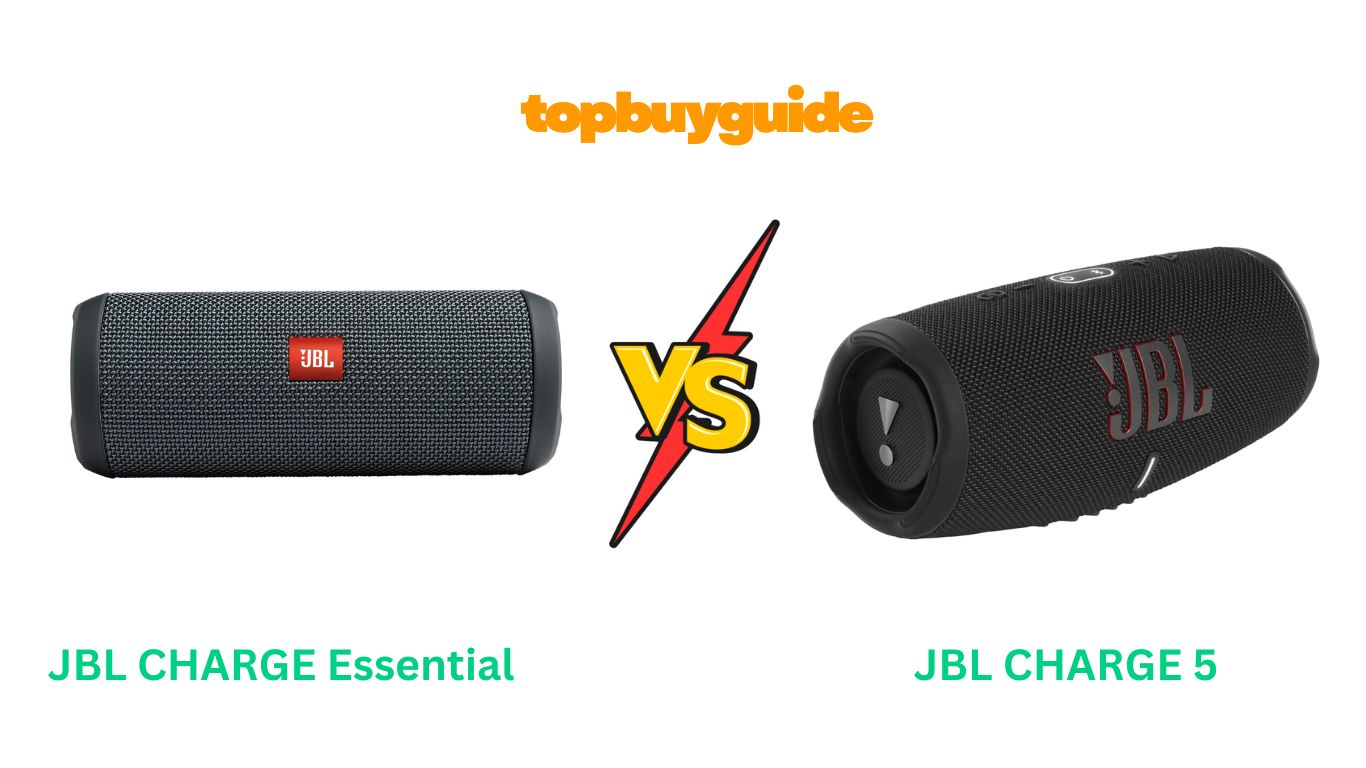
Deciding between the JBL Charge Essential and Charge 5 requires understanding their key performance differences. Both speakers deliver powerful sound, but they target different user needs and budgets. I recommend the JBL Charge 5 for most buyers seeking superior audio performance. The Charge 5 offers enhanced sound quality through its optimized driver system and advanced PartyBoost connectivity. These upgrades justify the price difference for anyone prioritizing premium portable audio experiences.
Why Do I Recommend The JBL Charge 5?
The JBL Charge 5 stands out as the superior choice for several compelling reasons:
- Advanced Driver Configuration: The Charge 5 features an optimized long excursion driver with a separate tweeter for crystal-clear highs. This sophisticated audio architecture delivers richer, more detailed sound across all frequencies. In contrast, the Charge Essential uses a simpler dual-driver setup without dedicated tweeter technology.
- Superior IP67 Protection Rating: The Charge 5 boasts IP67 certification, making it both waterproof and dustproof for extreme conditions. This comprehensive protection surpasses the Charge Essential’s IPX7 rating, which only covers water resistance. The dust protection makes the Charge 5 safer for beach trips and dusty outdoor environments.
- Enhanced Bluetooth 5.1 Technology: The Charge 5 utilizes Bluetooth 5.1 for more stable wireless connections and improved range. This newer protocol provides better audio quality and reduced latency compared to alternatives. Meanwhile, the Charge Essential operates on older Bluetooth 4.1, which offers less reliability and shorter range.
- PartyBoost Multi-Speaker Connectivity: The Charge 5 supports PartyBoost, allowing you to pair up to 100 compatible JBL speakers together. This feature creates massive sound systems perfect for large gatherings and parties. The Charge Essential lacks any speaker-pairing technology, limiting it to standalone operation only.
- Improved Audio Output Power: The Charge 5 delivers 30 watts RMS of powerful, room-filling sound output. This increased power produces louder volumes without distortion, even in outdoor settings. The Charge Essential provides 20 watts RMS (2 x 10W), which delivers less overall impact.
- Larger Battery Capacity: The Charge 5 packs a robust 7,500 mAh battery for extended playback sessions. This larger capacity supports the higher power output while maintaining 20-hour battery life. The Charge Essential uses a 6,000 mAh battery, which provides adequate but comparatively limited power reserves.
- Modern USB-C Charging Port: The Charge 5 features USB-C charging for faster recharge times and universal cable compatibility. This modern standard aligns with current smartphone and device charging infrastructure perfectly. The Charge Essential still uses micro-USB, which is becoming increasingly obsolete across electronic devices.
- Premium Build Quality and Design: The Charge 5 showcases refined aesthetics with sleek fabric covering and improved button placement. The larger JBL logo and LED battery indicator provide a more premium look. The Charge Essential maintains an earlier design language that appears less contemporary by comparison.
Side By Side Comparison Chart – JBL Charge Essential vs Charge 5
| Feature | JBL Charge Essential | JBL Charge 5 |
| Audio Output Power | 20W RMS (2 x 10W) | 30W RMS |
| Driver Configuration | Dual passive radiators | Long excursion driver + tweeter + dual radiators |
| Bluetooth Version | Bluetooth 4.1 | Bluetooth 5.1 |
| Waterproof Rating | IPX7 (waterproof only) | IP67 (waterproof + dustproof) |
| Dust Protection | No | Yes |
| Battery Capacity | 6,000 mAh | 7,500 mAh |
| Charging Port | Micro-USB | USB-C |
| Multi-Speaker Pairing | None | PartyBoost (up to 100 speakers) |
| Frequency Response | 60 Hz – 20 kHz | 65 Hz – 20 kHz |
| JBL App Support | No | Yes (JBL Portable app) |
| 3-Band EQ | No | Yes (via app) |
| Stereo Pairing | No | Yes (with another Charge 5) |
| Weight | 770g (1.7 lbs) | 960g (2.11 lbs) |
| Dimensions (W x D x H) | 213 x 87 x 89.7 mm | 223 x 94 x 96.5 mm |
| 3.5mm Aux Input | Yes | No |
| Multipoint Bluetooth | No | Yes |
| Exposed Bass Radiators | Yes | Yes (larger, visible) |
What Common Features Do JBL Charge Essential and Charge 5 Share?
Extended 20-Hour Battery Life
Both speakers deliver an impressive 20 hours of continuous playback on a single charge. This marathon battery life ensures uninterrupted music for full-day outdoor adventures and extended parties. The playtime varies based on volume levels and content type you’re playing. Both models maintain consistent performance even as battery levels drop during use. You can monitor remaining battery through LED indicators on each speaker’s control panel. This extended runtime eliminates frequent charging interruptions during your listening sessions.
Built-In Power Bank Functionality
Both the Charge Essential and Charge 5 function as portable power banks for your devices. Each speaker features a USB output port specifically designed for charging smartphones and tablets. This dual-purpose design proves invaluable during outdoor activities when power outlets aren’t accessible. The power bank function works independently, allowing device charging even without playing audio. You simply connect your device using a standard USB cable to the speaker’s output. This convenience feature ensures your phone stays charged during extended outdoor adventures.
IPX7 Waterproof Protection
Both speakers carry IPX7 waterproof certification, allowing submersion up to 1 meter for 30 minutes. This robust water resistance protects against pool splashes, sudden rainstorms, and beach wave exposure. You can confidently use either speaker near water without worrying about accidental damage. The waterproof sealing requires properly closing all port covers before any water exposure. Both models survive complete dunking in water, making them ideal for poolside entertainment. Remember that waterproof protection only works when all charging port covers are tightly sealed.
JBL Signature Sound Quality
Both speakers deliver JBL’s signature sound profile with powerful bass and clear audio reproduction. The proprietary audio tuning ensures balanced frequency response across lows, mids, and highs. JBL’s acoustic engineering creates room-filling sound that belies each speaker’s compact physical size. Both models handle various music genres effectively, from hip-hop to classical music. The signature sound profile emphasizes dynamic range and clarity at all volume levels. This consistent JBL audio character makes either speaker a reliable choice for music enthusiasts.
Dual Passive Bass Radiators
Both models incorporate dual passive radiators on the left and right sides for enhanced bass. These passive radiators move in response to the internal driver, creating deeper low-frequency response. The visible radiators provide visual feedback as they pulse with music’s bass notes. This passive radiator technology eliminates the need for larger, heavier active subwoofer components. Both speakers produce impressive bass depth despite their relatively compact cylindrical form factors. The dual-radiator design creates more impactful low-end than single-driver portable speakers typically achieve.
Durable Fabric Exterior
Both speakers feature rugged fabric material that resists wear from outdoor use and transportation. The fabric covering provides grip, preventing the speaker from slipping on smooth surfaces. This textile exterior also resists minor scratches and abrasions better than hard plastic housings. The fabric construction contributes to the speakers’ overall premium aesthetic and tactile appeal. Both models use similar fabric grades that balance durability with visual attractiveness. The material choice also helps protect the internal components from impact damage during travel.
Convenient Bluetooth Wireless Connectivity
Both speakers pair effortlessly with smartphones, tablets, laptops, and other Bluetooth-enabled devices. The wireless connection eliminates cable clutter, providing freedom of movement around your speaker. Pairing requires simple one-time setup, after which devices reconnect automatically when powered on. Both models maintain stable wireless connections within typical Bluetooth range limitations. You can control playback, volume, and track selection directly from your connected source device. The wireless design enhances portability by eliminating the need for physical audio cables.
USB Device Charging Output
Both speakers provide USB-A output ports for charging external devices during music playback. This feature transforms your speaker into a mobile power source for emergency device charging. The USB output delivers standard 5V power suitable for most smartphones and small tablets. You can continue playing music while simultaneously charging your connected device through the port. Both models protect the USB port with a waterproof rubber cover when not in use. This charging capability adds practical utility beyond the speaker’s primary audio function.
Common Features of JBL Charge Essential vs Charge 5
| Feature | JBL Charge Essential | JBL Charge 5 |
| Battery Life | Up to 20 hours | Up to 20 hours |
| Built-in Power Bank | ✓ Yes | ✓ Yes |
| USB Output for Charging | ✓ Yes (USB-A) | ✓ Yes (USB-A) |
| Waterproof (IPX7 minimum) | ✓ Yes (IPX7) | ✓ Yes (IP67) |
| Dual Passive Radiators | ✓ Yes | ✓ Yes |
| JBL Signature Sound | ✓ Yes | ✓ Yes |
| Rugged Fabric Exterior | ✓ Yes | ✓ Yes |
| Rubber Housing Protection | ✓ Yes | ✓ Yes |
| Bluetooth Wireless | ✓ Yes | ✓ Yes |
| Portable Cylindrical Design | ✓ Yes | ✓ Yes |
| LED Battery Indicators | ✓ Yes | ✓ Yes |
| Physical Control Buttons | ✓ Yes | ✓ Yes |
| Frequency Response Range | 60 Hz – 20 kHz | 65 Hz – 20 kHz |
| Wireless Streaming | ✓ Yes | ✓ Yes |
| Pair with 2 Devices | ✓ Yes | ✓ Yes |
| Rechargeable Battery | ✓ Yes (LiPo 6000mAh) | ✓ Yes (LiPo 7500mAh) |
A Detailed Comparison Of the JBL Charge Essential vs Charge 5
Audio Driver Technology and Configuration
The Charge 5 features an advanced audio system with an optimized long-excursion driver and separate tweeter. This configuration ensures crystal-clear high-frequency reproduction alongside powerful mid-range and bass response. The dedicated tweeter handles delicate audio details that single-driver systems often miss at high volumes. Together with dual passive radiators, this creates impressively balanced audio across all frequency ranges.
The Charge Essential uses a simpler dual 10-watt driver system without a dedicated tweeter component. While this configuration still delivers solid JBL signature sound, it lacks the refinement of separated drivers. High-frequency detail suffers slightly compared to the Charge 5’s specialized tweeter. The Essential remains capable for casual listening but doesn’t match the Charge 5’s audio clarity.
Waterproof and Dustproof Protection Ratings
The Charge 5 achieves IP67 certification, providing complete protection against both water immersion and dust ingress. This comprehensive sealing allows use in sandy beach environments, dusty campsites, and wet pool areas. The dust protection prevents particle buildup inside the speaker that could damage internal components over time. IP67 certification represents the highest practical protection level for portable consumer audio devices.
The Charge Essential carries IPX7 waterproof certification but lacks any dust protection rating. Water resistance allows full submersion up to 1 meter depth for 30 minutes safely. However, sand, dirt, and dust can potentially enter the speaker through various openings. This limitation makes the Essential less suitable for particularly dusty outdoor environments than the Charge 5.
Bluetooth Connectivity and Version Differences
The Charge 5 utilizes Bluetooth 5.1 technology for enhanced wireless performance and stability. This newer protocol provides improved range, allowing greater distance between speaker and source device. Bluetooth 5.1 also reduces audio latency, creating better synchronization for video watching. The technology supports multipoint connectivity, letting two devices stay connected simultaneously for easy switching.
The Charge Essential operates on older Bluetooth 4.1, which still provides reliable basic connectivity. However, the older protocol offers shorter wireless range and potentially less stable connections. Audio quality may suffer more from interference or distance compared to Bluetooth 5.1. The Essential also lacks multipoint support, requiring manual disconnection and reconnection when switching between devices.
Multi-Speaker Pairing Capabilities
The Charge 5 supports PartyBoost technology, enabling connection with up to 100 compatible JBL speakers. Two Charge 5 speakers can pair in stereo mode for true left-right channel separation. Alternatively, multiple speakers can play in mono mode for massive volume across large spaces. The PartyBoost feature works with other compatible JBL models like Flip 5 and Pulse 4.
The Charge Essential completely lacks any multi-speaker pairing or connectivity features. It operates exclusively as a standalone mono speaker without connection capabilities. You cannot link two Charge Essential units together for stereo sound or increased volume. This limitation restricts the Essential to smaller listening environments where single-speaker output suffices.
Mobile App Support and EQ Customization
The Charge 5 integrates with the JBL Portable app for advanced control and customization. The app provides a 3-band equalizer for adjusting bass, mid, and treble frequencies personally. You can manage firmware updates directly through the app to ensure latest features. The app also facilitates PartyBoost pairing and lets you name your speaker for identification.
The Charge Essential offers no mobile app support or integration whatsoever. All controls operate exclusively through physical buttons on the speaker’s top panel. You cannot adjust EQ settings, update firmware, or access any advanced features digitally. This basic approach works fine for users who prefer simplicity over customization options.
Battery Capacity and Power Management
The Charge 5 incorporates a substantial 7,500 mAh lithium polymer battery for robust power reserves. This larger capacity supports the higher 30-watt audio output while maintaining 20-hour playback. The battery efficiently manages power distribution between speaker operation and device charging functions. USB-C charging allows faster recharge times compared to older micro-USB standards significantly.
The Charge Essential uses a 6,000 mAh battery that adequately powers its 20-watt system. The smaller capacity reflects the lower power requirements of the Essential’s simpler driver configuration. Micro-USB charging takes longer than USB-C and requires older cable types increasingly rare today. The 6,000 mAh capacity still delivers the advertised 20-hour playback at moderate volumes.
Physical Port Configuration
The Charge 5 features modern USB-C for speaker charging and USB-A for device charging output. The USB-C port accepts any standard USB-C cable, matching current smartphone charging infrastructure. However, JBL removed the 3.5mm auxiliary input found on previous Charge models entirely. This omission forces exclusive Bluetooth connectivity, potentially frustrating users with older non-Bluetooth devices.
The Charge Essential includes both micro-USB charging input and a 3.5mm auxiliary input port. The aux jack allows wired connection to devices lacking Bluetooth capability or for situations requiring wired audio. However, micro-USB charging represents outdated technology that many users no longer carry cables for. The inclusion of aux input provides flexibility that the Charge 5 surprisingly lacks completely.
Conclusion
The JBL Charge 5 emerges as the clear winner for users seeking premium portable audio quality. The superior IP67 dust and water protection ensures reliable performance in any outdoor environment. Advanced Bluetooth 5.1 connectivity provides stable wireless performance with extended range beyond the Essential. PartyBoost multi-speaker pairing unlocks massive sound potential for parties and large gatherings impressively. The dedicated tweeter and optimized driver create noticeably richer, more detailed audio reproduction. While the Charge Essential offers solid basic performance at lower cost, the Charge 5’s comprehensive feature upgrades justify its premium positioning for serious music enthusiasts.
Frequently Asked Questions
Q: Can I pair JBL Charge Essential with Charge 5 speakers together?
No, the Charge Essential and Charge 5 use incompatible connection technologies. The Charge Essential lacks any multi-speaker pairing capability entirely. The Charge 5 uses PartyBoost technology that only works with other PartyBoost-compatible JBL speakers. You cannot create a stereo pair or linked system mixing these two models.
Q: Which speaker has better sound quality overall?
The JBL Charge 5 delivers noticeably superior sound quality through its advanced driver configuration. The dedicated tweeter provides clearer high-frequency reproduction than the Charge Essential’s simpler system. The Charge 5’s 30-watt output also produces louder, more impactful sound than the Essential’s 20 watts. Most listeners will immediately notice the Charge 5’s improved audio clarity and depth.
Q: Is the Charge 5 worth the extra cost over Charge Essential?
Yes, for most users the Charge 5’s improvements justify its higher price tag significantly. The IP67 dust protection, Bluetooth 5.1, PartyBoost connectivity, and superior audio quality provide substantial value. However, budget-conscious buyers who only need basic portable audio may find the Essential sufficient. Consider your specific needs for features like multi-speaker pairing before deciding between models.
Q: Can both speakers survive being dropped in a pool?
Yes, both speakers feature waterproof protection allowing full submersion in pools or lakes safely. The Charge Essential’s IPX7 and Charge 5’s IP67 ratings both cover underwater immersion protection. Always ensure all port covers are tightly sealed before any water exposure occurs. Both speakers can float briefly but may eventually sink, so retrieve them quickly from water.
Q: Does the Charge 5 have an auxiliary input jack?
No, the JBL Charge 5 removed the 3.5mm auxiliary input found on previous Charge models. The Charge 5 operates exclusively via Bluetooth wireless connectivity for all audio sources. Conversely, the Charge Essential retains the aux input for wired device connections. This represents one area where the older Essential model offers more connection flexibility.
Q: How long does it take to fully charge each speaker?
The Charge 5 requires approximately 4 hours for complete charging via its USB-C port. The Charge Essential also takes about 4 hours using its micro-USB charging connection. Both speakers support pass-through charging, allowing music playback while connected to power simultaneously. Fast charging provides about 1 hour of playback from just 15 minutes of charging.
Q: Can I use these speakers while they’re charging devices?
Yes, both speakers support simultaneous audio playback and device charging through their USB-A outputs. The power bank function operates independently from the speaker’s audio capabilities completely. However, charging devices will reduce overall battery life and may require more frequent speaker recharging. The speakers prioritize their own operation, so audio performance doesn’t suffer during device charging.
Q: Which speaker is better for beach use?
The JBL Charge 5 is significantly better for beach environments due to its IP67 dust protection. The dustproof rating prevents sand from entering and potentially damaging internal speaker components. The Charge Essential’s IPX7 rating only protects against water, leaving it vulnerable to sand infiltration. For regular beach use, the Charge 5’s comprehensive protection makes it the clearly superior choice.

Alex Turner is a dedicated product researcher and reviewer at TopBuyGuide.com, known for his clear, honest, and data-driven insights. He spends countless hours testing, comparing, and analyzing products to help readers make confident and informed buying decisions.