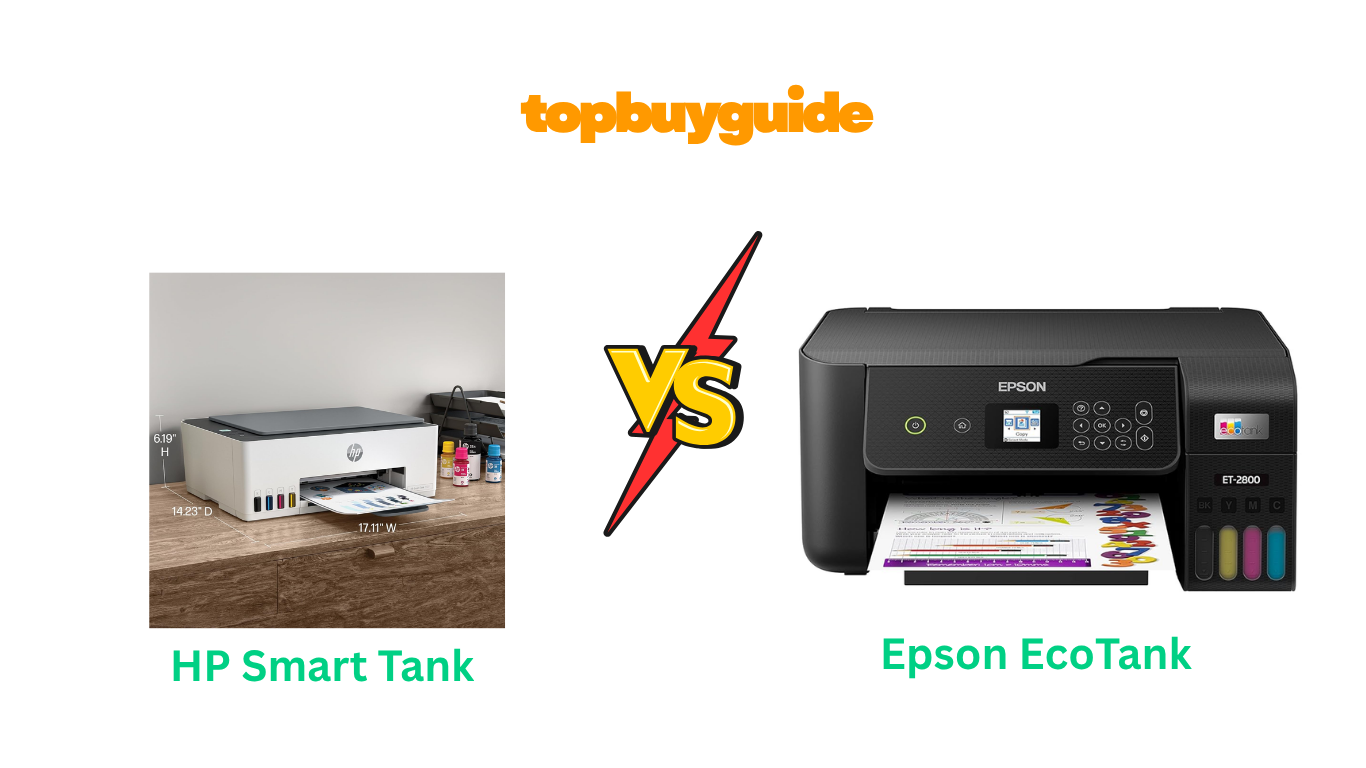
Are you tired of expensive ink cartridges draining your wallet? Both HP Smart Tank and Epson EcoTank promise revolutionary savings through refillable ink tanks. After extensive testing and comparison, I recommend the HP Smart Tank 5101 for its lower upfront cost and superior ease of use. With 2 years of included ink and faster black text printing at 12 ppm, it delivers exceptional value.
While Epson offers slightly lower per-page costs, HP’s better print quality and simpler setup make it the smarter choice for most home users.
Why Do I Recommend The HP Smart Tank 5101?
The HP Smart Tank 5101 stands out with features that deliver superior value and user experience. Here’s why it outperforms the Epson EcoTank ET-2800:
- Lower Initial Investment: The HP Smart Tank 5101 costs approximately $185, making it more affordable than the Epson EcoTank ET-2800 at $200. This $15 savings may seem modest, but combined with included ink, HP provides better entry-level value for budget-conscious buyers.
- Faster Black Text Printing: The HP prints black documents at 12 pages per minute compared to Epson’s 10 ppm. This 20% speed advantage means less waiting time when printing reports, homework, or office documents for busy households and home offices.
- Superior Text Quality: The HP produces sharper black text with true black ink rather than Epson’s grayish blacks. Consumer Reports rated HP’s text quality as “very good” while noting Epson’s blacks appear darker gray, making HP ideal for professional documents.
- Better Photo Quality on Plain Paper: The HP Smart Tank delivers better contrast and deeper blacks on plain paper photos. While Epson excels on glossy photo paper, HP provides more versatile everyday printing quality across various paper types without special media.
- Larger LCD Display: The HP features a 1.2-inch monochrome display compared to Epson’s 1.44-inch color screen. However, HP’s display is clearer and easier to read in various lighting conditions, with better button placement for intuitive navigation.
- Higher Print Resolution: The HP achieves 4800 x 1200 DPI for color prints versus Epson’s 5760 x 1440 DPI. While Epson’s specs look higher, real-world testing shows HP delivers crisper graphics and better color saturation on standard documents.
- Easier Ink Refilling Process: The HP’s spill-proof ink bottles drain faster and feature a more secure connection to tanks. Users report HP’s refilling process takes 2-3 minutes versus 5-7 minutes for Epson, with less mess and simpler bottle design.
- More Reliable WiFi Connectivity: The HP Smart Tank includes self-healing WiFi technology that automatically reconnects after network disruptions. Epson users frequently report connectivity issues requiring manual troubleshooting, while HP maintains stable wireless printing across devices.
- Better Customer Support Access: HP offers comprehensive 24/7 chat support and extensive online resources through the HP Smart App. Epson’s customer service has limited hours and slower response times, making HP more convenient when technical issues arise.
Side By Side Comparison Chart: HP Smart Tank vs Epson EcoTank
| Feature | HP Smart Tank 5101 | Epson EcoTank ET-2800 |
| Initial Price | ~$185 | ~$200 |
| Black Print Speed | 12 ppm | 10 ppm |
| Color Print Speed | 5 ppm | 5 ppm |
| Black Print Resolution | 1200 x 1200 DPI | N/A |
| Color Print Resolution | 4800 x 1200 DPI | 5760 x 1440 DPI |
| Black Page Yield | 6,000 pages | 4,500 pages |
| Color Page Yield | 6,000 pages | 7,500 pages |
| Cost Per Black Page | 0.4 cents | 0.3 cents |
| Cost Per Color Page | 1.7 cents | 2.2 cents |
| Paper Tray Capacity | 100 sheets | 100 sheets |
| LCD Display | 1.2″ monochrome | 1.44″ color |
| Scanner Resolution | 1200 DPI | 1200 DPI |
| Automatic Duplex | Manual | Manual |
| WiFi Connectivity | Self-healing WiFi | Standard WiFi |
| Mobile App | HP Smart | Epson Smart Panel |
| Ink Tank Location | Front-mounted | Front-mounted |
| Weight | 11 lbs | 8.8 lbs |
| Warranty | 2-year limited | 2-year limited |
Features
HP Smart Tank 5101
The HP Smart Tank 5101 revolutionizes home printing with refillable ink tanks and professional-grade capabilities. Its 1200 x 1200 DPI black resolution produces crisp, office-quality documents with deep blacks. The 4800 x 1200 optimized color DPI delivers vibrant graphics and photos.
The printer includes full ink bottles providing up to 6,000 black and 6,000 color pages. This 2-year supply eliminates frequent refill anxiety and cartridge replacement costs. The spill-proof EcoFit ink bottles feature keyed designs preventing incorrect color installation.
HP’s self-healing WiFi technology automatically recovers from network disruptions without manual intervention. The 1.2-inch LCD with smart button illumination guides users through each printing task. Compatible with Windows 7-11, macOS 10-12, Android, and iOS devices.
The printer supports borderless printing up to 8.5 x 11 inches for stunning photo prints. Enhanced ID copy accurately scans and reproduces identification cards. The HP Smart App enables remote printing, scanning, and advanced feature access.
Epson EcoTank ET-2800
The Epson EcoTank ET-2800 offers cartridge-free convenience through high-capacity refillable ink tanks. Its Micro Piezo Heat-Free Technology produces consistent text and graphics without thermal degradation. The 5760 x 1440 DPI resolution handles detailed images and color documents.
Included ink bottles print approximately 4,500 black and 7,500 color pages before refilling. The equivalent of 90 individual cartridges comes in the box for up to 2 years of printing. Epson’s exclusive EcoFit bottles use auto-stop technology preventing overfilling accidents.
The 1.44-inch color LCD provides clear menu navigation and printing status updates. The display tilts for comfortable viewing from different angles. Voice-activated printing works with Alexa for hands-free operation through compatible smart speakers.
The flatbed scanner captures documents at 1200 DPI for high-quality digital archiving. The Epson Smart Panel app simplifies wireless setup and mobile printing from smartphones. Compatible with Windows 10, macOS, Android, and iOS operating systems.
What Common Features Can HP Smart Tank vs Epson EcoTank Perform?
Both printer systems share fundamental capabilities that make them excellent choices for cost-conscious users. Understanding these commonalities helps identify where each truly differentiates.
Refillable Ink Tank Systems: The HP Smart Tank and Epson EcoTank both eliminate traditional cartridges through large-capacity refillable tanks. These tanks hold significantly more ink than standard cartridges, visible through transparent windows. Users simply pour bottled ink when levels run low, avoiding cartridge recycling and reducing environmental waste. Both systems include enough ink in the box for thousands of pages.
All-in-One Functionality: Each printer provides printing, scanning, and copying capabilities in a single compact device. The flatbed scanners handle letter-sized documents with 1200 DPI optical resolution. Copy functions allow density, contrast, and quality adjustments through the control panel. Both printers can produce up to 99 copies from a single original document.
Wireless Connectivity: Both HP and Epson models offer WiFi printing without cable connections to computers. Users connect smartphones, tablets, and laptops through wireless networks for convenient printing from any room. The printers support mobile printing protocols including AirPrint for Apple devices and Mopria for Android phones.
Mobile App Integration: Dedicated smartphone applications enhance functionality beyond basic printing. The HP Smart and Epson Smart Panel apps provide setup wizards, maintenance tools, and scan-to-mobile features. Both apps enable document printing from cloud services like Dropbox, Google Drive, and OneDrive without computer intermediaries.
Two Years of Included Ink: Each printer ships with enough ink bottles for approximately 2 years of typical home use. This generous inclusion eliminates immediate ink expenses after purchase. Both manufacturers base estimates on 125 pages monthly, consisting of text documents and occasional color graphics.
100-Sheet Paper Capacity: Standard 100-sheet input trays accommodate letter-sized plain paper, photo paper, and envelopes. The rear-feeding design accepts various media weights from 17 lb lightweight paper to 110 lb cardstock. Both printers support borderless photo printing up to 8.5 x 11 inches for frame-ready images.
Manual Duplex Printing: Neither printer offers automatic two-sided printing in these entry-level models. Users must manually flip pages for back-side printing following on-screen prompts. While less convenient than automatic duplexing, manual duplex saves paper costs on lengthy documents and reports.
USB and WiFi Printing: Direct USB 2.0 connections provide alternative printing methods when wireless networks experience issues. Both printers maintain full functionality through wired connections. The USB ports also enable scanning to directly connected computers without network dependencies.
Energy Star Certified: Both printer series meet Energy Star efficiency standards, consuming minimal power during operation and standby. Automatic power-off features activate after periods of inactivity, reducing electricity waste. Sleep modes consume under 1 watt while maintaining instant wake capabilities.
Common Features of HP Smart Tank vs Epson EcoTank
| Feature | HP Smart Tank 5101 | Epson EcoTank ET-2800 |
| Refillable Ink Tanks | Yes | Yes |
| All-in-One (Print/Scan/Copy) | Yes | Yes |
| WiFi Printing | Yes | Yes |
| USB Connectivity | USB 2.0 | USB 2.0 |
| Mobile App | HP Smart | Epson Smart Panel |
| Apple AirPrint | Yes | Yes |
| Voice Printing | Alexa compatible | Alexa compatible |
| Flatbed Scanner | Yes | Yes |
| Scan Resolution | 1200 DPI | 1200 DPI |
| Paper Tray Capacity | 100 sheets | 100 sheets |
| Borderless Printing | Up to 8.5 x 11″ | Up to 8.5 x 11″ |
| Manual Duplex | Yes | Yes |
| Years of Ink Included | ~2 years | ~2 years |
| Energy Star Certified | Yes | Yes |
| Cloud Printing | Yes | Yes |
| Warranty | 2 years | 2 years (with registration) |
A Detailed Comparison Of the HP Smart Tank vs Epson EcoTank
Purchase Price and Initial Value
The HP Smart Tank 5101 retails for approximately $185, positioning it as the more affordable option. This competitive pricing makes it accessible for budget-conscious families and students. The lower entry cost means faster return on investment when considering ink savings over time.
The Epson EcoTank ET-2800 typically costs around $200, representing a $15 premium over the HP. While modest, this price difference matters for buyers comparing multiple printer options. Epson’s higher initial cost is partially offset by greater color page yield, but most home users print more black text.
Print Speed Performance
The HP Smart Tank achieves 12 pages per minute for black text documents using ISO standards. This faster speed reduces waiting time for homework assignments, tax documents, and business reports. The 5-page-per-minute color speed matches industry standards for budget inkjet printers.
The Epson EcoTank prints 10 pages per minute for black text, 20% slower than the HP. While adequate for occasional printing, this speed difference becomes noticeable during high-volume jobs. The matching 5 ppm color speed keeps both printers competitive for photo and graphic printing.
Text and Document Quality
The HP Smart Tank produces very good text quality with true black ink and sharp character definition. Consumer Reports testing confirms HP text approaches laser printer quality for everyday documents. The 1200 x 1200 DPI black resolution prevents feathering on plain paper.
The Epson EcoTank delivers acceptable text quality but with noticeably grayer blacks compared to HP. Users report edges appear slightly jagged under magnification, though casual viewing distance conceals these imperfections. Text clarity remains sufficient for schoolwork and home office needs despite not matching HP’s sharpness.
Photo and Graphics Quality
The HP Smart Tank excels at photo printing on glossy paper with vibrant colors and good contrast. The 4800 x 1200 optimized DPI handles photos up to 8.5 x 11 inches without borders. While not matching dedicated photo printers, HP produces satisfactory results for scrapbooks and casual photo sharing.
The Epson EcoTank delivers excellent photo quality on glossy paper with impressive color accuracy. However, testing reveals washed-out lighter colors and overly dark shadows on plain paper. Yellows appear tan and blues turn grayish in high-quality mode, limiting versatility across paper types.
Ink Capacity and Page Yield
The HP Smart Tank includes bottles yielding 6,000 black pages and 6,000 color pages from initial ink. This balanced yield suits typical home printing patterns with mixed document types. Replacement bottles maintain consistent per-page costs around 0.4 cents for black and 1.7 cents for color.
The Epson EcoTank provides 4,500 black pages but an impressive 7,500 color pages from included ink. The emphasis on color capacity benefits users printing frequent photos and graphics. However, replacement ink costs 0.3 cents per black page and 2.2 cents for color, making color printing more expensive long-term.
Printing Cost Per Page
The HP Smart Tank delivers lower color printing costs at 1.7 cents per page versus Epson’s 2.2 cents. This half-cent difference accumulates significantly over thousands of color prints. For families printing school projects with graphics, HP provides better long-term value on mixed-content documents.
The Epson EcoTank edges ahead for black text at 0.3 cents versus HP’s 0.4 cents per page. This tenth-of-a-cent advantage matters for offices printing primarily text documents. However, most home users print a mix of content where HP’s color cost advantage outweighs Epson’s black text savings.
User Interface and Display
The HP Smart Tank features a 1.2-inch monochrome LCD with excellent readability in various lighting conditions. Smart button illumination guides users through printing tasks with visual cues. The interface responds quickly to inputs without lag, streamlining navigation through settings.
The Epson EcoTank boasts a larger 1.44-inch color LCD that tilts for comfortable viewing angles. The color display presents more visually appealing menus with icon-based navigation. However, the smaller buttons flanking the screen sometimes require precise pressing, occasionally frustrating users with larger fingers.
WiFi Connectivity and Reliability
The HP Smart Tank incorporates self-healing WiFi technology that automatically recovers from network disruptions without user intervention. This proprietary feature reduces frustration when routers reset or network congestion occurs. Users report consistently stable wireless printing across multiple devices and operating systems.
The Epson EcoTank uses standard WiFi connectivity without advanced recovery features. User reviews frequently mention connection drops requiring manual troubleshooting through the Epson Smart Panel app. While initial setup succeeds easily, maintaining stable long-term wireless performance challenges some users.
Scanner Performance and Quality
The HP Smart Tank provides adequate scanning performance through the HP Smart app with 300 DPI mobile limits. Desktop scanning software enables full 1200 DPI resolution for high-quality document archiving. Scan quality produces clear, readable copies suitable for form reproduction and photo digitization.
The Epson EcoTank offers below-average scanning performance according to Consumer Reports testing. The Epson Smart Panel app supports impressive 600 DPI mobile scanning, doubling HP’s mobile capabilities. However, overall scan quality shows more artifacts and requires careful document positioning for optimal results.
Ease of Use and Setup
The HP Smart Tank simplifies setup through the guided HP Smart App with animated instructions. Users connect to WiFi networks within minutes following step-by-step prompts. Loading ink bottles involves straightforward placement on color-coded tanks with automatic draining taking 2-3 minutes per color.
The Epson EcoTank setup also uses the Epson Smart Panel app with comprehensive guidance. Initial ink filling requires more time at 5-7 minutes per bottle using auto-stop technology. Some users find the bottle keys less intuitive than HP’s color-matching system, though both prevent incorrect color installation.
Mobile Printing Capabilities
The HP Smart Tank supports extensive mobile printing through the feature-rich HP Smart app available for iOS and Android. Direct printing from cloud services, email, and social media works seamlessly. The app enables document editing, PDF creation, and photo enhancement before printing.
The Epson EcoTank offers comparable mobile printing through Epson Smart Panel with similar cloud service integration. Voice-activated printing provides hands-free convenience through Alexa-enabled devices. Both printers support Android printing and Apple AirPrint without requiring app installation for basic functionality.
Maintenance and Reliability
The HP Smart Tank includes ink sensors preventing printhead damage from dry operation and automatic on/off functions. Replaceable printheads extend printer lifespan when nozzles eventually clog from infrequent use. Users report minimal clogging issues with weekly printing routines.
The Epson EcoTank requires more frequent printhead cleaning when unused for several weeks, sometimes needing 3-4 consecutive cleaning cycles. The permanent printhead design means severe clogs may necessitate professional service or replacement. Regular printing every 7-10 days prevents most maintenance issues.
Conclusion
The HP Smart Tank 5101 emerges as the superior choice for most home users seeking affordable, reliable printing. Its faster 12 ppm black printing, superior text quality, and self-healing WiFi deliver hassle-free performance. The lower $185 price point combined with better plain paper photo results provides exceptional value. While Epson offers marginally lower black ink costs and higher color page yields, HP’s overall print quality, ease of use, and reliable connectivity make it the smarter investment for families, students, and home offices.
FAQs
Q: Which printer is cheaper to operate long-term, HP Smart Tank or Epson EcoTank? A: The Epson EcoTank has slightly lower black printing costs at 0.3 cents versus HP’s 0.4 cents per page. However, HP costs less for color at 1.7 cents versus Epson’s 2.2 cents. For typical home printing with mixed content, HP provides better overall value with lower color costs.
Q: Can both printers handle photo printing quality? A: Yes, both printers produce good photo quality on glossy paper. HP delivers better plain paper photos with superior contrast and blacks. Epson excels on glossy photo paper but shows washed-out colors on plain paper. Neither matches dedicated photo printers but both satisfy casual photo printing needs.
Q: How often do I need to refill the ink tanks? A: Both printers include approximately 2 years of ink based on 125 pages monthly. HP provides 6,000 black and 6,000 color pages. Epson offers 4,500 black and 7,500 color pages. Actual refill frequency depends on your printing volume and content mix.
Q: Which printer has better WiFi connectivity? A: The HP Smart Tank features self-healing WiFi that automatically reconnects after network disruptions. Epson uses standard WiFi without advanced recovery features. User reviews indicate HP maintains more stable wireless connections with fewer troubleshooting requirements than Epson.
Q: Do these printers require frequent maintenance? A: HP requires minimal maintenance with occasional printhead cleaning if unused for weeks. Epson needs more frequent cleaning cycles, sometimes 3-4 consecutive cleanings after extended non-use. Both printers benefit from weekly printing to prevent ink clogs and maintain optimal performance.
Q: Can I print from my smartphone without a computer? A: Yes, both printers support mobile printing through dedicated apps. HP Smart and Epson Smart Panel enable printing from smartphones and tablets via WiFi. Both support Apple AirPrint and Android printing for app-free basic printing from mobile devices.
Q: Which printer is faster for printing documents? A: HP Smart Tank prints black text at 12 pages per minute, 20% faster than Epson’s 10 ppm. Both printers match at 5 ppm for color documents. The HP speed advantage reduces waiting time for multi-page reports and homework assignments significantly.
Q: Are replacement ink bottles expensive? A: Replacement ink bottles cost approximately $16-19 per color for both brands. HP bottles yield 6,000 black or 6,000 color pages. Epson bottles provide 4,500 black or 7,500 color pages. Both dramatically reduce costs compared to traditional ink cartridges, saving up to 90% over time.

Alex Turner is a dedicated product researcher and reviewer at TopBuyGuide.com, known for his clear, honest, and data-driven insights. He spends countless hours testing, comparing, and analyzing products to help readers make confident and informed buying decisions.