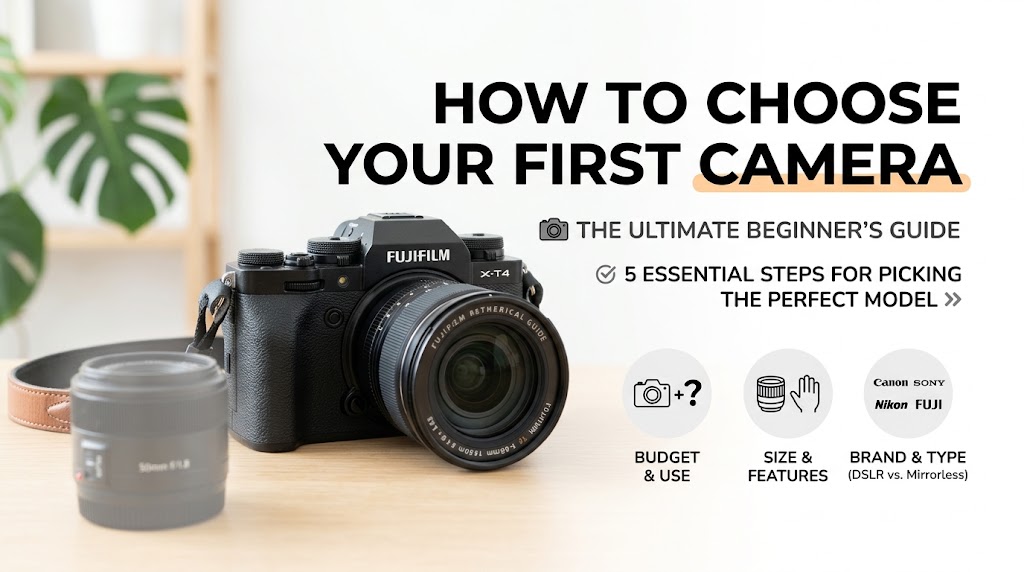
Stepping into the world of photography is thrilling, but buying your first real camera can quickly feel overwhelming. Walk into any camera store or scroll through online retailers, and you are immediately bombarded with a confusing maze of technical jargon: full-frame vs. APS-C, megapixel counts, autofocus tracking points, EVFs, optical stabilization, and IBIS.
Add to that the fact that modern smartphones are already remarkably capable pocket cameras, and a logical question arises: Why invest hundreds or thousands of dollars in a dedicated camera in 2026?
The short answer is control, creative freedom, and image quality that no computational smartphone software can truly replicate. A dedicated camera gives you hardware optical depth, interchangeable lenses, superior low-light performance, and the physical ergonomics that transform simple snapshot-taking into intentional art.
Whether your goal is to shoot striking portraits, capture breath-taking travel landscapes, film high-quality cinematic vlogs, or document your family’s milestone moments, this guide will walk you through every critical step of choosing your very first camera—without falling into expensive marketing traps.
Key Takeaway
The best first camera is not the most expensive one on the market. It is the camera that fits your specific photography goals, feels comfortable in your hands, and fits comfortably within your budget—allowing room for lenses and essential accessories.
Step 1: Define Your Primary Shooting Intent
Before looking at spec sheets or price tags, you must clarify what and how you plan to shoot. Cameras are tools, and different tools are optimized for different tasks. There is no single “best camera,” but there is a best camera for your specific needs.
                    +--------------------------------+
                    | What is your primary goal?    |
                    +---------------+----------------+
                                    |
        +---------------------------+---------------------------+
        |                           |                           |
        v                           v                           v
  [ Still Photos ]          [ Video & Vlogging ]       [ Hybrid / Both ]
  - High Megapixels         - Articulating Screen      - Fast Autofocus
  - EVF / Viewfinder        - 4K/60p, 10-bit color     - Balanced Sensor
  - Ergonomic Grip          - Microphone Jack          - Good Battery Life
1. Still Photography Focus
If your primary passion is capturing frozen moments—such as portraits, street photography, landscapes, or sports—your main priorities will be handling, sensor quality, autofocus speed, and access to a wide ecosystem of sharp lenses.
2. Video and Content Creation Focus
If you are buying a camera primarily for YouTube videos, TikToks, filmmaking, or vlogging, your feature priorities shift dramatically. You will want an articulating (flip-out) screen, excellent continuous video autofocus, strong internal audio capabilities (or external mic input), high frame rates (4K at 60fps), and effective image stabilization.
3. Hybrid Usage (The All-Rounder)
Most modern creators fall into this category. You want a capable tool that takes stunning 24–33 megapixel stills on the weekend and shoots clean, stabilized 4K video when needed.
Pro Tip: Reserving 30% to 40% of your total initial budget for lenses and accessories is far wiser than spending 100% of your budget on a top-tier camera body paired with a low-quality kit lens.
Step 2: Understand Camera Types (DSLR vs. Mirrorless vs. Compact)
The camera market today is divided into three primary form factors. Understanding the fundamental differences between them will immediately narrow down your options.
+------------------+----------------------------------+----------------------------------+
| Camera Type      | Key Advantages                   | Trade-Offs / Disadvantages       |
+------------------+----------------------------------+----------------------------------+
| Mirrorless       | • Electronic Viewfinder (WYSIWYG)| • Shorter battery life           |
|                  | • Fast AI Autofocus              | • Can be more expensive          |
|                  | • Compact & lighter design       |                                  |
+------------------+----------------------------------+----------------------------------+
| DSLR             | • Long battery life              | • Older/legacy technology        |
|                  | • Highly durable ergonomics      | • Bulkier and heavier            |
|                  | • Huge cheap lens market         | • Slower video autofocus         |
+------------------+----------------------------------+----------------------------------+
| Compact / Fixed  | • Ultra-portable (pocket-able)   | • Non-interchangeable lens       |
| Lens             | • All-in-one convenience         | • Harder to upgrade later        |
+------------------+----------------------------------+----------------------------------+
1. Mirrorless Cameras (The Modern Standard)
Mirrorless cameras have officially superseded DSLRs as the industry standard. By removing the traditional internal mirror box found in older cameras, mirrorless bodies are lighter, smaller, and vastly superior in video performance and autofocus precision.
-
Electronic Viewfinder (EVF): What you see inside the viewfinder is exactly what your final exposure and color will look like (What You See Is What You Get).
-
AI Autofocus: Modern mirrorless systems feature eye-tracking for humans, animals, and vehicles.
-
Verdict: The recommended choice for 95% of new buyers today.
2. DSLR Cameras (The Value Legacy)
DSLRs (Digital Single-Lens Reflex) use a physical mechanical mirror to reflect light into an optical viewfinder. While major manufacturers have shifted focus away from developing new DSLR models, buying a used or clearout DSLR can be a cost-effective entryway into dedicated photography.
-
Pros: Phenomenal battery life (1,000+ shots per charge), rugged build, and cheap secondhand lens availability.
-
Cons: Bulky, heavier, poorer live-view performance, and limited modern video features.
3. Compact / Fixed-Lens Cameras (Point-and-Shoot)
These cameras feature a built-in lens that cannot be removed or swapped. They range from basic pocket cameras to premium enthusiast compacts featuring large 1-inch or APS-C sensors (such as the Fujifilm X100 series or Sony RX100 series).
-
Pros: Extremely portable, unobtrusive, great for everyday carry and travel.
-
Cons: You cannot upgrade your focal length or optical character by changing lenses in the future.
Step 3: Decode Sensor Sizes (Micro Four Thirds vs. APS-C vs. Full-Frame)
The camera sensor is the digital equivalent of film—it captures light to form your image. Sensor size directly impacts light gathering, background blur (bokeh), dynamic range, and overall camera body size.
+--------------------------------------------------------+
|                      FULL FRAME                        |
|                     (36 x 24 mm)                       |
|  +--------------------------------------------------+  |
|  |                      APS-C                       |  |
|  |                   (23.5 x 15.6 mm)               |  |
|  |  +--------------------------------------------+  |  |
|  |  |            MICRO FOUR THIRDS               |  |  |
|  |  |             (17.3 x 13 mm)                 |  |  |
|  |  +--------------------------------------------+  |  |
|  +--------------------------------------------------+  |
+--------------------------------------------------------+
Micro Four Thirds (MFT)
-
Crop Factor: 2.0x
-
Best For: Wildlife, telephoto reach, travel, extreme portability, budget video.
-
Overview: Smaller sensor size allows for remarkably compact camera bodies and lightweight lenses. Systems like OM System (Olympus) and Panasonic Lumix excel here.
APS-C (Crop Sensor)
-
Crop Factor: 1.5x (1.6x for Canon)
-
Best For: The ideal sweet spot for beginners—balancing cost, size, and high-end image performance.
-
Overview: APS-C sensors provide incredible image quality, strong low-light capability, and access to lighter, affordable lenses while remaining significantly less expensive than full-frame setups. Examples include the Sony A6000 series, Fujifilm X-series, and Canon EOS R crop-sensor line.
Full-Frame (35mm Equivalent)
-
Crop Factor: 1.0x (Standard reference)
-
Best For: Professional portraits, low-light events, commercial photography, maximum dynamic range.
-
Overview: The professional standard. Full-frame sensors offer superior low-light sensitivity and creamier background separation (shallow depth of field), but the camera bodies and matching lenses are larger, heavier, and substantially more expensive.
Real-World Scenario: Choosing a Sensor for Travel vs. Low Light
Scenario A (The Backpacker): Alex wants a camera for multi-day hikes. Weight is paramount. An APS-C or Micro Four Thirds setup offers a complete kit (body + 3 lenses) weighing under 1.5 kg (3.3 lbs).
Scenario B (The Event Photographer): Sam shoots indoor music concerts in dimly lit venues. A Full-Frame camera combined with a fast lens ($f/1.8$) gathers significantly more light, reducing digital noise in high-ISO conditions.
Step 4: Critical Features to Prioritize (And Which to Ignore)
When comparing spec sheets, it is easy to get distracted by flashy numbers that matter very little for day-to-day shooting. Here is what actually matters when you are starting out:
    MUST-HAVE FEATURES                      OVERHYPED FEATURES
+-----------------------------+         +-----------------------------+
| • In-Body Stabilization     |         | • 40+ Megapixel Counts      |
| • Subject Detection AF      |   VS    | • 8K Video Resolution       |
| • Ergonomics & Touchscreen  |         | • 30+ fps Burst Shooting    |
| • Lens System Ecosystem     |         | • Uncompressed RAW / Log    |
+-----------------------------+         +-----------------------------+
1. In-Body Image Stabilization (IBIS)
IBIS physically moves the sensor inside the camera body to counteract hand tremors and camera shake. This allows you to shoot sharp photos at slower shutter speeds without a tripod and keeps handheld video footage smooth.
2. Autofocus (AF) System Quality
Hardware specs rarely convey how smart a camera’s autofocus is. Look for camera systems offering Phase-Detection Autofocus with real-time Eye and Face tracking. A reliable autofocus system ensures high hit rates on crisp, sharply focused photos without frustrating manual corrections.
3. Ergonomics and Menu Navigation
A camera can have world-class specs, but if the grip hurts your hand or the menu system takes ten minutes to navigate, you will leave it at home. Always attempt to handle a camera in person or purchase from retailers with flexible return policies.
4. The Megapixel Myth (What to Ignore)
Do not fall into the trap of believing more megapixels equals better photos. A 24-megapixel camera is more than sufficient to print wall-sized posters or display razor-sharp images on 4K/8K displays. Higher megapixels mean larger file sizes, requiring faster storage cards and more powerful computers for editing.
Step 5: Understanding Lenses (Your True Optical Investment)
When you buy an interchangeable-lens camera, you are not just buying a camera body—you are investing in a lens mount ecosystem. Lenses have a far greater impact on your image quality, background blur, and optical character than the camera body itself.
                       +----------------------------------+
                       |        LENS TYPES OVERVIEW       |
                       +----------------+-----------------+
                                        |
                 +----------------------+----------------------+
                 |                                             |
                 v                                             v
       [ Prime Lenses ]                               [ Zoom Lenses ]
  - Fixed Focal Length (e.g., 50mm)             - Variable Focal Range (e.g., 24-70mm)
  - Wider Aperture (f/1.4, f/1.8)               - Convenience & Versatility
  - Sharper, Great Bokeh                        - Slightly Slower (f/2.8, f/4, f/3.5-5.6)
  - Ideal for Portraits & Low Light             - Ideal for Travel & Events
Focal Length and Field of View
-
Ultra-Wide Angle (10mm – 24mm): Excellent for architecture, sweeping landscapes, and tight indoor spaces.
-
Standard / Normal (35mm – 50mm): Matches human natural visual field. Perfect for street photography, environmental portraits, and everyday shooting.
-
Telephoto (70mm – 300mm+): Brings distant subjects close. Ideal for wildlife, outdoor sports, and isolated portrait compression.
Aperture and the “f-number”
The aperture controls how much light enters the lens and affects your depth of field (background blur).
-
Wide Aperture ($f/1.4$, $f/1.8$, $f/2.8$): Lets in massive amounts of light; creates soft, blurred background separation (bokeh).
-
Narrow Aperture ($f/8$, $f/11$, $f/16$): Keeps both the foreground and background in sharp focus; ideal for landscape work.
Pro Tip: When buying your first camera kit, skip relying solely on the included $18-55mm\ f/3.5-5.6$ zoom lens. Pair your camera body with a cheap $50mm\ f/1.8$ prime lens (often referred to as the “Nifty Fifty”). It will immediately deliver the professional depth-of-field and low-light performance you expect from a dedicated camera.
Step 6: Budget Allocation Framework
A common mistake made by first-time buyers is spending their entire budget on a high-end camera body, leaving zero funds for necessary accessories or upgraded lenses.
Use this simple allocation model when establishing your budget:
+------------------------------------------------------------------+
|                  RECOMMENDED BUDGET SPLIT                        |
+------------------------+-------------------+---------------------+
| Camera Body (50-60%)   | Lenses (30-40%)   | Accessories (10%)   |
+------------------------+-------------------+---------------------+
Essential Accessories to Factor In:
-
High-Speed SD / CFexpress Memory Cards: Look for UHS-II speeds if shooting high-bitrate video or fast bursts.
-
Spare Battery: Mirrorless cameras consume battery power relatively quickly; carrying a spare battery is recommended.
-
Camera Bag / Protection: A comfortable, weather-resistant sling or backpack.
-
Lens Cleaning Kit: Microfiber cloths and a soft air blower.
-
Basic Filter (UV or Circular Polarizer): Protects the front glass of your lens and cuts through glare/reflections.
Common Pitfalls to Avoid When Buying Your First Camera
+------------------------------------+---------------------------------------------------+
| Common Mistake                     | How to Avoid It                                   |
+------------------------------------+---------------------------------------------------+
| Buying for future "what-ifs"       | Buy for what you actually shoot today.            |
| Ignoring total system weight       | Factor in the size of lenses, not just the body.  |
| Chasing higher megapixels          | Prioritize autofocus and lens quality instead.    |
| Buying gray-market without warranty| Buy from authorized dealers for support & coverage|
+------------------------------------+---------------------------------------------------+
1. Buying More Camera Than You Need
It is easy to get enticed by flagship professional bodies, but high-end cameras often drop user-friendly automatic modes, featuring complex menu structures tailored for experienced shooters. Start with an intuitive entry-level or mid-tier body to learn the fundamentals of the exposure triangle (ISO, Shutter Speed, Aperture).
2. Underestimating Lens Ecosystem Costs
Before selecting a camera brand (Sony, Canon, Nikon, Fujifilm, Panasonic), look at the price and selection of their lens lineup. Some mounts permit third-party lens manufacturers (like Sigma, Tamron, and Samyang) to build high-quality, affordable lenses, which can save you significant money long term.
3. Overlooking Used and Refurbished Gear
Camera gear from reputable platforms offering warranties (such as KEH, MPB, or manufacturer certified refurbished stores) can save you 20% to 40% compared to buying brand new. This allows you to step up a tier in performance without exceeding your budget.
Frequently Asked Questions (FAQ)
Is a dedicated camera really better than a modern smartphone?
Yes. While smartphones use smart software processing to clean up photos, a dedicated camera has a physically larger sensor that captures far more optical detail, dynamic range, and natural light. Dedicated cameras also allow you to swap optical lenses, giving you physical focal length reach and natural depth of field that software blur cannot match without digital artifacts.
Should I buy a full-frame camera as my first camera?
Not necessarily. Unless you frequently shoot low-light events or work professionally right out of the gate, an APS-C sensor camera offers an ideal balance of price, performance, size, and lens selection for beginners.
What is the single best lens to buy first?
If you are buying an interchangeable lens camera, a $35mm$ or $50mm$ prime lens with an aperture of $f/1.8$ is the best starting choice. They are inexpensive, lightweight, exceptional in low light, and deliver beautiful background blur.
How much money should a beginner spend on a first camera setup?
A solid budget range for a complete starter setup (camera body, primary lens, memory card, and bag) is typically between $700 and $1,500. This tier provides modern mirrorless technology, reliable autofocus, and room to grow creatively over several years.
Conclusion: Take the Next Step in Your Creative Journey
Choosing your first camera does not have to be an intimidating process. By focusing on your core shooting intent, selecting the right sensor size, prioritizing lens selection over megapixel hype, and allocating your budget wisely, you will set yourself up for years of creative satisfaction.
Remember: The camera is simply a tool—your eye, perspective, and light mastery are what truly create an exceptional photograph.

Alex Turner is a dedicated product researcher and reviewer at TopBuyGuide.com, known for his clear, honest, and data-driven insights. He spends countless hours testing, comparing, and analyzing products to help readers make confident and informed buying decisions.