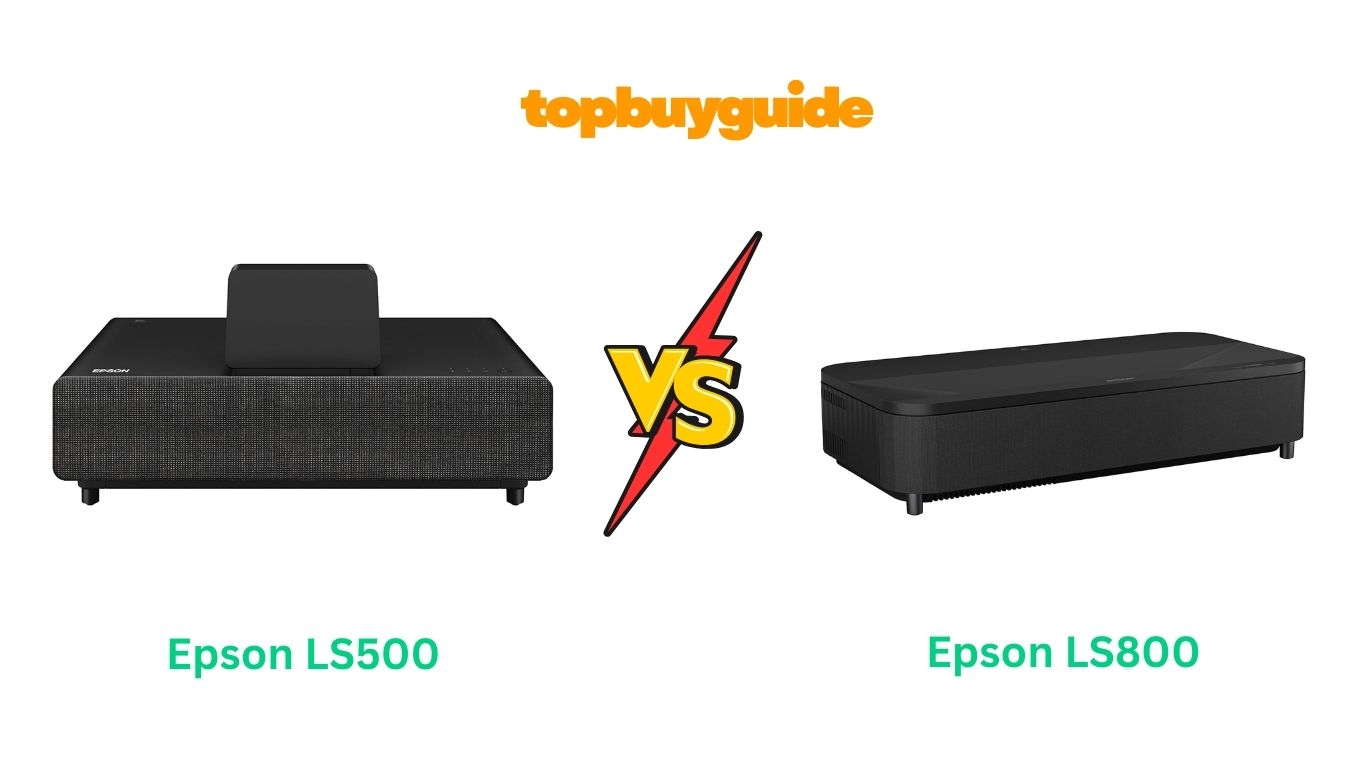
Choosing between the Epson LS500 and LS800 can be tough, as both are excellent ultra-short-throw projectors. However, if you’re a serious gamer or want the absolute shortest throw distance, the LS800 is the superior choice. Its incredibly low input lag and ability to project a massive image from just inches away make it a standout performer. This review will explore why the LS800 often comes out on top for modern home theater needs.
Why Do I Recommend The Epson EpiqVision LS800?
The Epson EpiqVision Ultra LS800 stands out as the premier choice, particularly for gaming enthusiasts and those with limited space. Here are the key reasons why it surpasses the LS500:
- LS800 for Superior Gaming: The LS800 is engineered for gaming with an incredibly low input lag of under 20ms, making it one of the most responsive projectors on the market. In contrast, the LS500’s input lag is higher, which can be noticeable in fast-paced competitive games.
- A Shorter Throw Distance: The LS800 features one of the shortest throw distances available. You can place it just inches from the wall to get a massive 100-inch image, whereas the LS500 needs to be positioned further back to achieve the same screen size, requiring more space.
- Enhanced Sound System: The LS800 comes with a powerful 2.1 channel virtual surround sound system designed by Yamaha. Conversely, the LS500 includes basic built-in stereo speakers that most users find underwhelming, often requiring an external sound system for an immersive experience.
- Larger Maximum Picture Size: The LS800 can project an image up to 150 inches, offering a truly cinematic scale for your home theater. The LS500, on the other hand, is limited to a maximum picture size of 130 inches.
- Sleeker, Modern Design: With its sleek, low-profile design, the LS800 blends more seamlessly into modern living spaces and media consoles. The LS500 has a taller, bulkier build that is less discreet.
- Up-to-Date Streaming: The LS800 runs on a newer version of the Android TV operating system, providing a smoother and more responsive user interface. Although both run Android TV, the LS800’s platform feels more current and user-friendly.
Side By Side Comparison Chart: Epson LS500 vs LS800
| Feature | Epson EpiqVision Ultra LS500 | Epson EpiqVision Ultra LS800 |
|---|---|---|
| Input Lag | Good for casual gaming (27ms) | Excellent for gaming (<20ms) |
| Throw Distance (for 100″ screen) | 15.4 inches | 3.9 inches |
| Maximum Picture Size | 130 inches | 150 inches |
| Built-in Speakers | 10W Stereo Speakers | 2.1 Channel Yamaha Sound System |
| Operating System | Android TV | Android TV (Newer Version) |
| Physical Design | Taller, bulkier design | Sleek, low-profile design |
| Gaming HDMI Port | No | Yes (HDMI 3 supports 1080p/120Hz) |
| Weight | 28.9 lbs | 27.6 lbs |
What Common Epson LS500 vs LS800 Features Can Do?
While the LS800 has some distinct advantages, both projectors share a foundation of premium Epson technology that delivers an exceptional viewing experience. They are both designed to replace a traditional television, offering a massive screen size without the complexity of a ceiling-mounted setup.
Both the LS500 and LS800 feature Epson’s advanced 3-chip 3LCD technology. This is a significant advantage over single-chip DLP projectors, as it ensures that there is no “rainbow effect” (flashes of color) and that both color and white brightness are equally high. This results in incredibly vibrant, color-accurate images that look great even in rooms with ambient light.
Another key shared feature is the 4K PRO-UHD technology. While not native 4K, this advanced pixel-shifting technology processes millions of pixels to deliver an incredibly sharp and detailed picture that accepts 4K source content. You’ll be able to enjoy your favorite 4K movies, sports, and shows with stunning clarity. Both models also support 10-bit HDR processing, which allows them to reproduce a wider range of brightness and color, bringing more depth and realism to your viewing experience.
Common Features of Epson LS500 vs LS800
| Feature | Epson EpiqVision Ultra LS500 | Epson EpiqVision Ultra LS800 |
|---|---|---|
| Brightness | 4,000 Lumens | 4,000 Lumens |
| Display Technology | 3-Chip 3LCD | 3-Chip 3LCD |
| Resolution | 4K PRO-UHD (pixel-shifting) | 4K PRO-UHD (pixel-shifting) |
| Light Source | Laser Array | Laser Array |
| Contrast Ratio | 2,000,000:1 | 2,500,000:1 |
| HDR Support | 10-bit HDR | 10-bit HDR |
| Connectivity | HDMI, Bluetooth, Wi-Fi | HDMI, Bluetooth, Wi-Fi, USB |
| Smart TV Platform | Android TV with Google Assistant | Android TV with Google Assistant |
A Detailed Comparison Of the Epson LS500 vs LS800
Picture Quality
The Epson LS500 delivers a fantastic viewing experience with its 4,000 lumens of brightness and 4K PRO-UHD technology. It produces bright, colorful images suitable for watching TV shows, sports, and movies, even in a moderately lit room. Its 3-chip 3LCD design prevents any rainbow effect, and the 2,000,000:1 dynamic contrast ratio ensures deep blacks. Some users have noted that achieving perfectly uniform focus across the entire screen can be challenging, but for most viewing, the picture is sharp and immersive.
The Epson LS800 matches the LS500 with 4,000 lumens and 4K PRO-UHD, but it pulls ahead with an improved dynamic contrast ratio of 2,500,000:1 for slightly deeper black levels. Its primary advantage is its advanced lens system, which allows for a much shorter throw distance and contributes to a sharper, more uniform image across the entire screen, up to an impressive 150 inches. This makes it easier to set up and provides a more consistent, high-quality picture without the focus issues sometimes reported with the LS500.
Gaming Performance
The Epson LS500 is a capable gaming projector for casual players. Its input lag is respectable for its class, allowing for enjoyable gameplay in most single-player and non-competitive multiplayer games. It supports 4K gaming at 60Hz through its HDMI 2.0 ports. However, serious gamers might notice the slight delay in fast-paced genres like first-person shooters or fighting games. The impressive brightness and color make games look vibrant, but the lack of a dedicated low-latency mode is a drawback for the competitive crowd.
This is where the Epson LS800 truly excels and justifies its higher price for gamers. It was engineered with gaming as a priority, boasting an input lag of under 20ms, which is exceptionally low for a projector. It also includes a dedicated gaming port (HDMI 3) that supports 1080p at a 120Hz refresh rate, delivering incredibly smooth motion. This combination of fast response time and high refresh rate makes the LS800 one of the best projectors available for competitive gaming, rivaling the performance of high-end gaming TVs.
Sound and Audio
The Epson LS500 comes equipped with two built-in 10W stereo speakers. While functional for casual TV watching, the sound quality is generally considered its weakest point. The audio lacks depth, bass, and overall power, and many users report that an external soundbar or full surround sound system is necessary to match the epic scale of the picture. The projector supports audio output via HDMI ARC, but some users have reported inconsistencies with this function.
In contrast, Epson significantly upgraded the audio capabilities in the LS800 by partnering with Yamaha. This model features a built-in 2.1 channel virtual surround sound system that delivers a much more powerful and immersive audio experience right out of the box. With dedicated sound modes for TV, sports, movies, and music, the audio is far richer and more dynamic than the LS500’s basic speakers. While a dedicated home theater system will still offer superior performance, the LS800’s built-in sound is impressive enough for many users to forego an external soundbar.
Design and Placement
The Epson LS500 features a functional but rather bulky design. It is taller and deeper than the LS800, which can make it more obtrusive when placed on a media console. To project a 100-inch image, it needs to be placed approximately 15.4 inches from the wall. While this is still a short distance, it requires a deeper media unit than some other UST projectors. Its connections are located on the front panel (facing the wall), which keeps wires tidy but can make access a bit tricky.
The Epson LS800 boasts a sleeker, more modern, and low-profile design that allows it to blend seamlessly into your decor. It is significantly less deep, and its ultra-short throw lens is a standout feature, requiring only 3.9 inches of space from the wall to project a 100-inch image. This makes it far more versatile for placement on standard media consoles. The LS800 is also available in both black and white, offering more options to match your room’s aesthetic.
Conclusion
Both the Epson LS500 and LS800 are top-tier ultra-short-throw projectors, but the LS800 is the clear winner for those seeking the ultimate home theater and gaming experience. Its exceptionally low input lag, higher refresh rate support, superior Yamaha sound system, and incredibly short throw distance make it a more advanced and versatile machine. If you are a serious gamer or want a projector that sits almost flush against your wall, the investment in the LS800 is well worth it for a future-proof setup.
FAQs
1. Is the Epson LS800 better than the LS500 for gaming?
Yes, absolutely. The LS800 has a much lower input lag (under 20ms) and a dedicated HDMI port for 120Hz gaming, making it one of the best projectors on the market for fast-paced, competitive gaming. The LS500 is suitable for casual gaming but not for serious gamers.
2. How much brighter is the LS800 compared to the LS500?
Both projectors have the same brightness rating of 4,000 lumens. This means they are equally capable of producing a vibrant image in rooms with ambient light. The LS800, however, has a slightly higher contrast ratio for better black levels.
3. Do I need a special screen for these projectors?
While you can project onto a white wall, an Ambient Light Rejecting (ALR) screen is highly recommended for both the LS500 and LS800. An ALR screen, especially one designed for UST projectors, dramatically improves contrast and color saturation, particularly in brighter rooms.
4. Can the Epson LS500 be mounted on the ceiling?
No, the Epson LS500 is designed exclusively for tabletop placement and cannot be ceiling-mounted. Some reviews mention that the LS800 can be ceiling-mounted, but both are primarily intended for placement on a media console below the screen.
5. Which projector has better built-in sound?
The Epson LS800 has a significantly better built-in sound system. It features a 2.1 channel virtual surround system designed by Yamaha, which provides a rich and immersive audio experience. The LS500’s basic 10W stereo speakers are much weaker in comparison.
6. What is the main difference in throw distance?
The Epson LS800 has a much shorter throw distance. It can project a 100-inch image from just 3.9 inches away from the wall. The LS500 needs to be placed further back, at around 15.4 inches, to achieve the same screen size.
7. Do both projectors support Netflix?
Natively, neither projector’s Android TV interface has certified Netflix support. This means you cannot download the Netflix app directly from the Google Play Store on the device. To watch Netflix, you will need to use a separate streaming device like an Apple TV, Fire TV Stick, or gaming console.
8. Which projector is newer?
The Epson LS800 is the newer model, released in late 2022. The Epson LS500 was released in 2020. The newer technology in the LS800 is reflected in its improved gaming performance, shorter throw distance, and more modern design.

Alex Turner is a dedicated product researcher and reviewer at TopBuyGuide.com, known for his clear, honest, and data-driven insights. He spends countless hours testing, comparing, and analyzing products to help readers make confident and informed buying decisions.