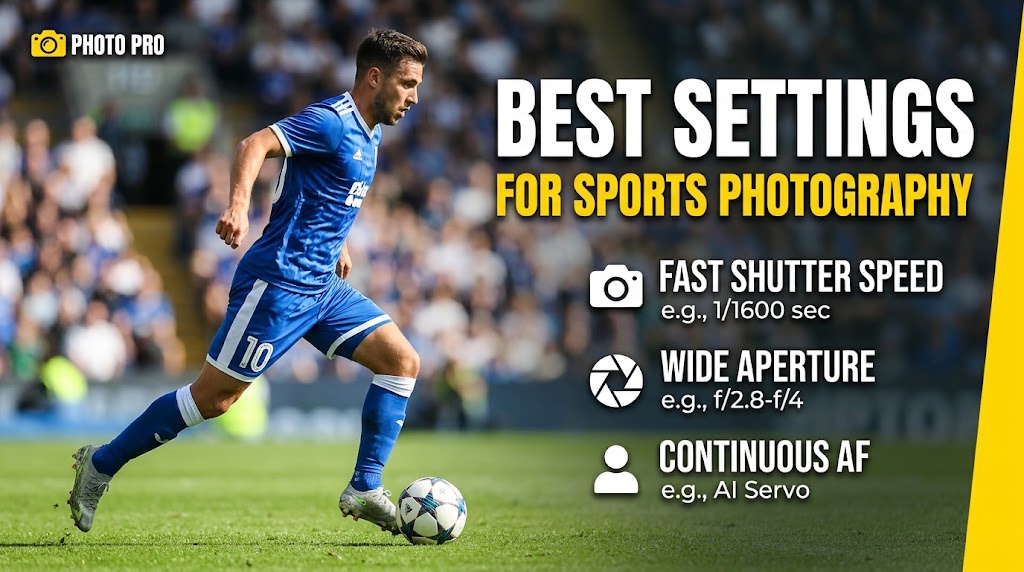
Photographing high-speed sports is one of the most demanding tasks in visual media. You are tracking erratic, high-velocity subjects across shifting light conditions, where missing focus or picking the wrong exposure mode by even a fraction of a second results in soft, blurry, unusable frames.
Whether you are shooting night football under dim stadium floodlights, outdoor soccer under harsh sunlight, fast-paced indoor basketball, or high-octane track cycling, relying on standard camera presets will fail you. Generic “Sports Modes” lack the intelligence required to balance minimum shutter thresholds, shallow depth of field, and continuous autofocus tracking.
This comprehensive masterclass breaks down exact exposure settings, autofocus configurations, custom button mappings, and scenario-specific cheat sheets to guarantee tack-sharp sports photographs every time.
1. The Exposure Triangle for Action: Freezing Motion
In sports photography, the traditional balance of the exposure triangle (Shutter Speed, Aperture, and ISO) shifts dramatically. Shutter speed is your non-negotiable priority. If your shutter speed drops too low, motion blur ruins the frame—and no amount of sharpening software can recover a soft image.
       [ SHUTTER SPEED ]
  Primary Priority (Freeze Motion)
               /\
              /  \
             /    \
            /      \
[ APERTURE ] ------ [ ISO / AUTO ISO ]
Subject Isolation    Light Compensation
Shutter Speed: The Action Baseline
To reliably freeze fast-moving athletes, your shutter speed must outrun the speed of the subject’s movement across your frame.
-
1/1000s: The absolute baseline minimum for general field sports (soccer, baseball, distance running).
-
1/1600s – 1/2000s: Essential for explosive, high-speed movement (basketball, sprinting, tennis, swimming spray).
-
1/3200s – 1/4000s: Required for hyper-velocity action (motorsports, golf swings at impact, baseball bat contact).
Pro Tip: Subject distance and focal length amplify apparent motion. A sprinter running toward you at 200mm requires a lower shutter speed to appear sharp than that same sprinter running past you perpendicularly across the frame. When in doubt, default to 1/2000s.
Aperture: Subject Isolation and Light Gathering
Wide apertures serve two critical functions in action sports: maximizing light intake to allow ultra-fast shutter speeds, and visually isolating athletes from noisy stadium backgrounds.
-
f/2.8: The gold standard for sports photographers. It creates creamy background blur (bokeh) that makes players pop off complex crowds and lets in massive light for indoor/night venues.
-
f/4: A practical sweet spot for long telephoto prime lenses (e.g., 400mm, 500mm, 600mm) or budget-conscious telephoto zooms.
-
f/5.6 – f/8: Used primarily when shooting multi-athlete interactions (scrum, team huddles) or when using longer telephoto glass with teleconverters where maximum depth of field is required to keep multiple subjects sharp.
ISO & Auto ISO: Strategic Exposure Safety
Do not fear digital noise; fear motion blur. A grainy photo of an iconic split-second play is valuable; a clean, smooth photo that is blurry is trash.
-
Outdoor Bright Light: ISO 100 – 400.
-
Overcast / Golden Hour: ISO 800 – 1600.
-
Indoor Gyms / Night Stadiums: ISO 3200 – 6400+.
The Auto ISO Strategy: Set your camera to Manual Mode (M) with Auto ISO enabled. Manually lock in your required shutter speed (e.g., 1/2000s) and aperture (e.g., f/2.8). Allow the camera’s meter to automatically adjust ISO across shifting light (such as a stadium half-covered in stadium shadows). Set an Auto ISO Upper Limit (e.g., ISO 6400 or 12800 depending on your camera sensor) to control noise ceilings.
2. Advanced Autofocus Configuration & Tracking
Modern mirrorless and DSLR cameras feature sophisticated autofocus engines, but default out-of-the-box settings will constantly hunt or snap focus onto background distractions like stadium seating or referee uniforms.
| AF Setting | Configuration Choice | Function / Purpose |
| Focus Mode | continuous AF (AF-C / AI Servo) | Continuously updates focus distance while the shutter button or Back-Button AF is engaged. |
| AF Area Mode | Dynamic / Expanded Spot or Zone AF | Provides a primary tracking point backed by cluster points to keep focus if the main point slips. |
| Tracking Sensitivity | Locked On / Low / Stickiness (+1 or +2) | Prevents the lens from jumping focus to an intervening player or referee crossing the frame. |
| Subject Detection | People / Eye AF (Vehicle for Motorsports) | Automatically locks focus onto the athlete’s eye or face beneath a helmet or visor. |
Back-Button Focus (BBF) Setup
By default, pressing the shutter button half-way locks focus, and pressing it fully fires the shutter. In sports, this setup causes focus hunting right when you try to trigger a burst sequence.
How to Configure Back-Button AF:
-
Enter your camera’s custom menu settings.
-
Disassociate autofocus activation from the Half-Press Shutter Button (set shutter button to Release Only).
-
Assign AF activation exclusively to the AF-ON button on the back of your camera body.
[ AF-ON Button ] ---> Controls Focus continuously (Thumb)
[ Shutter Button ] -> Controls Capture & Timing exclusively (Index Finger)
Why this matters: You can hold your thumb down on AF-ON to continuously track a running athlete, release your thumb to freeze focus distance when an obstacle passes, and tap the shutter button instantly whenever you want to snap frames without triggering focus readjustment.
3. Real-World Sports Scenario Cheat Sheets
Different sports present unique field velocities, spatial boundaries, and lighting challenges. Use these tailored baseline configurations in the field.
Outdoor Field Sports (Soccer, Football, Rugby)
-
Lighting: Variable (Sunlight to Night Floodlights)
-
Shooting Mode: Manual with Auto ISO
-
Shutter Speed: 1/1600s (day) to 1/2000s (night)
-
Aperture: f/2.8 to f/4
-
ISO: Auto (Base 100 to Max 6400)
-
AF Mode: AF-C / AI Servo with Zone or 9-Point Dynamic AF
Indoor Gym Sports (Basketball, Volleyball, Gymnastics)
-
Lighting: Dim, flickering high-bay lights (Tungsten/LED)
-
Shooting Mode: Manual
-
Shutter Speed: 1/1000s to 1/1250s
-
Aperture: f/2.8 (Widest lens option)
-
ISO: Fixed 3200 – 6400 (or Auto ISO)
-
AF Mode: AF-C with Eye-AF Enabled
-
White Balance: Custom Kelvin (3200K – 4200K) or Preset to prevent color shifts under gym lights.
Motorsports & High-Speed Racing (Panning Shots)
-
Goal: Intentionally blur the wheels and track while keeping the driver/vehicle tack-sharp to convey extreme speed.
-
Shooting Mode: Shutter Priority (Tv/S) or Manual
-
Shutter Speed: 1/60s to 1/250s (depending on vehicle speed)
-
Aperture: Auto or f/8 – f/11
-
ISO: 100 (Low native ISO)
-
AF Mode: AF-C with Vehicle Tracking / Wide Area
4. Drive Modes, Buffers, and Creative Techniques
Getting the perfect frame in sports requires mastering burst capabilities and camera memory buffers.
Continuous High (Burst Mode)
Set your camera drive mode to Continuous High (or Electronic Shutter High for mirrorless bodies offering 15–30 fps).
Important: High frame rates fill internal camera memory buffers quickly. Pair high burst modes with fast CFexpress Type A/B or UHS-II V90 SD cards. If your buffer bogs down, you will miss pivotal moments while the camera writes files to storage.
Creative Motion Blur (Panning)
Freezing action isn’t the only way to convey speed. Creative panning uses low shutter speeds combined with smooth upper-body tracking.
-
Select a slow shutter speed between 1/30s and 1/125s.
-
Stand stable, tucking elbows inward.
-
Lock focus on the subject as they approach.
-
Smoothly rotate your torso along the path of movement, firing a burst while continuing your follow-through motion after the shutter closes.
5. Common Sports Photography Pitfalls to Avoid
Even seasoned photographers make key operational errors when under high pressure at live sporting events.
-
Mistake 1: Relying on Aperture Priority (Av/A) or Program (P) Modes. In shifting light, Aperture Priority may drop shutter speeds down to 1/250s without warning, causing motion blur. Use Manual Mode with Auto ISO instead.
-
Mistake 2: Chimping (Checking the Screen Constantly). Reviewing images on your LCD screen between plays guarantees you will miss unexpected turn-overs, celebrations, or fast breaks. Review shots only during official timeouts or intermissions.
-
Mistake 3: Shooting Raw+JPEG with Slow Cards. Dual recording to slow memory cards chokes your camera’s buffer, bringing high burst rates to a sudden halt during peak action.
-
Mistake 4: Chasing the Ball Instead of the Emotion. Beginners focus exclusively on the ball. World-class sports photography often happens after the whistle—capturing reactions, coach interactions, and emotional victory/defeat celebrations.
6. Frequently Asked Questions
What shutter speed is best to freeze fast sports action?
A shutter speed of 1/1000s is the baseline standard for freezing athlete movement. For faster sports like basketball, tennis, or motorsports, increase your shutter speed to 1/1600s or 1/2000s.
Should I shoot RAW or JPEG for sports photography?
Most sports photographers shoot Compressed RAW or High-Quality JPEG. RAW provides maximum leeway for recovering shadows and correcting white balance in post-processing, but JPEG allows larger buffer capacities and faster file transfers for deadline-driven sports media workflows.
Is Auto ISO safe to use for sports photography?
Yes, using Manual Mode with Auto ISO is the industry-standard approach for sports coverage under variable light. It locks your required shutter speed and wide aperture while allowing the ISO to adjust automatically to changing stadium light.
What is the best focus mode for sports photography?
Use Continuous Autofocus (AF-C on Sony/Nikon/Fuji, AI Servo on Canon) combined with dynamic or zone focus area modes. Enable Back-Button Focus (AF-ON) for immediate, independent control over focus tracking.

Alex Turner is a dedicated product researcher and reviewer at TopBuyGuide.com, known for his clear, honest, and data-driven insights. He spends countless hours testing, comparing, and analyzing products to help readers make confident and informed buying decisions.