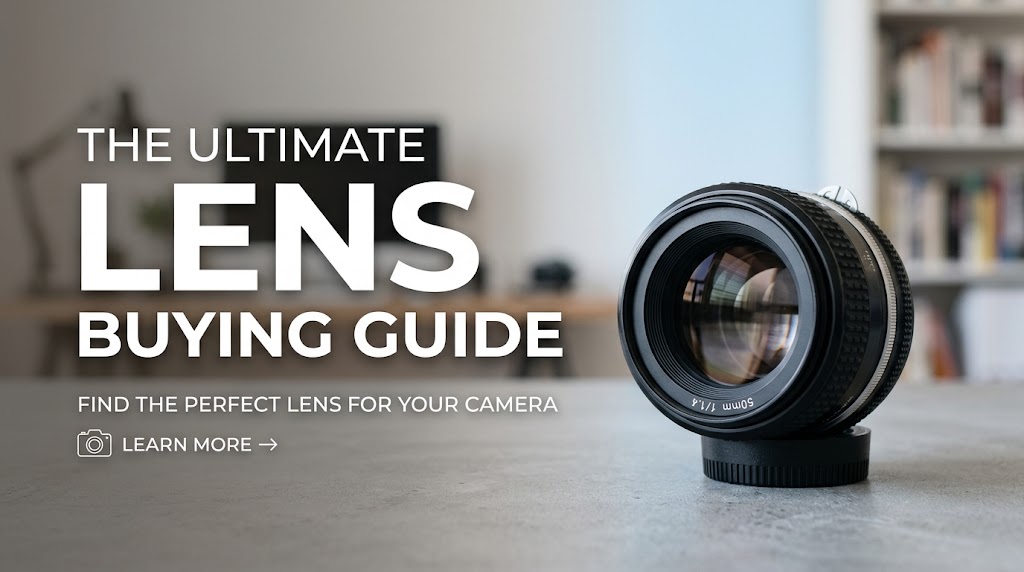
Imagine spending thousands of dollars on a flagship mirrorless camera body, unboxing it with high expectations, and taking your first set of shots—only to discover that your images look soft, muddy, and visually unimpressive.
This frustrating reality happens to photographers every day. The culprit is rarely the camera body itself. Instead, it is almost always the piece of glass screwed onto the front of it.
Your camera body is simply a digital canvas that records light; your lens is what sculpts that light. The sharpest sensor in the world cannot compensate for subpar optics, poor focus control, or micro-contrast loss. Investing in the right glass is the single most impactful decision you can make to elevate your photography, transform image quality, and unlock creative possibilities that were previously impossible.
However, navigating the lens market today feels overwhelming. Deciphering cryptic acronyms, understanding focal length dynamics, weighing prime versus zoom trade-offs, and matching glass to crop sensors demand clear clarity.
This comprehensive guide breaks down camera optics step-by-step. By the end of this guide, you will understand technical specifications, avoid costly purchasing mistakes, and select the exact lens needed for your creative vision and budget.
1. Deconstructing Lens Anatomy & Technical Jargon
Before evaluating specific lenses, you must understand the technical language used by manufacturers. Lens barrels are covered in alphanumeric strings like “FE 24-70mm f/2.8 GM II” or “RF 50mm f/1.2 L USM.” Understanding these terms clarifies what you are paying for.
   +-----------------------------------------------------------------+
   |                    OPTICAL FORMULA DIAGRAM                      |
   |                                                                 |
   |  [ Front ]    ( Aperture Blades )                  [ Sensor ]   |
   |   Element         \ | /                            Plane        |
   |     ( ( ( -------   |   ------- ) ) ) ----------||             |
   |                   / | \                                         |
   |                 <--- Light --->                                 |
   +-----------------------------------------------------------------+
Focal Length and Field of View
Focal length—expressed in millimeters ($mm$)—is not the physical length of the lens barrel. Technically, it is the distance from the optical center of the lens to the image plane (the digital sensor) when the lens is focused at infinity.
Focal length dictates two critical image attributes:
-
Magnification: How large the subject appears in the frame.
-
Angle of View: How much of the scene the lens captures.
-
Short Focal Lengths (e.g., $14mm – 35mm$): Provide a wide angle of view, making distant objects appear smaller while capturing vast horizontal and vertical expanses.
-
Long Focal Lengths (e.g., $85mm – 600mm$): Provide a narrow angle of view, magnifying distant subjects and narrowing the spatial field.
Aperture, $f$-stops, and Depth of Field
The aperture is the physical diaphragm inside the lens made of adjustable blades. It controls how much light enters the camera sensor. Aperture is denoted as an $f$-number (e.g., $f/1.4$, $f/2.8$, $f/8$, $f/16$).
Key Rule of Optics: The $f$-stop represents a fraction ($\text{Focal Length} \div \text{Aperture Diameter}$). Therefore, a smaller $f$-number indicates a physically wider opening, allowing more light into the sensor.
   APERTURE SCALE & LIGHT TRANSMISSION

   f/1.4      f/2.0      f/2.8      f/4.0      f/5.6      f/8.0      f/11       f/16
   ( O )      ( O )      ( O )      ( o )      ( o )      ( · )      ( · )      ( · )
   |<--- Maximum Light & Shallow Depth --->|   |<--- Deep Depth & Less Light --->|
-
Fast Apertures ($f/1.2 – f/2.8$): Allow massive amounts of light through the optics. They enable faster shutter speeds in low-light environments and create a shallow depth of field with creamy background blur (bokeh).
-
Slow Apertures ($f/4 – f/22$): Restrict light throughput. They require slower shutter speeds or higher ISO settings, but keep more of the scene—from foreground to background—in razor-sharp focus.
Lens Coatings and Optical Glass Elements
Modern camera lenses contain intricate groupings of individual glass elements arranged in functional blocks. Advanced lenses utilize specialized glass elements to correct optical defects:
-
Aspheric Elements: Custom-molded non-spherical glass elements designed to reduce spherical aberrations and eliminate peripheral distortion around frame edges.
-
Extra-low Dispersion (ED/UD/FLD) Glass: Specialized glass formulas engineered to direct light wavelengths evenly onto the sensor plane, eliminating chromatic aberration (purple and green color fringing along high-contrast edges).
-
Nano Coatings: Anti-reflective microscopic surface treatments applied directly to internal element surfaces to suppress lens flare, internal ghosting, and contrast degradation when shooting toward strong light sources.
Pro Tip: When evaluating lens specifications, look beyond raw glass element counts. Prioritize designs that feature at least 2–3 low-dispersion elements and advanced anti-reflective nano coatings if you frequently shoot backlit portraits or sunrise landscape scenes.
2. Understanding Crop Factors & Sensor Compatibility
One of the most widespread points of confusion among photographers is how sensor size alters a lens’s practical focal length and depth of field.
+----------------------------------------------------+
| FULL FRAME SENSOR (35mm Baseline / 1.0x Crop)      |
|  +----------------------------------------------+  |
|  | APS-C SENSOR (1.5x / 1.6x Crop)             |  |
|  |  +----------------------------------------+  |  |
|  |  | MICRO FOUR THIRDS (2.0x Crop)          |  |  |
|  |  |                                        |  |  |
|  |  +----------------------------------------+  |  |
|  +----------------------------------------------+  |
+----------------------------------------------------+
Full-Frame Baseline (35mm Standard)
The standard measurement for sensor size is derived from 35mm film stock ($36 \times 24mm$). When a lens is attached to a full-frame digital sensor, its physical focal length directly matches its effective field of view. A $50mm$ lens yields a true $50mm$ field of view.
APS-C and Micro Four Thirds (MFT) Crop Factors
Smaller sensors act like a crop box centered over a full-frame optical projection, cropping out the outer margins of the image circle. This creates a narrower field of view, making the lens appear more zoomed in.
To calculate the Effective Equivalent Focal Length, multiply the marked focal length by the camera sensor’s crop factor:
-
APS-C Sensors (Sony, Fujifilm, Nikon): Features a $1.5\times$ crop factor. A $50mm$ lens provides an effective field of view of $75mm$ ($50 \times 1.5$).
-
APS-C Sensors (Canon): Features a $1.6\times$ crop factor. A $50mm$ lens provides an effective field of view of $80mm$ ($50 \times 1.6$).
-
Micro Four Thirds Sensors (OM System/Olympus, Panasonic): Features a $2.0\times$ crop factor. A $50mm$ lens provides an effective field of view of $100mm$ ($50 \times 2.0$).
Crop Factor Comparison Table
| Physical Focal Length | Full Frame (1.0x) | APS-C Sony/Fuji (1.5x) | APS-C Canon (1.6x) | Micro Four Thirds (2.0x) | Primary Shooting Application |
| 16mm | Ultra-Wide ($16mm$) | Wide ($24mm$) | Wide ($25.6mm$) | Standard Wide ($32mm$) | Architecture, Astrophotography |
| 35mm | Wide-Normal ($35mm$) | Standard ($52.5mm$) | Standard ($56mm$) | Telephoto ($70mm$) | Environmental Portraits, Street |
| 50mm | Standard Nifty-Fifty ($50mm$) | Portrait ($75mm$) | Portrait ($80mm$) | Telephoto ($100mm$) | Studio, Street, General Use |
| 85mm | Short Telephoto ($85mm$) | Tight Portrait ($127.5mm$) | Tight Portrait ($136mm$) | Wildlife/Sports ($170mm$) | Headshots, Commercial Fashion |
| 200mm | Telephoto ($200mm$) | Action/Wildlife ($300mm$) | Action/Wildlife ($320mm$) | Super-Tele ($400mm$) | Sports, Distant Wildlife |
Important Real-World Scenario: If you mount an APS-C designated lens (such as a Sony E-mount E-series or Canon RF-S lens) onto a high-resolution full-frame camera, the camera will automatically switch into “Crop Mode.” This crops into the sensor matrix to prevent severe edge vignetting, but reduces your total megapixel output (e.g., a 45MP full-frame sensor reduces to roughly 18–20MP). Always check sensor coverage compatibility before purchasing.
3. Lens Types and Their Creative Applications
Choosing a lens requires matching optical physics to your aesthetic goals. Below is a detailed breakdown of each major lens category, including ideal usage, depth considerations, and target focal ranges.
+-------------------------------------------------------------------------+
|                        FOCAL LENGTH SPECTRUM                            |
|                                                                         |
| Ultra-Wide    Wide Angle      Standard/Normal     Telephoto    Super-Tele|
| (10 - 24mm)   (24 - 35mm)       (45 - 60mm)      (70 - 200mm)   (300mm+) |
|    [===]         [===]             [===]            [===]         [===] |
| Astrophoto   Landscapes       Documentary/Street   Portraits    Wildlife|
+-------------------------------------------------------------------------+
Ultra-Wide Angle Lenses ($10mm – 24mm$)
Ultra-wide optics offer an expansive view of a scene. They physically exaggerate distance scale, making objects close to the front glass appear disproportionately large while rendering distant backgrounds small and wide.
-
Best For: Landscape photography, astrophotography, architectural interiors, and real estate.
-
Optical Behavior: High visual distortion near frame edges; extreme depth of field even at wide open aperture settings.
-
Pro Tip: Keep your subject away from the outer edges of an ultra-wide lens barrel to prevent visual stretching and unflattering proportion distortion.
Standard / Normal Lenses ($35mm – 60mm$)
Standard focal ranges closely mirror human visual perception in terms of spatial perspective, rendering natural scale without dramatic distortion or compression.
-
Best For: Street photography, documentary work, lifestyle content, editorial photojournalism, and everyday walkaround shooting.
-
Optical Behavior: Neutral perspective rendition, versatile focus capabilities, and access to ultra-fast maximum apertures (such as $f/1.4$ or $f/1.2$).
Telephoto & Super-Telephoto Lenses ($70mm – 600mm+$)
Telephoto lenses pull far away subjects close. They create a visual optical effect called perspective compression, where foreground elements and background textures are visually pressed closer together.
  PERSPECTIVE COMPRESSION EXPLAINED

  Wide-Angle (24mm):     [Subject] -------- Distance -------- [Background]
                         (Subject looks large, background feels far away)

  Telephoto (200mm):     [Subject][Background]
                         (Background pulls in tight behind subject)
-
Best For: Outdoor sports, action photography, track events, birding, safari wildlife, and high-fashion portraiture.
-
Optical Behavior: Strong subject isolation, compressed spatial layers, and shallow depth of field.
Macro Lenses (Dedicated 1:1 Reproduction Ratio)
A true macro lens is engineered specifically to achieve a 1:1 magnification ratio (or higher). This means the physical subject is projected onto the digital camera sensor at its actual physical size or larger.
                  REPRODUCTION RATIO COMPARISON

    Standard Lens (1:4 Ratio)           True Macro Lens (1:1 Ratio)
    +-----------------------+           +-----------------------+
    |                       |           |  ...................  |
    |        .(Coin).       |           |  :                 :  |
    |                       |           |  :     (COIN)      :  |
    |                       |           |  :                 :  |
    +-----------------------+           +-----------------------+
    Subject projected at 25%             Subject projected at 100%
      of life size on sensor                life size on sensor
-
Best For: Product details, fine jewelry commercial work, insect photography, botanical studies, and high-resolution document archiving.
-
Optical Behavior: Exceptionally flat field of focus, edge-to-edge sharpness, and a close minimum focusing distance.
Specialty Optics: Fisheye, Tilt-Shift, and Anamorphic
-
Fisheye Lenses: Ultra-wide lenses featuring uncorrected curvilinear distortion, capturing hemispherical panoramic fields of view (up to 180 degrees).
-
Tilt-Shift Lenses: Mechanical lenses that tilt the optical axis relative to the sensor plane (controlling the Scheimpflug principle of depth) and shift elements vertically/horizontally to eliminate converging vertical lines in architectural photography.
-
Anamorphic Lenses: Motion-picture lenses that optically squeeze a widescreen cinema aspect ratio horizontally onto a standard sensor matrix, creating characteristic oval background blur and wide horizontal lens flares.
4. The Eternal Debate: Prime vs. Zoom Lenses
Choosing between fixed prime lenses and versatile zoom lenses is a foundational decision for every photography system.
+-------------------------------------------------------------------+
|                        PRIME VS. ZOOM LENS                        |
|                                                                   |
|         PRIME LENS                       ZOOM LENS                |
|    +------------------+             +------------------+          |
|    | Fixed Focal Length|             | Variable Focal   |          |
|    | Wide Aperture    |             | Moderate Aperture|          |
|    | Superior Optics  |             | Ultimate Flex    |          |
|    +------------------+             +------------------+          |
|     ( 35mm / f1.4 )                  ( 24-70mm / f2.8 )          |
+-------------------------------------------------------------------+
Prime Lenses: Fixed Focal Lengths
Prime lenses feature a static focal length (e.g., $35mm$, $50mm$, $85mm$). Because optical engineers optimize glass groups for one focal length, primes deliver top-tier optical quality.
Advantages:
-
Brighter Apertures: Reaches fast light limits like $f/1.4$, $f/1.2$, or even $f/0.95$.
-
Uncompromising Optical Sharpness: Minimal internal lens elements result in higher contrast and resolution.
-
Compact Ergonomics: Smaller physical size and lighter weight make primes ideal for long walkaround sessions.
Disadvantages:
-
Zero optical flexibility; you must physically change your position to reframe pictures.
-
Requires carrying multiple lenses to cover wide, standard, and telephoto fields.
Zoom Lenses: Variable Focal Lengths
Zoom lenses use complex internal element groups that move along internal track assemblies, allowing you to alter the focal length on demand (e.g., $24-70mm$, $70-200mm$).
Advantages:
-
Maximum Versatility: Adapt to fast-changing environments without switching physical lenses.
-
Efficiency: Eliminates sensor dust exposure caused by frequent field lens changes.
Disadvantages:
-
Narrower Apertures: Professional zooms typically cap at $f/2.8$; entry-level options drop to $f/4.0 – f/6.3$.
-
Weight and Volume: Dense assembly requires heavy housing, adding noticeable bulk to your kit bag.
Direct Architectural Breakdown: Prime vs. Zoom
| Parameter | Prime Lenses (f/1.4−f/1.8) | Professional Zooms (f/2.8) | Kit/Variable Zooms (f/3.5−f/6.3) |
| Maximum Light Gathering | High (Exceptional in low light) | Moderate (Reliable for events) | Low (Requires bright light or high ISO) |
| Optical Sharpness | High (Sharp across the frame) | Very High (Pro-grade optical coatings) | Moderate (Soft at frame edges) |
| Subject Isolation / Bokeh | Creamy, smooth background blur | Strong separation at telephoto ends | Minimal background blur |
| Physical Weight & Size | Lightweight and compact | Heavy, robust construction | Medium, often plastic barrel build |
| Budget Value Index | Excellent performance per dollar | Expensive premium investment | Entry-level, low cost |
Key Takeaway Callout Box
Recommendation: If you prioritize low-light photography, shallow depth of field, and optical resolution, choose a Prime Lens. If you cover fast-paced events, travel, weddings, or documentary projects where you cannot step closer or further from your subject, invest in a Professional $f/2.8$ Zoom Lens.
5. Essential Feature Checklist for Smart Buyers
Before spending money on glass, review these essential mechanical and optical features to confirm the lens matches your shooting needs.
   CHECKLIST FOR BUYING GLASS
   [✓] Image Stabilization Mechanism (OIS / IS / VR / Steadyshot)
   [✓] Autofocus Motor Drive Tech (Linear Stepping vs Ultra-Sonic)
   [✓] Weather Sealing Gaskets & Build Construction Quality
   [✓] Minimum Focus Distance & Max Magnification Scale
   [✓] Filter Thread Diameter Size (mm)
Optical Image Stabilization (OIS / IS / VR / VC)
Optical stabilization uses internal gyro sensors and floating element groups to shift opposite to hand movement. This compensates for small camera shakes, allowing you to shoot at slower shutter speeds without camera shake blur.
-
Why It Matters: If your camera body lacks In-Body Image Stabilization (IBIS), buying stabilized lenses is critical for low-light handheld shooting and smooth handheld video work.
-
Interoperability: Modern mirrorless systems sync lens stabilization with body stabilization to offer up to 6–8 stops of handheld stabilization compensation.
Autofocus Motor Technologies
Autofocus speed, sound, and accuracy depend directly on internal motor technology:
-
Linear Stepping Motors (STM / Linear Actuators): Quiet, smooth operational focus tracks ideal for continuous tracking during video recording.
-
Ultrasonic Drive Motors (USM / SSM / VXD): High-torque motors designed to snap heavy internal prime glass elements into focus rapidly, making them ideal for sports and action photography.
Build Quality and Weather Sealing
If you shoot outdoors, entry-level consumer lenses without protective rubber seals can allow rain, high humidity, and fine dust to penetrate the lens housing, damaging internal elements.
               WEATHER SEALING ENGINE SCHEMATIC

         Front Fluorine-Coated Protective Element
         |
         |     Rubber Focus-Ring Gasket Seals
         v     v
       +---------------------------------------------+
   ===>| [Element]   [Ring]   [Ring]   [Element]     | ===> Mount Flange
       +---------------------------------------------+      Rubber Ring Seal
                                                            (Blocks Dust/Water)
Look for full weather sealing, which includes:
-
A durable rubber gasket ring around the metal lens mount flange.
-
Internal rubber seal rings behind manual control rings and buttons.
-
Front element Fluorine coatings that repel rain droplets, oil, fingerprint smudges, and dirt.
6. Genre-Specific Lens Recommendations
Match your main photo style to the recommended focal lengths, optimal aperture settings, and key features listed below:
+---------------------------------------------------------------------+
|                      GENRE RECOMMENDATION MATRIX                    |
|                                                                     |
|   LANDSCAPE             PORTRAIT               WILDLIFE / SPORTS    |
|   16-35mm f/4          85mm f/1.4              100-400mm f/4.5-5.6   |
|   Edge Sharpness       Creamy Bokeh            Ultra-fast AF        |
|   Weather Sealed       Eye-AF Tracking         Tripod Collar        |
+---------------------------------------------------------------------+
Landscape & Astrophotography
-
Target Focal Ranges: Ultra-Wide ($14mm – 24mm$) or Versatile Wide ($16-35mm$).
-
Aperture Priority: $f/2.8$ or faster for Astrophotography (capturing sharp, pin-point stars without trailing); $f/8.0 – f/11$ for landscape vistas.
-
Key Specs: Exceptional corner-to-corner sharpness, minimal coma (comatic aberration), and robust weather sealing.
-
Pro-Glass Pick: $16-35mm\ f/2.8\text{ Zoom}$ or $20mm\ f/1.8\text{ Wide Prime}$.
Portraiture & Fashion
-
Target Focal Ranges: Short Telephoto ($85mm$, $105mm$, or $135mm$).
-
Aperture Priority: Ultra-fast openings ($f/1.2$, $f/1.4$, or $f/1.8$).
-
Key Specs: Round aperture blades (9+ blades) for smooth background blur, zero facial perspective distortion, and fast eye-tracking autofocus response.
-
Pro-Glass Pick: $85mm\ f/1.4\text{ Prime}$.
Sports & Wildlife
-
Target Focal Ranges: Telephoto to Super-Telephoto ($70-200mm$, $100-400mm$, $150-600mm$, $600mm\text{ Prime}$).
-
Aperture Priority: $f/2.8$ to $f/4.0$ constant apertures for sports; flexible $f/4.5-f/5.6$ options for outdoor daylight wildlife.
-
Key Specs: Ultra-fast linear focus drive motors, optical image stabilization modes (including panning mode), and built-in tripod collar mounts.
-
Pro-Glass Pick: $70-200mm\ f/2.8\text{ Telephoto Zoom}$.
Street, Documentary & Travel
-
Target Focal Ranges: Moderately Wide to Standard ($28mm$, $35mm$, or $50mm$).
-
Aperture Priority: $f/1.8 – f/2.8$.
-
Key Specs: Compact physical footprint, discrete low-profile appearance, low physical weight, and snappy close-up autofocus performance.
-
Pro-Glass Pick: $35mm\ f/1.8\text{ Compact Prime}$.
7. Common Pitfalls & Buying Mistakes to Avoid
Even experienced photographers can fall into traps when upgrading their camera lenses. Avoid these costly optical mistakes:
+-------------------------------------------------------------------+
|                   FIVE COSTLY LENS BUYING ERRORS                  |
|                                                                   |
| [1] Falling for "Focal Range Greed" (Superzooms: 18-300mm)         |
| [2] Buying Cheap Filters That Degrade Premium Glass Optics        |
| [3] Overlooking Minimum Focus Distance Limits                     |
| [4] Ignoring Lens Physical Weight and Balance on Small Bodies    |
| [5] Purchasing Outdated Third-Party Mount Adapters                |
+-------------------------------------------------------------------+
Pitfall 1: Superzoom Convenience Traps
Avoid broad-range “do-it-all” superzoom lenses (e.g., $18-300mm\ f/3.5-f/6.3$). While appealing for travel convenience, designing a lens with a $16\times$ zoom ratio forces heavy optical compromises. These lenses suffer from soft image corners, high optical distortion, and dark variable apertures that struggle in medium-to-low light.
-
Correction Strategy: Split broad focal ranges into a “Holy Trinity” lens strategy: a wide-angle zoom ($16-35mm$), a standard zoom ($24-70mm$), and a telephoto zoom ($70-200mm$).
Pitfall 2: Ruining Quality with Low-Grade Protection Filters
Attaching an inexpensive $15 basic UV filter to a high-end $2,000 professional camera lens will degrade your optical performance. Poor protective filter glass creates ghosting, flares, optical soft spots, and light reflections.
-
Correction Strategy: If you use protective lens filters, invest in multicoated options from reputable optical brands (e.g., B+W, Hoya, NiSi, K&F Nano Series). Otherwise, rely on your plastic lens hood to protect the front element from impacts.
Pitfall 3: Ignoring Physical Weight and Ergonomic Balance
A heavy $70-200mm\ f/2.8$ lens weighing over 3 pounds ($1.4\text{ kg}$) can feel unbalanced on a small mirrorless camera body. If a lens feels too bulky or uncomfortable to carry, you will likely leave it home more often.
-
Correction Strategy: Test heavy zoom lenses in a camera shop or consider renting them first. If handheld portability matters most for your workflow, choose an $f/4$ zoom alternative or compact fast primes.
8. Frequently Asked Questions (FAQ)
What is the difference between constant aperture and variable aperture zoom lenses?
A constant aperture zoom lens maintains its maximum aperture setting (e.g., $f/2.8$) across its entire zoom range, providing consistent exposure control. A variable aperture zoom lens changes its maximum aperture setting as you zoom in (e.g., $f/3.5$ at $18mm$, which closes down to $f/5.6$ at $55mm$). This forces your shutter speed to slow down or your ISO to increase to maintain exposure.
Can I mount DSLR lenses onto new mirrorless camera bodies?
Yes, you can easily adapt DSLR lenses (Canon EF, Nikon F) onto mirrorless camera bodies using first-party mount adapters (such as the Canon EF-EOS R or Nikon FTZ adapter). These adapters maintain electronic communication, preserving autofocus tracking speeds, automatic exposure adjustments, and metadata transmission without image quality loss.
Is an $f/1.2$ or $f/1.4$ prime lens worth the extra cost over an $f/1.8$ lens?
For most photographers, an $f/1.8$ prime offers the best balance of optical performance, compact design, and value. Ultra-fast $f/1.4$ and $f/1.2$ lenses are built for professionals who need extreme low-light performance, maximum background blur, and heavy-duty weather sealing. However, they are significantly heavier, physically larger, and up to three times more expensive.
What does a lens hood do, and should I always use it?
A lens hood shades the front element to prevent stray, off-axis light rays from causing flare, ghosting artifacts, and contrast loss. It also acts as a physical buffer, protecting the glass front from accidental bumps, drops, fingerprints, and weather exposure. You should keep your lens hood attached whenever you shoot.
9. Conclusion: Finding Your Optical Formula
Your camera lenses are long-term investments. Camera bodies age quickly as digital sensor technology updates, but high-grade optical glass retains its value, outlasting multiple camera body updates over decades.
When selecting your next lens, follow these key guidelines:
-
Prioritize Optics Over Camera Bodies: Spending money on high-performance lenses improves image sharp resolution, color fidelity, and auto-focus speed more than upgrading your camera body.
-
Match Glass to Your Real-World Needs: Avoid buying lenses based on theoretical specs. Choose focal lengths and aperture limits that fit the specific subjects, environments, and lighting conditions you shoot in most.
-
Build Systematically: Start with a versatile standard fast prime ($35mm$ or $50mm$) or a flexible constant $f/2.8$ zoom. Add specialized wide, macro, or super-telephoto options as your creative goals grow.
Ready to Upgrade Your Photography Kit?
Before buying your next lens, review your existing photo catalog. Filter your image library by focal length and aperture to pinpoint where your current glass limits your creative vision.
What single lens is currently top on your wishlist? Share your primary shooting style below, and let’s analyze the absolute best optical glass value for your setup!

Alex Turner is a dedicated product researcher and reviewer at TopBuyGuide.com, known for his clear, honest, and data-driven insights. He spends countless hours testing, comparing, and analyzing products to help readers make confident and informed buying decisions.