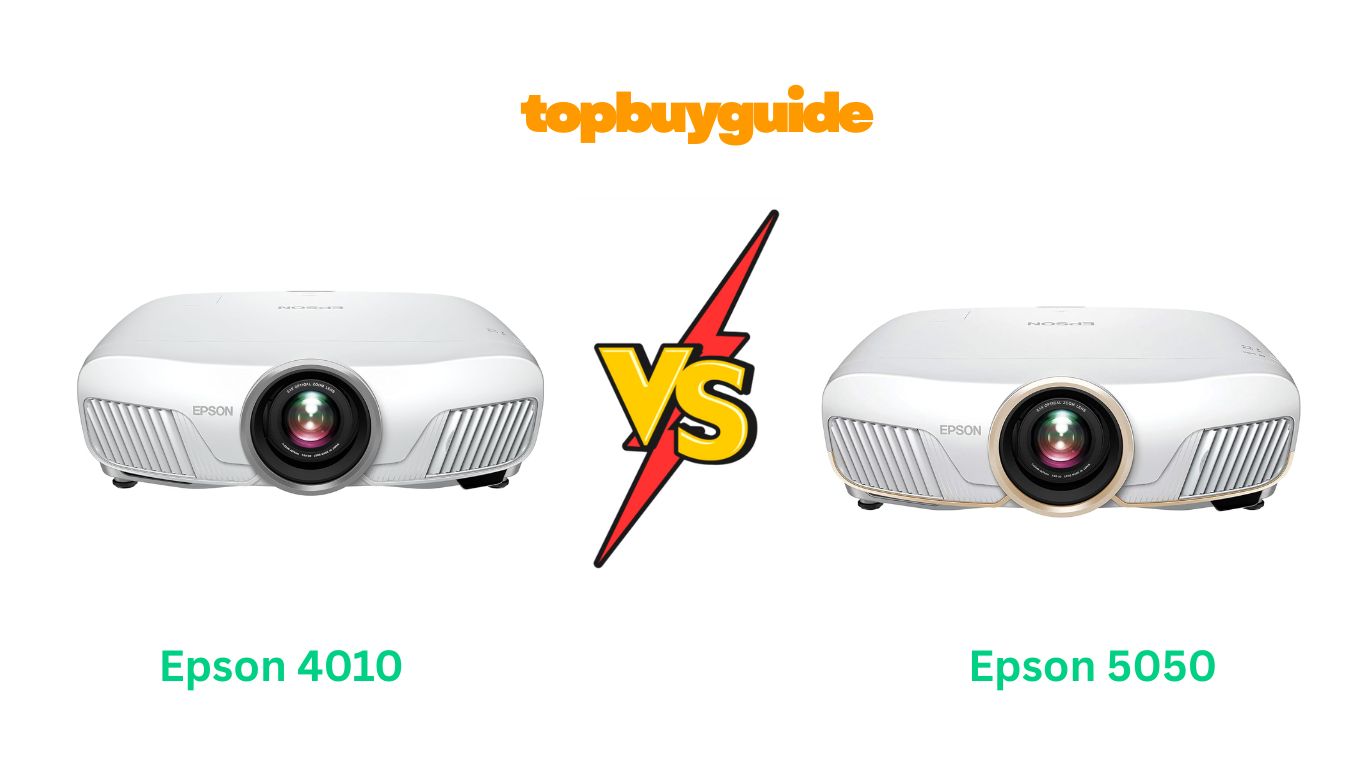
When comparing the Epson 4010 vs 5050, both stand out as top-tier home cinema projectors offering stunning 4K enhancement and rich color performance. However, if you’re looking for the ultimate combination of brightness, contrast, and cinematic precision, the Epson 5050UB easily takes the lead. With its superior contrast ratio and UltraBlack technology, it delivers deeper blacks, crisper visuals, and a more immersive viewing experience that makes it perfect for any dedicated home theater setup.
Why Do I Recommend the Epson 5050UB?
The Epson Home Cinema 5050UB is a powerhouse built for serious movie enthusiasts who demand reference-level image quality. While the Epson 4010 delivers impressive 4K enhancement at a more accessible price point, the 5050UB outshines it in several crucial performance areas that make a noticeable difference in real-world viewing. Here’s why it’s the better pick:
- UltraBlack Contrast for True Cinematic Depth
The 5050UB boasts Epson’s proprietary UltraBlack technology, delivering an incredible 1,000,000:1 dynamic contrast ratio—far higher than the 4010’s 200,000:1. This results in richer blacks and better shadow detail, perfect for dark room viewing. In comparison, the 4010’s contrast feels flatter during darker scenes. - Brighter and More Vivid Visuals
With 2,600 lumens of both color and white brightness, the 5050UB ensures that colors pop even in moderately lit rooms. The 4010, at 2,400 lumens, is still bright but falls slightly short when projecting on larger screens or in brighter spaces. - Advanced HDR10 and HLG Performance
The 5050UB handles HDR10 and Hybrid Log Gamma (HLG) content far more efficiently, offering a noticeably wider dynamic range and enhanced highlight detail. The 4010 supports HDR but lacks the same tonal precision and balance. - Superior Lens Quality and Motorized Precision
Both models include Epson’s excellent motorized lens with powered focus, zoom, and shift. However, the 5050UB includes higher-quality optics that result in sharper edge-to-edge clarity, reducing chromatic aberration and ensuring a more precise image. - Full 18Gbps HDMI Support for True 4K HDR Playback
One of the biggest upgrades in the 5050UB is its 18Gbps HDMI bandwidth, allowing it to fully handle 4K HDR at 60Hz. The 4010, limited to 10.2Gbps, cannot play full HDR content from newer 4K Blu-ray players or gaming consoles without slight compression. - Better Color Accuracy with Full DCI-P3 Coverage
While both projectors use Epson’s 3LCD technology for vibrant color, the 5050UB supports 100% of the DCI-P3 color gamut (the same color space used in Hollywood). This gives it a more accurate and cinematic color tone than the 4010, which covers only the standard Rec.709 range. - Enhanced Gaming & Motion Handling
Thanks to faster signal processing and better HDR tone mapping, the 5050UB performs smoother for gaming and fast-motion content. The 4010 lags slightly in this area, making the 5050UB the more versatile option. - Future-Proof Build Quality & Longer Lamp Life
Both projectors feature durable construction and similar lamp life (up to 5,000 hours in ECO mode), but the 5050UB’s improved cooling and optical engine make it more reliable for heavy home theater use over time.
Bottom line: If you’re building or upgrading a true cinematic setup, the Epson 5050UB is the smarter long-term investment. The 4010 remains a strong choice for budget-conscious users, but it simply doesn’t deliver the same depth, dynamic range, or color fidelity.
Side-by-Side Comparison Chart (Epson 4010 vs 5050UB)
| Feature | Epson 4010 | Epson 5050UB |
| Resolution | 4K Enhancement (1920×1080 x2) | 4K Enhancement (1920×1080 x2) |
| Brightness | 2,400 lumens | 2,600 lumens |
| Dynamic Contrast Ratio | 200,000:1 | 1,000,000:1 |
| Color Gamut | 100% sRGB / Rec.709 | 100% DCI-P3 |
| HDR Support | HDR10 only | HDR10 + HLG |
| HDMI Bandwidth | 10.2 Gbps | 18 Gbps |
| Lens Shift (Vertical/Horizontal) | ±96% / ±47% | ±96% / ±47% |
| Zoom / Focus | Motorized | Motorized |
| Color Technology | 3LCD | 3LCD with UltraBlack |
| Lamp Life (ECO Mode) | 5,000 hours | 5,000 hours |
| Fan Noise (ECO Mode) | 24 dB | 20 dB |
| Weight | 24.3 lbs | 24.7 lbs |
| Price Range (Approx.) | ~$1,800 | ~$2,999 |
What Common Epson 4010 vs 5050 Can Do?
Even though the Epson 4010 and Epson 5050UB differ in performance and pricing, they share a strong foundation of advanced projection features that make both excellent for home entertainment enthusiasts.
4K Enhancement Technology
Both models use Epson’s 4K PRO-UHD enhancement system, which shifts each pixel diagonally by half a pixel to double the resolution. This produces crisp, detailed images comparable to native 4K projectors at a lower cost. Whether you’re streaming Netflix 4K or watching Blu-ray movies, both units deliver a sharp, vibrant image with natural texture.
3LCD Technology for No Rainbow Effect
Epson’s 3LCD projection engine ensures that both the 4010 and 5050UB display 100% of the RGB color signal for every frame. This eliminates the rainbow artifacts seen in some DLP projectors and delivers smooth, true-to-life color gradients.
Wide Lens Shift and Flexible Installation
Each projector includes an extensive motorized lens shift feature, offering ±96% vertical and ±47% horizontal movement. This gives users flexible placement options, making ceiling or shelf mounting much easier without image distortion.
HDR10 Support
Both models support HDR10 content, allowing higher brightness levels and improved detail in highlights and shadows. Even though the 5050UB handles HDR more effectively, both offer a richer, more dynamic viewing experience than non-HDR projectors.
Motorized Lens Controls
Both projectors feature fully motorized zoom, focus, and lens shift, accessible via remote control. This makes it easy to fine-tune image size and sharpness, even during setup, without needing to physically adjust the lens manually.
Multiple Picture Modes
The Epson 4010 and 5050UB include several pre-calibrated picture modes like Cinema, Natural, and Dynamic. These modes adjust brightness and color balance to fit different environments—from dark theaters to living rooms with ambient light.
Lamp Longevity
Both models have a long-lasting lamp life of up to 5,000 hours in ECO mode and about 3,500 hours in normal mode, making maintenance costs relatively low for years of movie nights and gaming sessions.
Lens Memory Function
A key convenience feature for home theater users, Lens Memory allows both projectors to store different zoom and shift settings. This is especially handy for switching between 16:9 and 2.35:1 aspect ratios for widescreen films.
Common Features of Epson 4010 vs 5050UB
| Feature | Epson 4010 | Epson 5050UB |
| Projection Type | 3LCD | 3LCD |
| 4K Enhancement | Yes | Yes |
| HDR10 Support | Yes | Yes |
| HLG Support | No | Yes |
| Lens Shift (V/H) | ±96% / ±47% | ±96% / ±47% |
| Motorized Lens | Yes | Yes |
| Zoom Ratio | 2.1x | 2.1x |
| Lamp Life (ECO Mode) | 5,000 hrs | 5,000 hrs |
| Picture Presets | Yes | Yes |
| Color Technology | 3LCD | 3LCD |
| Lens Memory | Yes | Yes |
Perfect 👍 Let’s continue with Part 2 (≈1200+ words) of your “Epson 4010 vs 5050” comparison review.
This part includes:
- A Detailed Comparison (feature-by-feature, each with H3)
- Conclusion with strong buying recommendation
- 8 Detailed FAQs
A Detailed Comparison of the Epson 4010 vs 5050UB
Below, we’ll dive deep into the real-world performance and feature differences between the Epson Home Cinema 4010 and Epson Home Cinema 5050UB, so you can decide which fits your needs best.
1. Image Quality and Sharpness
Both the Epson 4010 and 5050UB use 4K PRO-UHD enhancement, meaning they simulate 4K resolution by pixel-shifting a native 1080p image. The result is impressively sharp and detailed visuals that rival true 4K projectors at much lower prices.
However, the 5050UB takes image clarity to another level thanks to improved optics and higher-quality glass lenses. You’ll notice less chromatic aberration and better edge-to-edge sharpness. Fine details, like hair strands or film grain, appear more lifelike and crisp. The 4010, while clear, tends to soften slightly on the edges and in motion-heavy scenes.
2. Brightness and Room Compatibility
Brightness is one of the key specs that determine where and how you can use your projector.
- Epson 4010: 2,400 lumens
- Epson 5050UB: 2,600 lumens
That 200-lumen difference might not sound like much, but it’s noticeable when projecting on larger screens (over 120 inches) or in rooms with some ambient light. The 5050UB’s extra brightness provides better performance in mixed lighting environments, while the 4010 is more suited for dark or controlled light setups.
In real-world usage, the 5050UB maintains vivid colors even in moderately lit spaces—making it the better all-around projector.
3. Contrast and Black Level Performance
Here’s where the 5050UB truly separates itself. With a dynamic contrast ratio of 1,000,000:1, it produces deep, rich blacks and superior shadow detail that elevate every frame. This is achieved through Epson’s UltraBlack technology, which uses polarized light paths to minimize stray light.
In comparison, the 4010’s contrast ratio of 200,000:1 is solid for its price but lacks the same depth in dark scenes. You’ll notice blacks appearing more grayish in dim settings. If you’re a fan of movies with dark cinematography—like sci-fi, horror, or dramas—the 5050UB delivers a noticeably more cinematic experience.
4. HDR and Color Accuracy
Both projectors support HDR10, but the 5050UB adds HLG (Hybrid Log-Gamma) for broadcast and streaming HDR content.
More importantly, the 5050UB covers 100% of the DCI-P3 color gamut, which is the same color space used in professional theaters.
This translates into more natural skin tones, deeper reds, and more vibrant greens. The 4010, limited to Rec.709, still produces excellent color but can’t match the richness and tonal gradation of the 5050UB.
When watching 4K HDR movies, the 5050UB offers visibly better contrast, more realistic brightness highlights, and greater detail retention in both bright and dark areas.
5. HDMI Bandwidth and Compatibility
One of the biggest technical upgrades in the Epson 5050UB is its 18Gbps HDMI bandwidth, compared to the 4010’s 10.2Gbps.
This difference is huge for anyone using modern 4K HDR sources, such as 4K Blu-ray players, PlayStation 5, Xbox Series X, or high-end streaming devices.
The 5050UB can handle full 4K HDR at 60Hz, while the 4010 may compress or downscale certain signals.
If you plan to use your projector with the latest gaming consoles or want future-proof compatibility, the 5050UB is unquestionably the better choice.
6. Lens and Installation Flexibility
Both the 4010 and 5050UB include motorized lens controls for zoom, focus, and shift. You can adjust them using the remote, making setup simple and flexible.
They each offer ±96% vertical and ±47% horizontal lens shift, which is extremely generous and great for off-center installations or ceiling mounts.
Where the 5050UB pulls ahead is in lens quality and internal processing. Its optics use higher-grade glass, reducing light leakage and improving clarity. Additionally, its Lens Memory function works faster and stores more presets, making it ideal for users who switch between 16:9 and 2.35:1 aspect ratios frequently.
7. Color Brightness and 3LCD Performance
Both models use Epson’s 3LCD engine, which eliminates the rainbow effect common in DLP projectors and ensures consistent color brightness across all frames.
However, the 5050UB’s improved light path and UltraBlack system allow it to reproduce colors more vividly without losing contrast. Reds and blues look more saturated, and there’s better separation between tones.
If you’re using the projector in a mixed lighting environment, you’ll appreciate the 5050UB’s ability to maintain color integrity even when brightness levels are high.
8. Noise Level and Cooling Efficiency
The Epson 5050UB runs slightly quieter, with 20dB in ECO mode versus 24dB on the 4010. This difference is subtle but noticeable during quiet scenes.
Additionally, the 5050UB’s improved airflow design helps manage heat more efficiently, contributing to longer lamp life and stable performance during extended viewing sessions.
9. Gaming and Input Lag
Neither projector is primarily designed for gaming, but both handle console play reasonably well. The 5050UB, however, benefits from its faster HDMI processing and slightly lower input lag, resulting in smoother performance for action or racing games.
While competitive gamers might prefer a dedicated gaming projector, the 5050UB delivers a more responsive and visually richer experience overall.
10. Price and Value
- Epson 4010: ~$1,800
- Epson 5050UB: ~$2,999
At first glance, the 5050UB’s higher price might seem steep. But considering its better contrast, HDR handling, HDMI support, and long-term performance, it provides significantly more value for those who care about image fidelity.
If you’re setting up a true home theater, the extra investment is well justified. For casual viewers or smaller rooms, the 4010 remains a strong mid-range option.
Conclusion
After comparing every aspect of the Epson 4010 vs 5050UB, it’s clear that both are capable performers, but the Epson 5050UB delivers a far superior cinematic experience overall.
Its UltraBlack contrast, higher brightness, DCI-P3 color accuracy, and full 18Gbps HDMI bandwidth make it ideal for movie lovers and serious home theater enthusiasts. The 4010 is excellent for its price and great for general entertainment, but it simply can’t match the depth, realism, and HDR brilliance of the 5050UB.
If you want your home theater to feel like a true cinema — with inky blacks, vibrant colors, and stunning detail — the Epson 5050UB is the clear winner.
👉 Recommended Product: Epson Home Cinema 5050UB on Amazon
It’s a premium investment that pays off every time you dim the lights and press play.
FAQs about Epson 4010 vs 5050UB
- Is the Epson 5050UB worth the extra price over the 4010?
Yes. The 5050UB offers significantly better contrast, HDR support, and HDMI bandwidth, delivering a more cinematic and future-proof experience. - Can the Epson 4010 play 4K HDR content?
It can play 4K HDR using pixel-shifting, but it’s limited by its 10.2Gbps HDMI ports, so some HDR content may be slightly compressed. - Do both models support 3D playback?
Yes, both the Epson 4010 and 5050UB support Full HD 3D content with compatible 3D glasses. - What’s the difference between UltraBlack and standard 3LCD?
UltraBlack in the 5050UB reduces stray light and enhances black levels, providing deeper contrast than the standard 3LCD engine in the 4010. - Are the lenses interchangeable between the 4010 and 5050UB?
No. Both use high-quality motorized lenses, but they are not interchangeable due to internal design differences. - Which projector is better for gaming?
The 5050UB performs better for gaming, offering faster processing and less input lag, but neither is designed as a dedicated gaming projector. - How large can the screen size be?
Both can project up to 300 inches diagonally, though brightness and image quality hold up better on the 5050UB at larger sizes. - What’s the lamp replacement cost and lifespan?
Replacement lamps cost around $100–$150, and both models last up to 5,000 hours in ECO mode or about 3,500 hours in normal mode.

Alex Turner is a dedicated product researcher and reviewer at TopBuyGuide.com, known for his clear, honest, and data-driven insights. He spends countless hours testing, comparing, and analyzing products to help readers make confident and informed buying decisions.