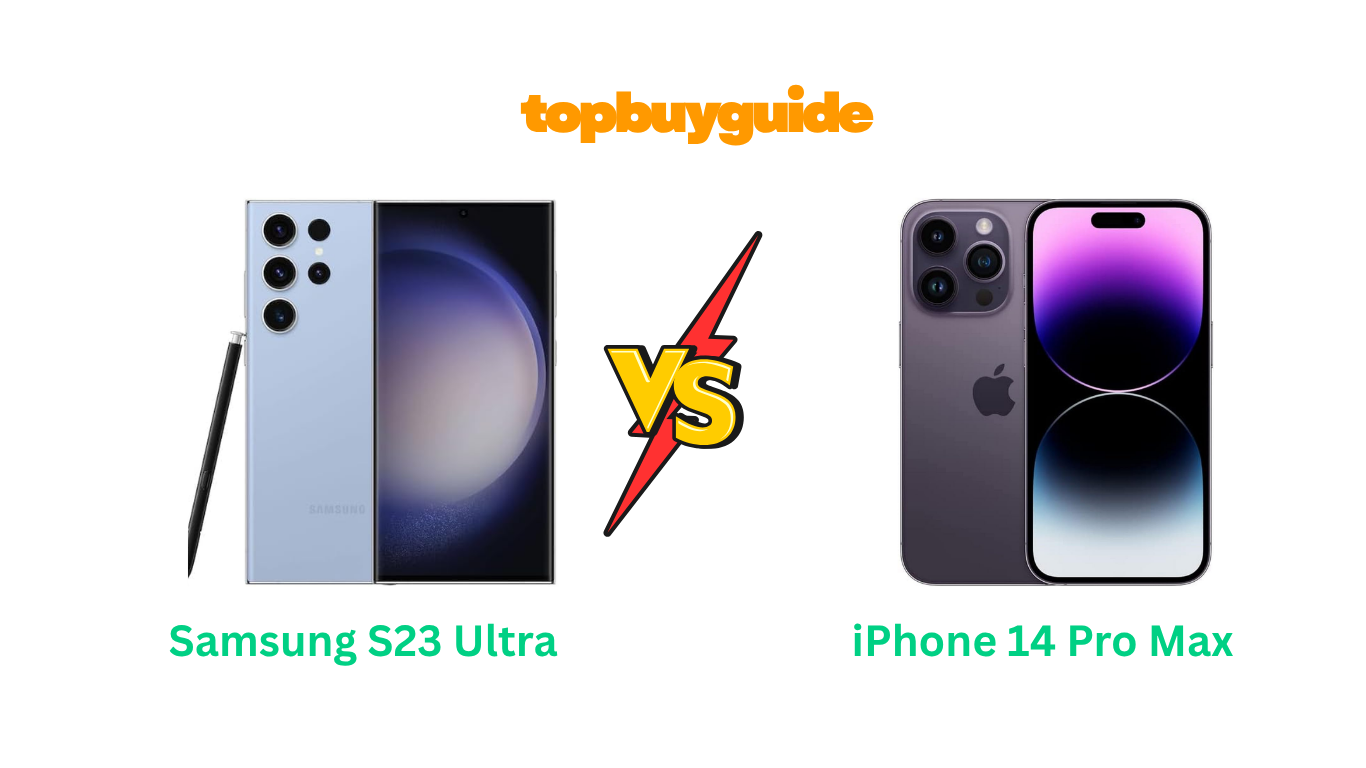
Choosing between two flagship titans can be overwhelming. The Samsung S23 Ultra and iPhone 14 Pro Max both represent peak smartphone engineering. After extensive testing, I recommend the Samsung S23 Ultra for its revolutionary 200MP camera and built-in S Pen stylus. The S23 Ultra delivers more versatile photography options and productivity features.
While the iPhone 14 Pro Max excels in video quality and ecosystem integration, Samsung’s offering provides superior value with double the base storage at a comparable price point.
Why Do I Recommend The Samsung S23 Ultra?
The Samsung S23 Ultra stands out as my top recommendation for several compelling reasons that outshine the iPhone 14 Pro Max:
- Revolutionary 200MP Camera: The S23 Ultra’s main sensor captures four times more detail than the iPhone’s 48MP camera. You can crop images extensively while maintaining sharpness. The iPhone 14 Pro Max produces excellent photos, but can’t match this level of detail retention.
- Built-in S Pen Stylus: Samsung includes a precision stylus for note-taking, drawing, and precise screen control. The iPhone 14 Pro Max offers no stylus option whatsoever. This feature transforms the S23 Ultra into a portable productivity powerhouse.
- 256GB Base Storage: The S23 Ultra starts with 256GB storage at $1,199. In contrast, the iPhone 14 Pro Max begins at only 128GB for $1,099. Upgrading the iPhone to 256GB costs $1,199, eliminating any price advantage.
- Faster Charging Speed: The S23 Ultra supports 45W fast charging, reaching full charge in under 60 minutes. Meanwhile, the iPhone 14 Pro Max maxes out at 27W, requiring nearly two hours for complete charging.
- Larger 5000mAh Battery: Samsung’s battery capacity exceeds the iPhone’s 4323mAh significantly. This translates to longer usage time between charges. The S23 Ultra consistently outlasts the iPhone in standby and call time.
- Higher Resolution Display: The 6.8-inch QHD+ screen (3088×1440) on the S23 Ultra delivers sharper visuals than the iPhone’s 6.7-inch display (2796×1290). Text appears crisper and images show finer details.
- Superior Color Accuracy: Samsung’s screen covers 112% of the DCI-P3 color gamut in natural mode. Conversely, the iPhone 14 Pro Max achieves only 83.2% coverage. Colors appear more vibrant and accurate on the S23 Ultra.
- Expandable Zoom Capability: Dual telephoto lenses provide 3x and 10x optical zoom on the S23 Ultra. The iPhone offers 2x and 3x optical zoom only. Samsung delivers more versatility for distant subjects.
Side By Side Comparison Chart Samsung S23 Ultra vs iPhone 14 Pro Max
| Features | Samsung S23 Ultra | iPhone 14 Pro Max |
| Main Camera | 200MP | 48MP |
| Display Size | 6.8 inches | 6.7 inches |
| Resolution | 3088 x 1440 | 2796 x 1290 |
| Processor | Snapdragon 8 Gen 2 for Galaxy | Apple A16 Bionic |
| Base Storage | 256GB | 128GB |
| Battery Capacity | 5000mAh | 4323mAh |
| Charging Speed | 45W | 27W |
| Stylus | S Pen included | None |
| Telephoto Cameras | Dual (3x, 10x) | Dual (2x, 3x) |
| Refresh Rate | 1-120Hz adaptive | 1-120Hz adaptive |
| Starting Price | $1,199 | $1,099 |
| Weight | 233g | 240g |
| Operating System | Android 13/One UI 5.1 | iOS 16 |
| Charging Port | USB-C | Lightning |
What Common Samsung S23 Ultra vs iPhone 14 Pro Max Features Can Do?
Both flagships share remarkable capabilities that define premium smartphone experiences. Understanding these commonalities helps you appreciate what you’re getting regardless of your choice.
120Hz Adaptive Refresh Rate Display: Both phones feature LTPO technology enabling smooth scrolling. The screens dynamically adjust between 1Hz and 120Hz based on content. This conserves battery during static content while maintaining fluidity during scrolling. Whether browsing social media or gaming, both devices deliver buttery-smooth visuals.
Premium Build Quality: Samsung uses Armor Aluminum and Gorilla Glass Victus 2 for durability. Apple employs stainless steel and Ceramic Shield glass for protection. Both phones achieve IP68 water resistance, surviving submersion up to 6 meters. The construction quality ensures these devices withstand daily wear and demanding conditions.
Wireless Charging Support: Both flagships support Qi wireless charging for cable-free power. Samsung offers 15W wireless charging speed, while Apple provides 15W MagSafe charging. Reverse wireless charging works on both devices for powering accessories. This flexibility eliminates cable dependency in your daily routine.
5G Connectivity: Both phones support sub-6GHz and mmWave 5G networks where available. Download speeds reach gigabit levels on compatible networks. The connectivity ensures future-proof performance as 5G coverage expands. Streaming, downloading, and video calls benefit from lightning-fast data speeds.
Advanced Security Features: Samsung implements ultrasonic fingerprint scanning under the display for secure unlocking. Apple uses Face ID with 3D facial recognition technology. Both systems provide bank-level security for payments and sensitive data. Your personal information remains protected with either authentication method.
HDR Video Recording: Both cameras capture HDR video with exceptional dynamic range. The S23 Ultra supports HDR10+ recording, while the iPhone uses Dolby Vision. Colors appear more vibrant and highlights remain controlled in challenging lighting. Your videos look professional with either device.
Stereo Speakers: Dual speaker systems on both phones deliver immersive audio. The sound quality ranks among the best in smartphones. Music, videos, and games benefit from clear, balanced audio output. Volume levels reach impressive peaks without significant distortion.
Common Features of Samsung S23 Ultra vs iPhone 14 Pro Max
| Features | Samsung S23 Ultra | iPhone 14 Pro Max |
| Adaptive Refresh Rate | 1-120Hz | 1-120Hz |
| Water Resistance | IP68 | IP68 |
| Wireless Charging | 15W | 15W MagSafe |
| 5G Support | Sub-6, mmWave | Sub-6, mmWave |
| Stereo Speakers | Yes | Yes |
| HDR Video | HDR10+ | Dolby Vision |
| Face Recognition | Yes | Yes (Face ID) |
| Wi-Fi 6E | Yes | Yes |
| Bluetooth | 5.3 | 5.3 |
| NFC | Yes | Yes |
| GPS | Multi-band | Multi-band |
| Emergency Features | Yes | Satellite SOS |
A Detailed Comparison Of Samsung S23 Ultra vs iPhone 14 Pro Max
Display Quality and Technology
The Samsung S23 Ultra showcases a 6.8-inch Dynamic AMOLED 2X display with QHD+ resolution. The screen delivers 500 pixels per inch for exceptional sharpness. Gorilla Glass Victus 2 protects against scratches and drops. Peak brightness reaches 1,750 nits outdoors, ensuring excellent visibility in sunlight.
The iPhone 14 Pro Max features a 6.7-inch Super Retina XDR display with slightly lower resolution. However, Apple achieves remarkable 2,000 nits peak brightness outdoors. The Dynamic Island replaces the traditional notch for notifications. While brightness favors iPhone, Samsung’s higher resolution and color accuracy create a more immersive experience.
Camera System and Photography
Samsung’s 200MP main camera revolutionizes mobile photography with unprecedented detail capture. The quad-pixel sensor combines 16 pixels into one for excellent low-light performance. Dual telephoto lenses (3x and 10x optical) provide extensive zoom range. The 12MP ultrawide camera completes the versatile quad-camera system.
Apple’s 48MP main camera uses pixel binning for 12MP images with larger pixels. The sensor excels in challenging lighting conditions with Apple’s Photonic Engine. Two telephoto options (2x digital, 3x optical) limit zoom flexibility compared to Samsung. The 12MP ultrawide matches Samsung’s specification but processes images differently.
Performance and Processing Power
The Samsung S23 Ultra runs on Snapdragon 8 Gen 2 for Galaxy, custom-tuned for Samsung devices. The processor features overclocked cores running at 3.36GHz for enhanced performance. Gaming performance particularly impresses with the Adreno 740 GPU running at 719MHz. The phone stays cooler during intensive tasks than previous models.
Apple’s A16 Bionic chip delivers exceptional single-core performance with efficiency cores. The 6-core CPU and 5-core GPU handle demanding tasks effortlessly. While benchmarks show mixed results, real-world performance remains stellar on both devices. The iPhone excels in video editing, while Samsung dominates graphics-intensive gaming.
Battery Life and Charging
Samsung packs a substantial 5000mAh battery supporting full-day heavy usage easily. The 45W fast charging reaches 68% in just 30 minutes. Complete charging takes approximately 55 minutes with appropriate charger. The larger capacity ensures longer standby and talk time compared to iPhone.
The iPhone 14 Pro Max contains a 4323mAh battery optimized for iOS efficiency. Apple achieves impressive video playback time despite smaller capacity. However, 27W charging feels sluggish, restoring only 48% in 30 minutes. Full charging requires nearly two hours, testing user patience regularly.
Design and Build
The Samsung S23 Ultra features flat top and bottom edges with slightly curved sides. The matte finish resists fingerprints effectively across all color options. Four individual camera lenses protrude distinctly from the back glass. The included S Pen slides into a dedicated silo seamlessly.
Apple maintains its signature flat-edge design with stainless steel frame construction. The pill-shaped Dynamic Island houses front cameras and sensors innovatively. Three cameras sit in a prominent square module. However, the glossy back attracts fingerprints more readily than Samsung’s matte finish.
Storage Options and Value
Samsung starts at 256GB storage with 8GB RAM for $1,199. The 512GB variant with 12GB RAM costs $1,379. The top 1TB model reaches $1,619 with 12GB RAM. UFS 4.0 storage provides faster read/write speeds than previous generations.
Apple’s base 128GB model costs $1,099 but quickly becomes limiting. Upgrading to 256GB raises the price to $1,199, matching Samsung’s starting price. The 512GB variant costs $1,399, while 1TB reaches $1,599. Apple charges premium pricing for storage upgrades across the board.
Software and Ecosystem
Samsung ships Android 13 with One UI 5.1, offering extensive customization options. The interface supports widgets, themes, and third-party launchers freely. Samsung promises four years of major Android updates. The software integrates seamlessly with Windows through Samsung DeX.
Apple’s iOS 16 delivers consistent, smooth performance with optimized app selection. The closed ecosystem ensures better privacy and security controls. Apple typically supports devices for 5-6 years with updates. However, customization remains limited compared to Android’s flexibility.
Video Recording Capabilities
The Samsung S23 Ultra records 8K video at 30fps with impressive detail. Expert RAW mode provides professional-level control for photographers. Super Steady mode stabilizes footage effectively during movement. Astrophotography mode captures stunning night sky timelapses automatically.
The iPhone 14 Pro Max excels in video with Cinematic mode at 4K 30fps. ProRes video recording appeals to professional content creators significantly. Action mode delivers exceptional stabilization without requiring gimbals. Dolby Vision HDR recording produces stunning dynamic range.
Connectivity and Ports
Samsung includes USB-C 3.2 for fast data transfer and universal compatibility. The port supports DisplayPort for external monitor connections. Wi-Fi 6E and Bluetooth 5.3 ensure cutting-edge wireless connectivity. The phone works with most chargers and accessories universally.
Apple sticks with Lightning connector limiting transfer speeds to USB 2.0. While convenient for existing accessories, the proprietary connection feels outdated. Wi-Fi 6 and Bluetooth 5.3 match Samsung’s wireless specifications. However, the charging port choice disappoints many potential buyers.
Conclusion
The Samsung S23 Ultra emerges victorious with its groundbreaking 200MP camera and built-in S Pen. The device offers superior value with 256GB base storage matching iPhone’s 256GB price point. Faster 45W charging and larger 5000mAh battery provide practical daily advantages. The versatile quad-camera system with dual telephoto lenses outperforms iPhone’s setup. While the iPhone 14 Pro Max delivers excellent performance and ecosystem benefits, Samsung’s feature-rich package justifies the investment better for most users.
FAQs
Which phone has better camera quality? The Samsung S23 Ultra wins with its 200MP main camera capturing more detail. The dual telephoto system offers superior zoom versatility. However, iPhone 14 Pro Max excels in video recording quality. For photography enthusiasts, Samsung provides more creative flexibility.
Does the S23 Ultra have better battery life? Yes, the 5000mAh battery outlasts iPhone’s 4323mAh in most scenarios. Samsung achieves longer standby and call time consistently. The 45W fast charging reaches full charge much quicker. However, iPhone optimizes software efficiency for impressive video playback time.
Is the S Pen worth it? Absolutely, the S Pen transforms productivity and creativity on the S23 Ultra. You can take handwritten notes, draw precisely, and control apps remotely. The iPhone 14 Pro Max offers no stylus support whatsoever. Business users and artists particularly benefit from this feature.
Which phone has better display? Samsung’s 6.8-inch QHD+ display delivers higher resolution and color accuracy. The screen covers 112% DCI-P3 compared to iPhone’s 83.2% coverage. However, iPhone achieves brighter 2,000 nits peak brightness outdoors. Overall, Samsung provides a more vibrant viewing experience.
Does iPhone 14 Pro Max charge faster? No, the iPhone charges significantly slower with only 27W maximum speed. Full charging takes nearly two hours compared to Samsung’s 55 minutes. The S23 Ultra’s 45W charging provides more practical convenience. This difference matters during busy days requiring quick power boosts.
Which phone receives longer software updates? Apple typically supports iPhones for 5-6 years with major iOS updates. Samsung promises 4 years of Android updates for the S23 Ultra. Both manufacturers provide security patches regularly throughout support periods. Apple maintains a slight edge in long-term software support.
Is the price difference justified? The S23 Ultra costs $1,199 for 256GB versus iPhone’s $1,099 for 128GB. Comparing equivalent 256GB models, both cost $1,199 identically. Samsung includes more features like S Pen and better camera hardware. The value proposition clearly favors Samsung for the same price point.
Which ecosystem is better? Apple’s ecosystem integrates seamlessly across devices with Continuity features. Samsung offers flexibility with Windows integration through DeX and Android openness. Choose iPhone if you own multiple Apple devices already. Pick Samsung if you prefer customization and cross-platform compatibility.

Alex Turner is a dedicated product researcher and reviewer at TopBuyGuide.com, known for his clear, honest, and data-driven insights. He spends countless hours testing, comparing, and analyzing products to help readers make confident and informed buying decisions.