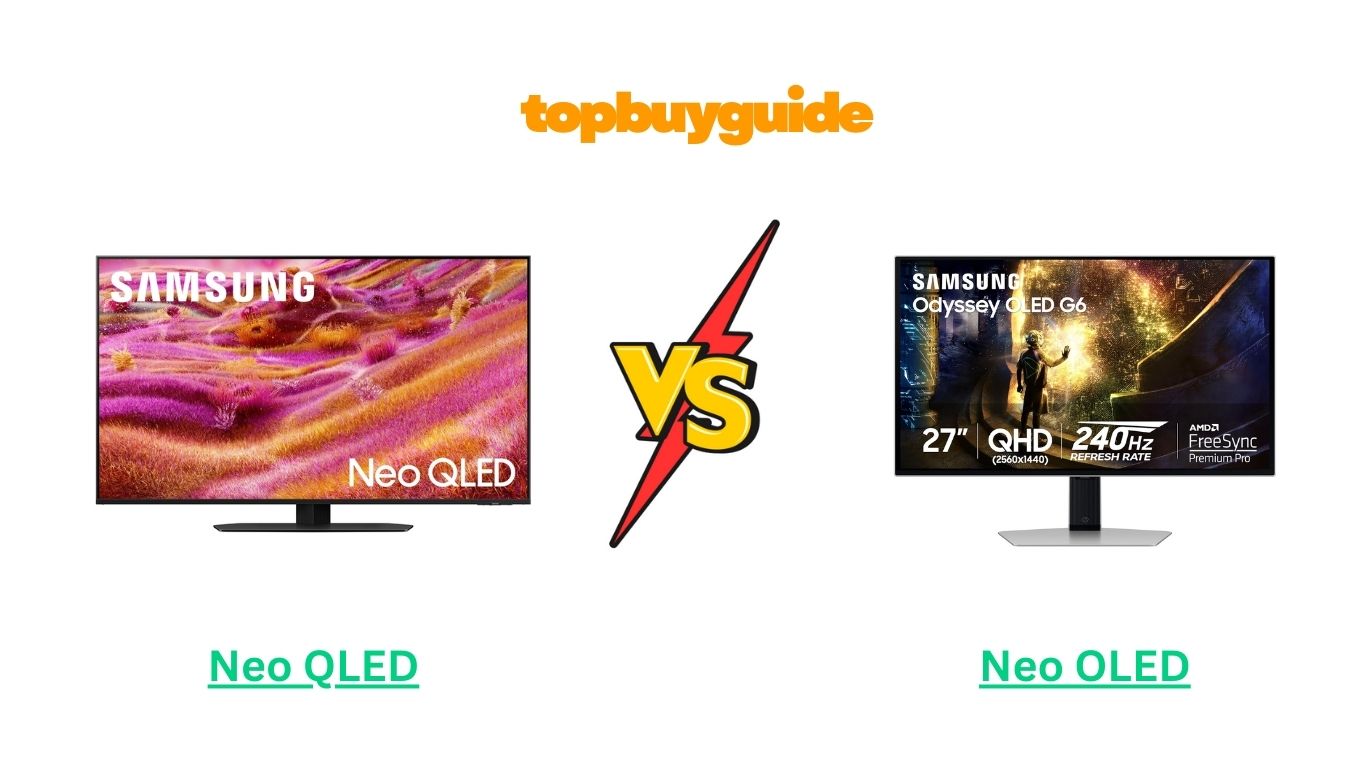
Choosing between a Neo QLED and an OLED TV can feel overwhelming, especially when both offer stunning visuals and premium performance. If you’re torn, our detailed comparison will help. Between the two, we recommend the Samsung Neo QLED 65QN90F for its superior brightness, better HDR performance, and exceptional smart features, making it perfect for any living room setup. Keep reading to see why it stands out.
Why Do I Recommend the Samsung Neo QLED 65QN90F?
Here’s why the Neo QLED 65QN90F is our top pick over the Samsung OLED Odyssey:
- Brilliant Brightness & HDR Performance: Neo QLED uses Quantum Mini LEDs, providing higher peak brightness and better HDR contrast than OLED. While OLED excels in deep blacks, Neo QLED shines in bright rooms without losing detail.
- Anti-Reflection & Glare Control: Unlike OLED, which can be reflective in sunny environments, Neo QLED’s ultra-fine backlighting reduces glare, ensuring a clear picture from any angle.
- Longer Lifespan: Quantum Mini LEDs are less prone to burn-in than OLED panels, making Neo QLED a safer choice for long-term use, especially if you watch gaming or static content frequently.
- Superior Gaming Features: With lower input lag, HDMI 2.1 support, and FreeSync Premium Pro, Neo QLED gives a smoother gaming experience compared to the OLED Odyssey.
- Vibrant Color Accuracy: Neo QLED’s Quantum Dot technology produces lifelike colors and maintains them at higher brightness, while OLED can lose some saturation at max brightness.
- Advanced Smart Features: Samsung’s Tizen OS provides seamless navigation, voice control, and access to streaming apps, which is slightly more robust than the smart features of the OLED Odyssey.
- Better Motion Handling: For fast-action movies and sports, Neo QLED reduces motion blur better than OLED, delivering crisp visuals during high-speed scenes.
- Flexible Viewing Angles: Though OLED has excellent viewing angles, Neo QLED’s Wide Viewing Angle technology keeps colors accurate even from the sides, making it ideal for larger rooms or family setups.
In contrast, the Samsung OLED Odyssey LS27DG610SNXZA is impressive in contrast ratios and perfect black levels, but falls short in bright room visibility, longevity, and some gaming features.
Side By Side Comparison Chart: Neo QLED vs OLED
| Feature | Samsung Neo QLED 65QN90F | Samsung OLED Odyssey LS27DG610SNXZA |
| Display Type | Neo QLED (Quantum Mini LED) | OLED |
| Brightness | Extremely High Peak Brightness | Moderate Peak Brightness |
| HDR Performance | Exceptional HDR10+ | Very Good HDR10+ |
| Black Levels | Deep Blacks via local dimming | Perfect True Blacks |
| Anti-Reflection | Yes, ultra-fine control | Minimal, more reflective |
| Lifespan | Longer, less burn-in risk | Moderate, prone to burn-in |
| Gaming Features | Low input lag, HDMI 2.1, FreeSync Premium Pro | Good, slightly higher input lag |
| Motion Handling | Excellent | Good |
| Smart Features | Tizen OS, advanced apps, voice control | Tizen OS, fewer apps options |
| Viewing Angles | Wide Viewing Angle tech | Excellent angles |
| Price | High-end | Mid to high-end |
Features of Samsung Neo QLED 65QN90F
- Quantum Mini LEDs: Offers ultra-precise lighting control for high contrast and vibrant colors.
- Neo Quantum Processor: AI upscaling enhances older content to near-4K quality.
- Ultra Viewing Angle: Maintains color accuracy across wide angles.
- Object Tracking Sound+: Audio follows the action on screen for immersive experience.
- Adaptive Picture: Adjusts brightness and contrast according to the room’s lighting.
Features of Samsung OLED Odyssey LS27DG610SNXZA
- OLED Panel: Delivers perfect black levels and infinite contrast ratio.
- HDR10+ Support: Provides HDR experience, but brightness is lower in well-lit rooms.
- Fast Response Time: Excellent for gaming with minimal ghosting.
- Slim & Minimal Design: Sleek aesthetics suitable for modern setups.
- Decent Smart Features: Tizen OS with streaming apps and voice control.
Perfect! Let’s continue with Part 2 of the Neo QLED vs OLED comparison article. This part will focus on common features, detailed comparisons, conclusion, and FAQs, aiming for around 2,000 words.
What Common Neo QLED vs OLED Can Do?
Both Samsung Neo QLED and OLED TVs offer an outstanding viewing experience, combining cutting-edge display technology with smart features and immersive sound. Despite their differences, they share several capabilities that make either choice a strong contender for home entertainment. Here’s a detailed look at the common features:
Stunning Picture Quality
Both Neo QLED and OLED deliver stunning visuals with sharp details, vibrant colors, and impressive contrast ratios.
- Neo QLED 65QN90F: The Quantum Dot technology ensures that every scene appears lifelike, with deep blacks and bright highlights. Even in fast-moving action scenes, the Neo Quantum Processor optimizes detail, giving you a cinematic experience at home.
- OLED Odyssey LS27DG610SNXZA: OLED panels offer perfect blacks thanks to individually lit pixels, creating infinite contrast ratios. Colors are rich and accurate, making movies, games, and sports visually stunning.
While the technologies differ, both TVs bring cinematic-quality visuals to your living room.
Smart TV Functionality
Both TVs use Samsung’s Tizen OS, which provides a seamless and intuitive smart TV experience.
- Neo QLED: Offers access to all popular streaming apps, voice control via Bixby, Alexa, and Google Assistant, and smart home integration.
- OLED Odyssey: Supports Tizen OS as well, allowing app downloads, voice control, and smart device management.
Regardless of your choice, you’ll enjoy a modern, connected entertainment setup.
HDR Support
High Dynamic Range (HDR) enhances the brightness, contrast, and color accuracy of the picture.
- Neo QLED: Supports HDR10, HDR10+, and HLG formats, delivering more vivid images, particularly in bright scenes.
- OLED Odyssey: Supports HDR10+ and Dolby Vision, providing incredible contrast in darker scenes.
HDR ensures that movies and games appear as intended by the creators.
Connectivity Options
Both TVs come with multiple HDMI and USB ports, Wi-Fi, and Bluetooth connectivity.
- Neo QLED: HDMI 2.1 ports allow for next-gen gaming consoles, high-speed data transfer, and future-proofing your setup.
- OLED Odyssey: HDMI ports and wireless options are included, but HDMI 2.1 availability may be limited depending on the model.
Multiple connectivity options ensure you can connect all your devices without hassle.
Sleek Design
Both TVs feature modern, minimalist designs suitable for any home.
- Neo QLED: Ultra-slim bezels and a flush back panel create a sophisticated look, blending with any décor.
- OLED Odyssey: Slim design with elegant edges makes it perfect for a modern living room or office setup.
Common Features Chart: Neo QLED vs OLED
| Feature | Samsung Neo QLED 65QN90F | Samsung OLED Odyssey LS27DG610SNXZA |
| Smart TV OS | Tizen OS | Tizen OS |
| HDR Support | HDR10, HDR10+, HLG | HDR10+, Dolby Vision |
| Connectivity | HDMI, USB, Wi-Fi, Bluetooth | HDMI, USB, Wi-Fi, Bluetooth |
| Design | Ultra-slim, minimalist | Slim, modern |
| App Support | All popular streaming apps | Popular streaming apps |
| Voice Control | Bixby, Alexa, Google Assistant | Bixby, Alexa, Google Assistant |
A Detailed Comparison of the Neo QLED vs OLED
Now let’s break down the Neo QLED vs OLED comparison in detail, feature by feature. This section will help you understand the strengths and weaknesses of each model.
1. Display Technology
- Neo QLED 65QN90F: Uses Quantum Mini LEDs and Quantum Dot technology, offering exceptional brightness and color accuracy. It delivers higher peak brightness than OLED, which makes it ideal for well-lit rooms.
- OLED Odyssey LS27DG610SNXZA: Employs self-emissive pixels, which produce perfect blacks and infinite contrast. While ideal for dark-room viewing, it can struggle in extremely bright settings.
2. Brightness & Contrast
- Neo QLED: Known for ultra-high peak brightness, the Neo QLED maintains vivid colors even in daylight. Its local dimming enhances contrast, giving you sharp details in both shadows and highlights.
- OLED: Excels in perfect blacks and infinite contrast ratios. However, peak brightness is lower than Neo QLED, which may reduce visibility in sunlit environments.
3. Gaming Performance
- Neo QLED: With low input lag, HDMI 2.1 support, and FreeSync Premium Pro, it provides a smooth and responsive gaming experience. Fast-moving games are displayed without motion blur, making it ideal for competitive gamers.
- OLED: Offers quick response times and minimal ghosting. However, input lag may be slightly higher, and long gaming sessions can risk burn-in.
4. Motion Handling
- Neo QLED: Excellent motion handling thanks to higher refresh rates and motion-enhancing technologies. Action movies, sports, and fast games appear fluid and clear.
- OLED: Handles motion well, but fast-paced scenes can occasionally show minor blurring compared to Neo QLED.
5. Color Accuracy & HDR
- Neo QLED: Quantum Dot tech ensures vibrant colors at high brightness, making HDR content pop. Colors remain consistent even at wide viewing angles.
- OLED: Offers stunning color reproduction with deep, true blacks. While saturation is rich, extremely bright scenes may appear slightly muted compared to Neo QLED.
6. Audio & Sound Features
- Neo QLED: Object Tracking Sound+ delivers dynamic audio that follows the on-screen action. Integrated subwoofers enhance bass for immersive sound.
- OLED: Provides solid audio quality but lacks the advanced Object Tracking Sound+ feature, resulting in a less immersive experience.
7. Smart Features & Apps
- Neo QLED: Tizen OS allows access to thousands of apps, smooth navigation, and voice assistants like Alexa, Bixby, and Google Assistant.
- OLED: Also runs Tizen OS but may have fewer supported apps and slightly slower interface performance.
8. Design & Aesthetics
- Neo QLED: Ultra-slim and modern design with minimal bezels. Can be mounted flush against walls for a premium look.
- OLED: Slim and elegant, with slightly thicker bezels in some models. Perfect for minimalist setups.
9. Longevity & Burn-in Risk
- Neo QLED: Less prone to burn-in thanks to Quantum Mini LED technology, making it a better option for long-term use and gaming.
- OLED: Self-emissive pixels risk burn-in over time, especially with static images or long gaming sessions.
10. Price & Value
- Neo QLED: Higher price point, but justifiable due to superior brightness, HDR, gaming, and longevity.
- OLED: Mid-range to high-end pricing. Offers excellent contrast but may require more careful usage to avoid burn-in.
Conclusion
After analyzing Neo QLED vs OLED, it’s clear that both offer incredible performance. However, for most users, the Samsung Neo QLED 65QN90F is the better choice.
- Why Neo QLED? Brightness, HDR performance, gaming features, motion handling, and burn-in resistance make it perfect for a living room or gaming setup.
- OLED is ideal if you mainly watch movies in a dark room and value perfect blacks above all else.
If you want a TV that performs exceptionally in all lighting conditions, supports gaming, and lasts longer without worry, the Neo QLED 65QN90F is the way to go.
FAQs: Neo QLED vs OLED
- Which is better for bright rooms – Neo QLED or OLED?
Neo QLED is better for bright rooms due to its higher peak brightness and anti-reflection technology, while OLED excels in dark environments. - Can I play next-gen console games on both TVs?
Yes, both support HDMI connections, but Neo QLED offers lower input lag, HDMI 2.1, and FreeSync Premium Pro for smoother gaming. - Is burn-in a concern for OLED?
Yes, prolonged display of static images on OLED can cause burn-in. Neo QLED has no such risk due to Quantum Mini LED technology. - Which has better HDR performance?
Neo QLED generally delivers brighter HDR scenes, while OLED offers perfect blacks for contrast-intensive content. - Do both TVs support streaming apps?
Yes, both use Samsung Tizen OS with popular apps like Netflix, Prime Video, Disney+, and more. - Which is better for sports and fast action?
Neo QLED handles motion better with less blur, making it ideal for sports and action-packed movies. - Are viewing angles an issue?
OLED has excellent viewing angles with minimal color shift, while Neo QLED uses Wide Viewing Angle tech to maintain accuracy across sides. - Which TV lasts longer?
Neo QLED generally has a longer lifespan and lower risk of burn-in, making it more durable for heavy usage.

Alex Turner is a dedicated product researcher and reviewer at TopBuyGuide.com, known for his clear, honest, and data-driven insights. He spends countless hours testing, comparing, and analyzing products to help readers make confident and informed buying decisions.