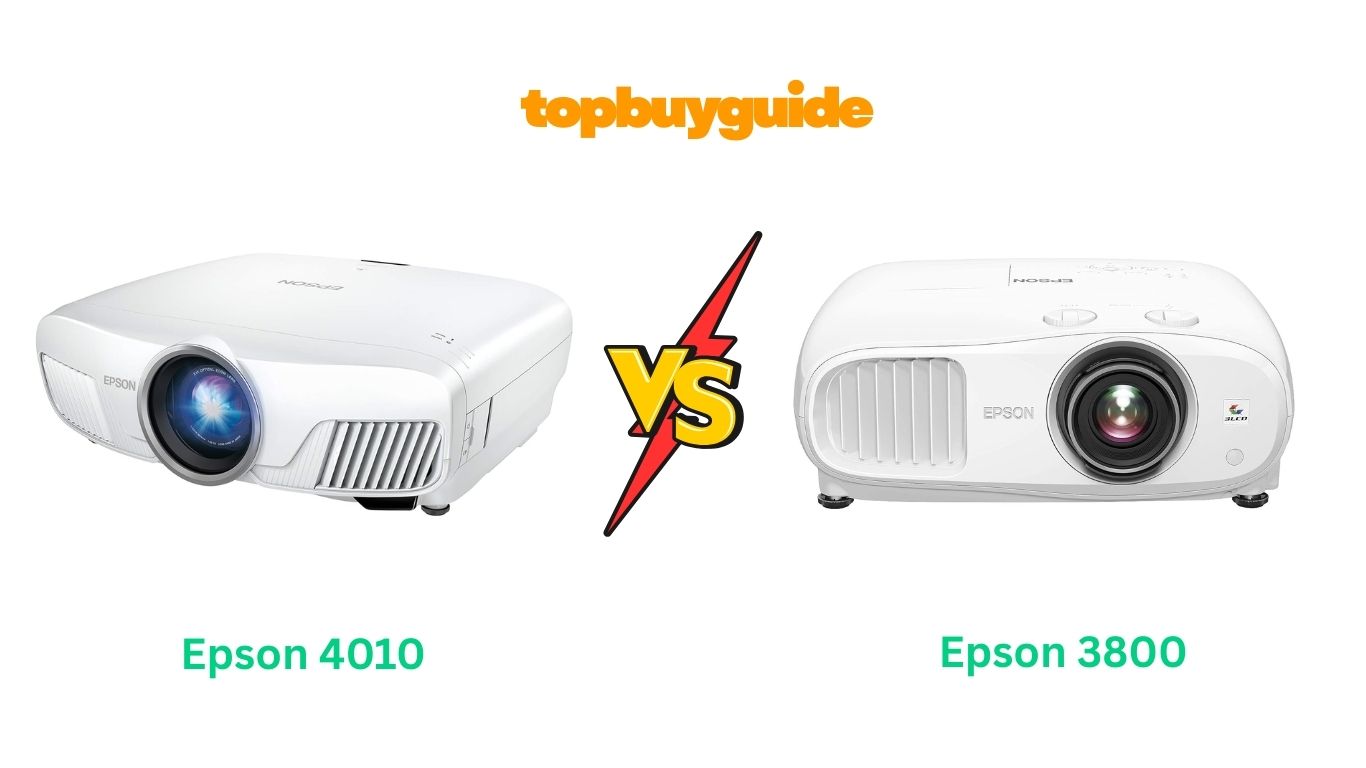
Choosing the right projector for your home theater can be tough, especially when comparing two excellent models from the same brand. Both the Epson Home Cinema 4010 and 3800 promise a stunning 4K experience, but which one is the better investment? After a detailed analysis, I recommend the Epson Home Cinema 3800 for most users. Its superior brightness and integrated Bluetooth audio offer better everyday usability at a more accessible price point.
Why Do I Recommend The Epson Home Cinema 3800?
While both projectors are fantastic, the Epson Home Cinema 3800 pulls ahead with a combination of performance and practical features that make it a more versatile and convenient choice for most home theater setups. Here’s why it gets my top recommendation:
- Superior Brightness: The Epson 3800 offers an impressive 3,000 lumens of both color and white brightness. This is significantly higher than the 2,400 lumens of the Epson 4010, making the 3800 a better performer in rooms with some ambient light. You won’t have to wait for complete darkness to enjoy a vibrant, clear picture for movies or gaming.
- Integrated Audio Solution: The Epson 3800 comes equipped with two built-in 10W stereo speakers. While they won’t replace a dedicated surround sound system, they are more than adequate for casual viewing or gaming sessions. In contrast, the Epson 4010 has no built-in speakers, requiring an external audio system for any sound at all.
- Built-in Bluetooth: A key advantage of the Epson 3800 is its built-in aptX Bluetooth connectivity. This allows you to easily and wirelessly connect to external Bluetooth speakers or headphones for a more immersive audio experience without the clutter of extra cables. The Epson 4010 lacks this convenient feature.
- Better Value for Money: The Epson 3800 generally comes in at a lower price point than the 4010. Considering its higher brightness and integrated audio features, it provides a more compelling overall value proposition without a significant compromise on core picture quality.
- Lighter and More Compact: Weighing in at 15.2 pounds, the Epson 3800 is considerably lighter and more compact than the hefty 24.3-pound Epson 4010. This makes it easier to handle, install, and position, especially for ceiling-mounted setups.
- Full 18 Gbps HDMI 2.0 Support: The Epson 3800 supports the full 18 Gbps bandwidth on its HDMI ports, ensuring compatibility with 4K HDR content at a full 60 Hz. This is particularly important for modern gaming consoles and streaming devices. The Epson 4010, on the other hand, is limited to HDMI 1.4 on one of its ports.
Side By Side Comparison Chart (Epson 4010 vs 3800)
| Feature | Epson Home Cinema 4010 | Epson Home Cinema 3800 |
| Brightness | 2,400 Lumens | 3,000 Lumens |
| Dynamic Contrast Ratio | 200,000:1 | 100,000:1 |
| Built-in Speakers | No | Yes (2 x 10W) |
| Bluetooth | No | Yes (aptX) |
| Weight | 24.3 pounds | 15.2 pounds |
| Dimensions | 20.5″ x 17.7″ x 6.7″ | 16.1″ x 13.0″ x 6.5″ |
| HDMI Ports | 1x HDMI 2.0 (HDCP 2.2), 1x HDMI 1.4 | 2x HDMI 2.0 (HDCP 2.2, 18 Gbps) |
| Price | ~$1,999 (New) | ~$1,599 (New) |
What Common Features Can the Epson 4010 vs 3800 Do?
Despite their differences, the Epson 4010 and 3800 share a core set of impressive technologies that deliver a premium viewing experience. They are both built on Epson’s renowned PRO-UHD platform, which is designed to provide exceptional color, clarity, and detail.
4K PRO-UHD Resolution Enhancement
Both the Epson 4010 and 3800 utilize Epson’s advanced 4K PRO-UHD pixel-shifting technology. While neither projector uses a native 4K chip, this technology precisely controls three individual 1080p LCD chips, firing pixels in rapid succession to produce a 4K resolution image on screen (3840 x 2160). The result is an incredibly sharp and detailed picture that is virtually indistinguishable from native 4K to the human eye, especially at normal viewing distances. This approach allows Epson to deliver a 4K experience at a much more affordable price than projectors with native 4K panels.
True 3-Chip 3LCD Technology
A key advantage of both Epson projectors is their true 3-chip 3LCD design. This technology dedicates a separate chip to each primary color (Red, Green, and Blue), displaying 100% of the RGB color signal for every frame. This eliminates the “rainbow effect”—color flashes that can be seen on some single-chip DLP projectors. It also ensures that the color brightness matches the white brightness, resulting in vibrant, balanced, and accurate colors across the entire image.
Full 10-Bit HDR Processing
Both the Epson 4010 and the Epson 3800 support full 10-bit High Dynamic Range (HDR) processing. This means they can accept and faithfully reproduce 100% of the HDR source information from your 4K Blu-rays, streaming services, and gaming consoles. This feature dramatically expands the range of contrast and color, delivering brighter whites, deeper blacks, and an exceptional level of detail in both the brightest and darkest parts of an image for a truly lifelike picture. The Epson 3800 also adds support for HLG (Hybrid Log-Gamma), an HDR standard used for broadcast television.
Epson Precision Lens
High-quality optics are crucial for a sharp, clear image, and both projectors feature an Epson Precision Lens. This multi-element glass structure ensures outstanding image clarity and edge-to-edge focus uniformity. This means the picture will be just as sharp in the corners as it is in the center. Both models also feature significant manual lens shift capabilities (both vertical and horizontal), which provides incredible flexibility for placing the projector off-center without needing to use digital keystone correction, which can degrade image quality.
Common Features of Epson 4010 vs 3800
| Feature | Epson 4010 | Epson 3800 |
| Resolution | 4K PRO-UHD (Pixel Shift) | 4K PRO-UHD (Pixel Shift) |
| Display Technology | 3-Chip 3LCD | 3-Chip 3LCD |
| HDR Support | Yes (Full 10-Bit HDR) | Yes (Full 10-Bit HDR, HLG) |
| Lens Shift | Yes (Vertical & Horizontal) | Yes (Vertical & Horizontal) |
| 3D Support | Yes (Active 3D) | Yes (Active 3D) |
| Video Processing | 12-bit real-time processing | 12-bit real-time processing |
| Color Space | Full DCI-P3 | Full DCI-P3 |
A Detailed Comparison Of the Epson 4010 vs 3800
Let’s dive deeper into the key features to see how these two projectors stack up head-to-head.
Brightness and Contrast Ratio
The Epson 3800 stands out with 3,000 lumens of both color and white brightness. This extra output gives it a clear edge over the Epson 4010’s 2,400 lumens, making the 3800 more suitable for viewing in rooms with moderate ambient light. You can enjoy a vibrant, punchy image for a Sunday afternoon football game without needing to black out the entire room.
However, the Epson 4010 fights back with a superior dynamic contrast ratio of 200,000:1, which is double the 100,000:1 ratio of the 3800. This means that in a dedicated, light-controlled home theater, the 4010 can deliver deeper black levels and more shadow detail, creating a more cinematic and immersive experience for movie nights.
Audio and Connectivity
This is a major point of difference. The Epson 3800 includes a pair of 10-watt speakers and Bluetooth connectivity. While the built-in speakers are basic, they provide a convenient, all-in-one solution for casual viewing. More importantly, the Bluetooth feature allows you to easily connect to a soundbar or wireless headphones for better audio.
The Epson 4010 has no internal speakers or Bluetooth capabilities. This projector is designed for a dedicated home theater where it will be integrated with a separate AV receiver and surround sound system. While this offers the highest audio fidelity, it also means an external sound system is a mandatory additional purchase and setup step.
Gaming Performance
Both projectors are excellent for gaming, but the Epson 3800 has a slight edge for competitive players. It supports 4K HDR content at a full 60 frames per second (fps) thanks to its full 18 Gbps HDMI 2.0 ports. This ensures a smooth, responsive gaming experience with the latest consoles like the PlayStation 5 and Xbox Series X.
The Epson 4010 also performs well for gaming. However, its HDMI 1.4 port limitation can be a factor for some high-frame-rate sources. For most casual gamers, the difference will be negligible, but those seeking the best possible performance from their next-gen consoles will appreciate the 3800’s full bandwidth support.
Size, Weight, and Installation
The Epson 4010 is a beast of a projector, weighing nearly 25 pounds and measuring over 20 inches wide. It’s designed for a permanent, “set-it-and-forget-it” installation in a dedicated home theater, likely with a sturdy ceiling mount.
In comparison, the Epson 3800 is significantly lighter at around 15 pounds and has a more compact footprint. This makes it much easier to handle and provides more flexibility for installation, whether on a ceiling, a rear shelf, or even for occasional portability to a different room or a friend’s house.
Conclusion
So, which projector should you buy? The choice between the Epson 4010 and 3800 comes down to your specific needs and viewing environment.
If you are a dedicated cinephile building a light-controlled home theater and already have a high-quality external sound system, the Epson 4010 is an excellent choice. Its superior contrast ratio will provide slightly deeper black levels for a truly cinematic experience.
However, for the vast majority of users, the Epson Home Cinema 3800 is the smarter buy. It’s brighter, making it more versatile for rooms with some ambient light. The inclusion of built-in speakers and Bluetooth offers far greater convenience and flexibility right out of the box. Combined with its lower price and full support for 4K/60Hz gaming, the Epson 3800 delivers an incredible package and better overall value.
FAQs
- Which projector is better for a room with some ambient light?
The Epson 3800 is the better choice for rooms with ambient light. Its 3,000 lumens of brightness will produce a more vibrant and watchable image during the day or with lights on compared to the 2,400 lumens of the Epson 4010. - Do I need an external sound system for these projectors?
For the Epson 4010, yes, you absolutely need an external sound system as it has no built-in speakers. The Epson 3800 has two built-in 10W speakers, which are adequate for casual viewing, but you will still want an external system for an immersive home theater experience. - Is the Epson 4010’s higher contrast ratio a big deal?
The higher contrast ratio of the 4010 allows for deeper black levels, which can be noticeable in a completely dark room. However, in a room with any ambient light, this advantage is largely negated. For most viewing situations, the 3800’s excellent picture is more than sufficient. - Are these projectors true 4K?
Both projectors use Epson’s 4K PRO-UHD technology, which is a form of pixel shifting. They accept a native 4K signal and use advanced processing to render a 4K image on the screen. While not a native 4K chip, the resulting image is exceptionally sharp and detailed. - Which projector is better for gaming?
The Epson 3800 is slightly better for gaming because it supports 4K HDR at a full 60Hz on both HDMI ports. This ensures a smooth and responsive experience with the latest gaming consoles. The 4010 is also great for gaming, but its port limitations may affect some high-frame-rate content. - Can I connect Bluetooth speakers to both projectors?
No, only the Epson 3800 has built-in Bluetooth for connecting to wireless speakers or headphones. The Epson 4010 does not have this feature and requires a wired connection to an AV receiver or an external Bluetooth transmitter. - Is there a big difference in size between the two?
Yes, the Epson 4010 is significantly larger and heavier (24.3 lbs) than the Epson 3800 (15.2 lbs). This makes the 3800 easier to install and more manageable for shelf placement or ceiling mounting. - Do both projectors support 3D content?
Yes, both the Epson 4010 and the Epson 3800 support active 3D content, so you can enjoy your collection of 3D Blu-rays. You will need to purchase compatible active 3D glasses separately.

Alex Turner is a dedicated product researcher and reviewer at TopBuyGuide.com, known for his clear, honest, and data-driven insights. He spends countless hours testing, comparing, and analyzing products to help readers make confident and informed buying decisions.