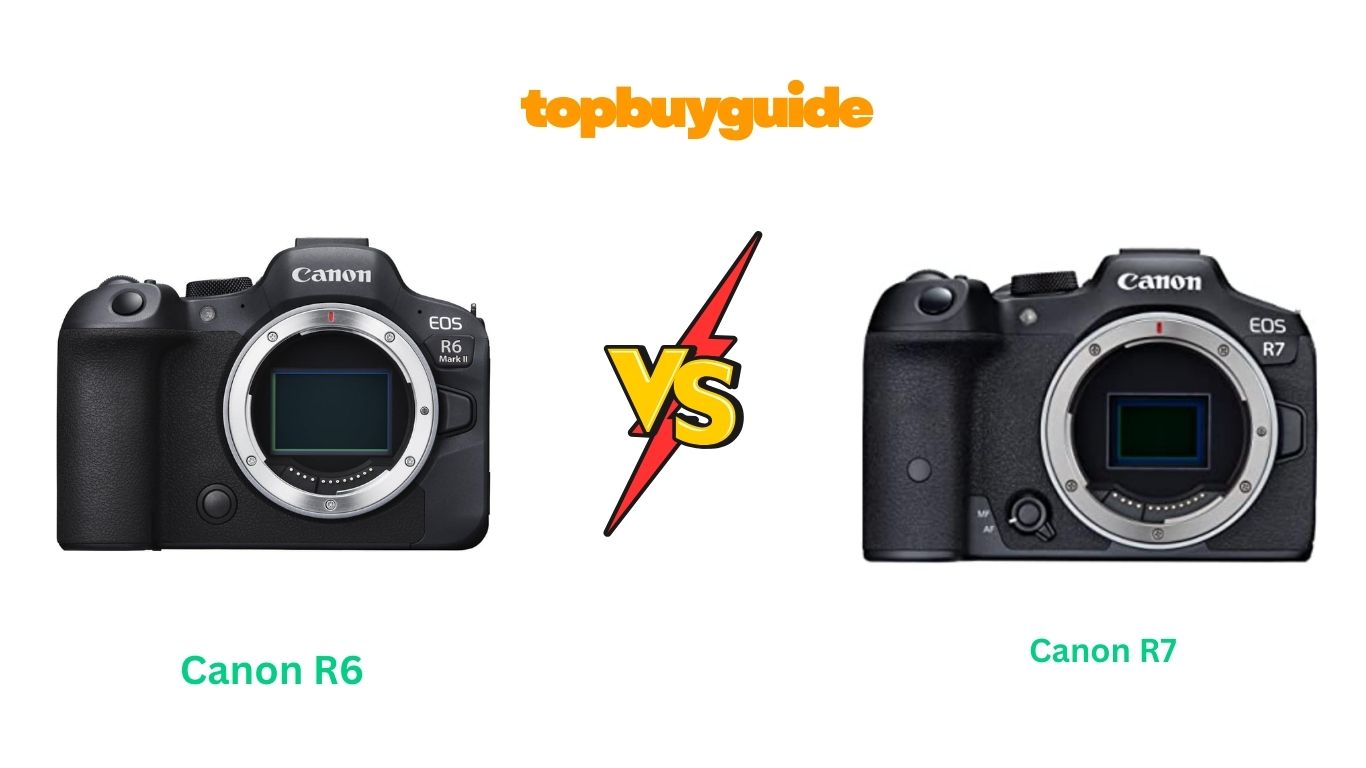
If you’re torn between the Canon R6and Canon R7, you’re not alone — both are powerhouse mirrorless cameras built for enthusiasts and professionals alike. After testing both, I recommend the Canon R6 Mark IIfor its superior low-light performance and full-frame sensor, which delivers outstanding image quality and smoother depth of field. But the Canon R7 still holds its ground for action shooters. Let’s break it all down.
Why Do I Recommend the Canon R6?
While both cameras shine in their own categories, the Canon R6 Mark II simply provides a more premium shooting experience that’s worth the extra investment. Here’s why I’d recommend it over the R7:
- Full-Frame Sensor for Stunning Image Quality
The R6 comes with a 24.2MP full-frame CMOS sensor, offering superior light-gathering capabilities and dynamic range compared to the R7’s APS-C sensor. This means cleaner, richer photos — especially in dim or tricky lighting conditions. - Better Low-Light and ISO Performance
Thanks to its full-frame build and DIGIC X processor, the Canon R6 delivers exceptional results even at ISO 102,400. The R7, while solid, shows more noise at higher ISOs due to its smaller sensor size. This gives the R6 an undeniable edge for night photography and indoor events. - Professional-Grade Video Capabilities
The R6 can record oversampled 4K video at up to 60p from 6K capture, offering sharper and cleaner footage. The R7’s 4K 60p video is great but not oversampled — meaning slightly less detail. If you shoot both photos and professional video, the R6 clearly wins. - Superior Autofocus Accuracy and Speed
With Canon’s Dual Pixel CMOS AF II system, the R6 achieves lightning-fast focusing across 100% of the frame. It tracks subjects flawlessly, even in dim environments. The R7 also uses the same AF system but slightly slower due to its smaller sensor readout speed. - Better Image Stabilization (Up to 8 Stops)
Both cameras offer 5-axis in-body image stabilization, but the R6 pairs more effectively with RF lenses, achieving smoother results. This is especially noticeable when handheld shooting or filming moving subjects. - Higher Build Quality and Weather Sealing
The R6 feels sturdier, with magnesium-alloy construction and improved weather sealing, making it more reliable in challenging outdoor conditions. The R7 is durable too, but more compact and slightly less robust. - Improved Rolling Shutter and Burst Shooting
The R6 Mark II can shoot up to 40 fps with the electronic shutter and reduces rolling shutter distortion better than the R7, which maxes at 30 fps. This matters a lot for sports and wildlife photographers. - More Natural Depth and Bokeh
The R6’s full-frame sensor gives you that smooth background blur and natural depth of field that’s harder to achieve with the R7’s crop sensor. Portrait and wedding photographers will absolutely appreciate this aesthetic difference.
In short, if you prioritize image quality, low-light performance, and professional video output, the Canon R6 Mark II is your best bet. The R7, however, is a solid alternative for wildlife and action shooters who want reach and speed on a budget.
Side-by-Side Comparison Chart (Canon R6 vs R7)
| Feature | Canon R6 Mark II | Canon R7 |
| Sensor Type | 24.2MP Full-Frame CMOS | 32.5MP APS-C CMOS |
| Image Processor | DIGIC X | DIGIC X |
| ISO Range | 100–102,400 (expandable to 204,800) | 100–32,000 (expandable to 51,200) |
| Autofocus System | Dual Pixel CMOS AF II, 1053 AF Points | Dual Pixel CMOS AF II, 651 AF Points |
| Continuous Shooting | 40 fps (Electronic) / 12 fps (Mechanical) | 30 fps (Electronic) / 15 fps (Mechanical) |
| Image Stabilization | 5-Axis IBIS up to 8 stops | 5-Axis IBIS up to 7 stops |
| Video Resolution | 4K 60p (oversampled from 6K), Full HD 180p | 4K 60p (non-oversampled), Full HD 120p |
| Viewfinder | 3.69M-dot OLED EVF | 2.36M-dot OLED EVF |
| LCD | 3.0” Vari-Angle Touchscreen | 3.0” Vari-Angle Touchscreen |
| Battery Life | 580 shots (CIPA) | 660 shots (CIPA) |
| Weather Sealing | Yes (Magnesium Alloy Body) | Yes (Polycarbonate Alloy Body) |
| Storage Slots | Dual UHS-II SD | Dual UHS-II SD |
| Weight | 670g (Body Only) | 612g (Body Only) |
What Common Canon R6 vs R7 Can Do?
Even though they target slightly different users, the Canon R6 and R7 share many powerful features that make both excellent choices for hybrid shooters.
Dual Pixel CMOS AF II Autofocus System
Both the R6 and R7 come equipped with Canon’s acclaimed Dual Pixel CMOS AF II, offering fast, accurate, and smooth subject tracking across nearly 100% of the frame. Whether you’re capturing fast-moving wildlife or shooting portraits, the autofocus locks onto subjects effortlessly.
In-Body Image Stabilization (IBIS)
Each camera features 5-axis In-Body Image Stabilization, compensating for camera shake during handheld shooting. When paired with stabilized RF lenses, both can achieve up to 7–8 stops of correction, ensuring sharp results even in low light or while filming handheld video.
Dual UHS-II SD Card Slots
Both models include dual UHS-II SD card slots, providing flexibility for redundant backups or overflow storage. This is especially useful for professional photographers who need reliable file management on the go.
4K 60p Video Recording
The Canon R6 and R7 are both capable of shooting 4K 60p video, giving creators smooth, cinematic footage. While the R6 offers oversampled 4K for crisper detail, the R7 still delivers impressive quality at a slightly lower readout resolution.
Fully Articulating Touchscreen
Each camera features a 3.0-inch vari-angle touchscreen, making it easy to shoot from creative angles or record vlogs. Both interfaces are intuitive, with responsive touch menus familiar to Canon users.
Weather-Sealed Construction
The R6 and R7 both feature durable, weather-sealed builds. You can confidently take them outdoors for travel or wildlife photography without worrying about light rain or dust.
Common Features of Canon R6 vs R7
| Feature | Canon R6 Mark II | Canon R7 |
| Autofocus System | Dual Pixel CMOS AF II | Dual Pixel CMOS AF II |
| Image Processor | DIGIC X | DIGIC X |
| In-Body Stabilization | 5-Axis IBIS | 5-Axis IBIS |
| Video | 4K 60p | 4K 60p |
| LCD Screen | 3.0″ Vari-Angle Touchscreen | 3.0″ Vari-Angle Touchscreen |
| Card Slots | Dual UHS-II SD | Dual UHS-II SD |
| Connectivity | Wi-Fi, Bluetooth | Wi-Fi, Bluetooth |
| Weather Sealing | Yes | Yes |
A Detailed Comparison of the Canon R6 vs R7
Let’s dive deep into how these two mirrorless cameras stack up against each other feature by feature — from design and image quality to performance and video capabilities.
1. Sensor and Image Quality
The Canon R6 Mark II features a 24.2MP full-frame CMOS sensor, while the Canon R7 houses a 32.5MP APS-C CMOS sensor.
While the R7 technically has a higher megapixel count, the R6’s larger sensor delivers richer colors, superior depth, and cleaner details, particularly in challenging lighting. Full-frame sensors excel in dynamic range, allowing you to capture more shadow and highlight details.
In contrast, the R7’s APS-C sensor gives you a 1.6x crop factor, effectively extending your focal length — great for wildlife or sports photography, where extra reach is handy. But for portraits, landscapes, and low-light work, the R6 wins decisively.
2. ISO and Low-Light Performance
When it comes to low-light shooting, the R6 is a clear leader. Its ISO range goes up to 102,400 (expandable to 204,800), allowing photographers to capture noise-free images in near darkness.
The R7, while decent, caps at ISO 32,000 (expandable to 51,200), and at higher ISO levels, noise becomes more noticeable. If you often shoot in dim environments — think weddings, concerts, or indoor scenes — the R6’s cleaner ISO performance will save you hours of post-processing.
3. Autofocus and Subject Tracking
Both cameras share the Dual Pixel CMOS AF II system, but the R6 has 1053 focus points versus the R7’s 651 points.
This gives the R6 more precision in tracking subjects across the frame, especially for fast-moving objects.
However, the R7 offers subject detection for people, animals, and vehicles, making it an excellent choice for action photographers. Still, the R6’s full-frame sensor and faster readout mean smoother tracking and better focus reliability in low light.
4. Burst Shooting and Shutter Speed
Speed lovers will appreciate that the Canon R6 Mark II can shoot up to 40 frames per second (electronic shutter), while the Canon R7 reaches 30 fps.
While both are lightning-fast, the R6 offers less rolling shutter distortion, which matters for moving subjects like sports or wildlife.
The R7 compensates slightly with a faster mechanical shutter speed of 1/8000 sec, compared to the R6’s 1/4000 sec, but overall, the R6’s burst performance feels smoother and cleaner.
5. Video Performance
The Canon R6 takes the lead for video creators. It records oversampled 4K at 60fps from 6K capture — giving it extra detail, clarity, and less moiré. It also supports Full HD 180p slow-motion for cinematic effects.
The Canon R7, on the other hand, can shoot 4K 60fps (non-oversampled) and Full HD 120p, which is still excellent but slightly softer. Additionally, the R6 handles overheating better during long takes, making it ideal for vloggers and videographers alike.
6. Image Stabilization (IBIS)
Both cameras feature 5-axis in-body image stabilization, but the R6 manages up to 8 stops of correction compared to the R7’s 7 stops.
In real-world use, this difference means the R6 delivers smoother handheld footage and steadier photos when shooting without a tripod — particularly helpful for low-light and travel photography.
7. Build and Ergonomics
The R6 Mark II feels more premium, built with a magnesium alloy body and weather-sealing that can withstand rough conditions. The R7, although also weather-sealed, uses a polycarbonate alloy, making it lighter but less robust.
The R6’s grip and control layout feel more natural, especially for long sessions. It’s a camera built for professionals, while the R7 caters more to enthusiasts looking for a lighter kit.
8. Battery Life
The R7 slightly edges out with 660 shots per charge (CIPA), compared to the R6’s 580 shots. That said, both can last longer depending on settings and shooting style. If you record a lot of video, consider investing in spare batteries regardless.
9. Price-to-Performance Ratio
The R7 offers exceptional value for its price, packing many of Canon’s high-end features in a smaller, more affordable body. However, if your priority is pure image quality and professional output, the Canon R6 Mark II justifies its price tag.
Conclusion
Both the Canon R6 Mark II and Canon R7 are fantastic mirrorless cameras — but they serve different audiences.
If you want a full-frame camera that excels in image quality, low-light shooting, and professional video production, the Canon R6 Mark II is the smarter investment. Its superior ISO performance, sensor size, autofocus reliability, and video sharpness make it ideal for portrait, event, and commercial photographers.
On the other hand, if you’re a wildlife or sports shooter seeking speed, reach, and portability at a lower cost, the Canon R7 is an excellent choice. Its APS-C sensor gives you more zoom reach without compromising on sharpness.
👉 Bottom Line:
If your goal is professional-grade quality and versatility, go with the Canon R6 Mark II.
If you’re budget-conscious but still want top-tier performance, the Canon R7 delivers more than you’d expect for its price.
FAQs About Canon R6 vs R7
- Which camera is better for low-light photography, Canon R6 or R7?
The Canon R6 performs significantly better in low light due to its full-frame sensor and higher ISO range. It produces cleaner images with less noise. - Does the Canon R7 have the same autofocus system as the R6?
Yes, both use Canon’s Dual Pixel CMOS AF II, but the R6 has more focus points (1053 vs 651), making it more precise for subject tracking. - Is the Canon R7 good for wildlife photography?
Absolutely. Its APS-C sensor gives a 1.6x crop factor, providing extra reach that’s ideal for capturing distant subjects like birds or animals. - Can the Canon R6 shoot oversampled 4K video?
Yes, the R6 shoots oversampled 4K video from 6K capture, resulting in sharper, more detailed footage — perfect for professional videographers. - Which has better stabilization, R6 or R7?
The Canon R6 offers up to 8 stops of in-body stabilization, while the R7 provides up to 7 stops. Both are excellent, but the R6 is slightly smoother in handheld shooting. - Is the Canon R6 heavier than the R7?
Yes, the R6 weighs about 670g, while the R7 is lighter at around 612g — making the R7 easier to carry for travel or long shoots. - Can both cameras use the same lenses?
Yes, both use Canon’s RF mount system, meaning you can interchange lenses between them easily — a great benefit if you own multiple Canon bodies. - Which camera is best for beginners?
For beginners, the Canon R7 is more affordable, lighter, and still packed with advanced features. But if you want a camera that will grow with you professionally, go for the Canon R6.

Alex Turner is a dedicated product researcher and reviewer at TopBuyGuide.com, known for his clear, honest, and data-driven insights. He spends countless hours testing, comparing, and analyzing products to help readers make confident and informed buying decisions.