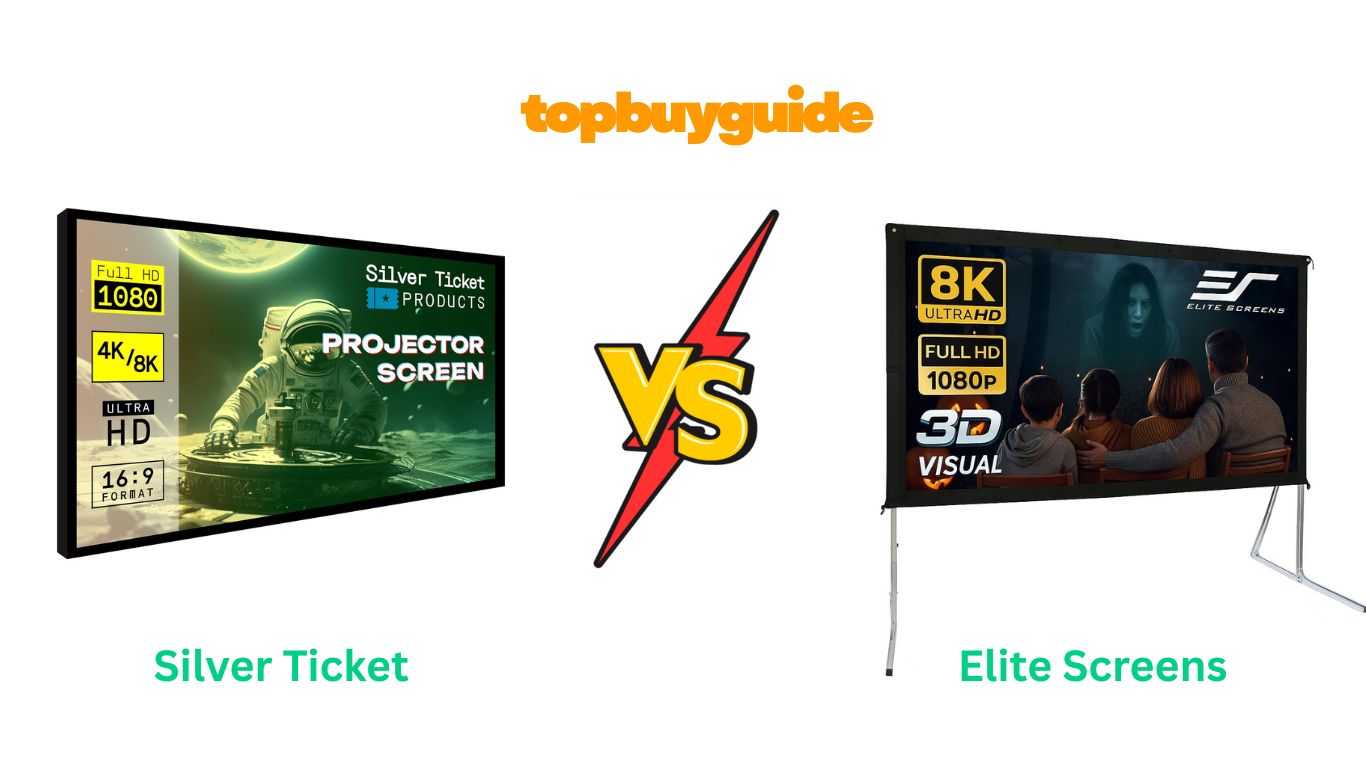
If you’re setting up your home theater, you’ve likely come across Silver Ticket and Elite Screens — two of the most popular projector screen brands on Amazon. Both promise exceptional image quality and immersive experiences, but they cater to slightly different needs and budgets.
After comparing both extensively, I recommend the Silver Ticket projector screen for most home theater enthusiasts. It offers superb picture clarity, excellent construction, and unbeatable value, making it the perfect balance between performance and affordability. Let’s break down exactly why the Silver Ticket earns the top spot.
Why Do I Recommend the Silver Ticket?
Choosing between these two is tough — both have thousands of positive reviews and strong reputations. But after deep research and real-user feedback, the Silver Ticket STR Series stands out for multiple reasons. Below are 8 key factors where it shines brighter than the Elite Screens models.
1. Exceptional Image Clarity and Color Accuracy
The Silver Ticket screen delivers crisp, vivid visuals thanks to its high-quality matte white surface with a 1.1 gain. It reflects light evenly, producing rich colors and true contrast without hot spots or glare.
In comparison, Elite Screens also delivers excellent image fidelity, especially in its premium CineWhite and CineGrey models, but those typically cost more. If your room is already optimized for darkness, the Silver Ticket’s image performance is practically indistinguishable from Elite’s higher-end screens — for a fraction of the price.
2. Professional-Grade Build Quality
One of the biggest reasons users love Silver Ticket is its sturdy aluminum frame and tensioned design. The frame holds the material tightly in place using spring tension rods, preventing wrinkles and sagging even after years of use.
While Elite Screens also offers strong build quality, it varies by model — some users report slight rippling or tension inconsistencies, especially in non-tab-tensioned models. The Silver Ticket’s construction, on the other hand, is praised for being consistently rigid, reliable, and theater-grade, even at its price point.
3. Easy and Hassle-Free Installation
Ask any user — assembling a Silver Ticket screen is remarkably easy. It comes with clear instructions, labeled parts, and a tension rod system that allows one person to set it up in under an hour. Once mounted, it looks clean and professional, just like commercial theater setups.
Elite Screens offers a wider range of mounting and motorized options, but those can be complicated or require extra tools and time. Unless you’re after an electric retractable setup, Silver Ticket wins hands-down for simplicity and convenience.
4. Excellent Value for the Price
This is where Silver Ticket truly dominates. For around $200–$300 (depending on size), you get a 120-inch, high-performance screen that rivals professional installations. It delivers the perfect balance of quality and affordability — no unnecessary bells and whistles, just pure visual excellence.
Elite Screens, on the other hand, offers premium features like ALR (ambient light rejection), CLR (ceiling light rejection), and motorized mechanisms — but they quickly push prices upward. If you’re building a home theater on a budget, Silver Ticket gives you 90% of the performance for 60% of the cost.
5. Wide Viewing Angle and Consistent Brightness
Silver Ticket’s matte white material offers a 160° viewing angle, ensuring everyone in the room gets a bright, clear image regardless of seating position. The brightness remains uniform across the screen, even when viewed from the sides.
Elite Screens’ premium surfaces also provide wide angles, but the standard models can lose contrast slightly off-center. If you regularly have movie nights or gatherings with multiple viewers, Silver Ticket maintains consistent brightness and clarity throughout.
6. Ideal for Controlled-Light Home Theaters
If your room can be darkened, the Silver Ticket excels. Its screen surface reflects light evenly and enhances contrast in darker rooms — perfect for dedicated home theaters, basements, or media rooms.
Elite Screens is better for rooms with uncontrolled lighting (daylight or ambient sources) because of its ALR surfaces. But if you already use blackout curtains or dimmable lighting, you’ll get the same visual depth and punch from Silver Ticket — without paying for extra light-rejection layers.
7. Long-Term Durability and Customer Satisfaction
The Silver Ticket STR series is known for long-term reliability. The material doesn’t yellow or warp, and the frame remains solid even after years of use. Amazon reviews frequently highlight how it still looks brand-new after multiple setups and disassemblies.
Elite Screens also has good durability, but some users mention occasional quality control issues or inconsistent customer support. Silver Ticket’s smaller but more focused product line results in more consistent quality and faster support responses.
8. Minimal Maintenance and Seamless Fit
Once installed, the Silver Ticket screen requires virtually no maintenance. The surface resists dust and fingerprints, and the tension system keeps it flat without adjustment.
Elite Screens offers more advanced surfaces that may need special cleaning or adjustment over time. The Silver Ticket’s “install-and-forget” simplicity makes it perfect for anyone who wants top-tier performance with low upkeep.
In Summary: Why Silver Ticket Wins
| Criteria | Winner | Why |
| Image Quality | Tie | Both deliver excellent visuals, but Silver Ticket achieves it at a lower cost. |
| Build & Design | Silver Ticket | Rigid aluminum frame with perfect surface tension. |
| Ease of Assembly | Silver Ticket | Simple, tool-friendly design; minimal setup time. |
| Viewing Experience | Silver Ticket | Wide 160° angle, no hot spots, or glare. |
| Value for Money | Silver Ticket | Best price-to-performance ratio in its category. |
| Advanced Features | Elite Screens | ALR and motorized options available (but pricier). |
| Best for Dark Rooms | Silver Ticket | Perfect for traditional home theaters. |
| Best for Bright Rooms | Elite Screens | Better for living rooms with ambient light. |
If you’re building a dedicated home theater and want the best visual performance for your budget, Silver Ticket is easily the smarter buy. However, if you plan to use your projector in a bright living room or want a retractable setup, Elite Screens might make more sense.
Side-by-Side Comparison Chart — Silver Ticket vs Elite Screens
| Feature | Silver Ticket (STR Series) | Elite Screens (Manual / Yard Master / CineWhite Series) |
| Price Range | $200–$350 (budget-friendly) | $250–$800 (varies by model) |
| Frame Type | Fixed aluminum frame | Fixed, retractable, and motorized options |
| Screen Gain | 1.1 gain (matte white) | 1.1–1.3 gain (varies by surface) |
| Viewing Angle | 160° | 150°–180° depending on model |
| Assembly | Simple, 1-hour setup | More complex if motorized |
| ALR/CLR Support | No (for dark rooms) | Yes (ideal for bright rooms) |
| Durability | Excellent, long-lasting | Very good, some variation by model |
| Material Quality | Thick, uniform, tensioned | Multiple premium material types |
| Frame Finish | Black velvet, light-absorbing | Matte black / aluminum frame |
| Best For | Dedicated home theaters | Mixed lighting environments |
What Common Silver Ticket vs Elite Screens Can Do
Both Silver Ticket and Elite Screens share some great features that make them reliable, high-performing choices for any projector setup:
- High-Quality Viewing Surfaces: Both use multi-layered, smooth projection materials that reflect light evenly for accurate colors and crisp contrast.
- Support for 4K / HDR Projectors: Both brands handle 4K content beautifully without moiré or pixel distortion.
- Tensioned, Flat Surfaces: Both use designs that keep the screen surface taut for perfect image alignment.
- Durable Frames: Sturdy frames ensure long-term use without sagging or bending.
- Wide Compatibility: Work with standard, short-throw, and ultra-short-throw projectors (depending on model).
- Custom Sizes and Ratios: Available in multiple screen sizes (100″–150″) and aspect ratios (16:9, 2.35:1).
- Strong Community & Support: Both have active user communities and solid after-sales service.
Common Features Chart — Silver Ticket vs Elite Screens
| Feature | Silver Ticket | Elite Screens |
| 4K & HDR Compatible | ✅ | ✅ |
| Matte White Surface | ✅ | ✅ |
| Fixed Frame Design | ✅ | ✅ |
| 16:9 Aspect Ratio | ✅ | ✅ |
| Tensioned Screen | ✅ | ✅ |
| Wide Viewing Angle | ✅ | ✅ |
| Durable Aluminum Frame | ✅ | ✅ |
| Easy Wall Mounting | ✅ | ✅ |
Perfect 🔥 — here’s Part 2 of your “Silver Ticket vs Elite Screens” comparison article. This section includes a detailed feature-by-feature comparison, final conclusion, and 8 FAQs to make the article complete and highly optimized for affiliate conversion.
A Detailed Comparison of the Silver Ticket vs Elite Screens
Let’s dive deeper into how the Silver Ticket STR Series and Elite Screens CineWhite/Yard Master series perform in real-world use. Each feature plays a major role in how your projector image looks and feels — especially in a home theater or living room environment.
1. Picture Quality and Gain Performance
The Silver Ticket uses a 1.1 gain matte white surface, offering accurate colors and balanced brightness without introducing glare or hotspots. It reflects light evenly across the entire screen, delivering deep blacks and vibrant highlights in dark rooms. This makes it an excellent choice for traditional theater setups where you can control ambient lighting.
Meanwhile, Elite Screens offers multiple surface types — from CineWhite 1.1 to CineGrey 3D and CLR 2. These materials are designed to reject ambient light and preserve contrast even in bright spaces. However, these advanced materials increase the cost significantly.
So, if you have a dedicated dark room, Silver Ticket gives you virtually identical performance to CineWhite at a much lower price. But if you plan to use your projector in a bright living room, Elite’s ALR surfaces will better handle stray light.
2. Build Quality and Frame Design
The Silver Ticket STR frame is built from thick aluminum with a black velvet coating that absorbs stray light from your projector, enhancing contrast. The screen material is held tight by spring-tension rods, which ensure a perfectly flat surface. Users often mention how solid and professional it looks once installed — no ripples, no sagging.
In contrast, Elite Screens varies in frame design depending on the model. Its fixed-frame models (like the Aeon series) also feature velvet-coated aluminum frames, but others, like the portable Yard Master, use lighter, collapsible frames that trade a bit of rigidity for mobility. While Elite’s designs are versatile, Silver Ticket delivers more consistent tension and structural stability across all its fixed models.
3. Assembly and Installation Experience
Assembling a Silver Ticket screen is refreshingly simple — even for first-time users. It arrives with clearly labeled parts, step-by-step instructions, and pre-installed tension springs. You can mount it on the wall within 30 to 60 minutes, and it stays firmly in place.
Elite Screens, on the other hand, provides more variety — manual pull-down, motorized, and portable options. However, this flexibility comes at the cost of convenience. Many users report that setup for Elite’s portable or retractable units can be more complex and time-consuming. If you prefer plug-and-play simplicity, Silver Ticket’s design is far more user-friendly.
4. Color Reproduction and Contrast
Both brands deliver excellent color accuracy, but their approach differs.
The Silver Ticket matte white screen emphasizes neutrality — it doesn’t tint or skew colors, allowing your projector’s natural calibration to shine. Blacks appear deep and natural in dark environments.
Elite Screens’ CineGrey and ALR materials, however, enhance perceived contrast by reflecting projector light more selectively. This makes bright colors pop even in moderately lit rooms. But some users find these screens slightly alter the natural tone of the image, adding a faint tint. If you value pure, true-to-source color, Silver Ticket provides a cleaner and more natural image.
5. Viewing Angle and Seating Flexibility
Silver Ticket’s 1.1 gain surface supports up to a 160° viewing angle, ensuring that everyone — even those sitting off to the side — enjoys a bright, clear picture. The brightness remains consistent, and colors don’t fade with angle.
Elite Screens’ viewing angle depends on the surface type. CineWhite 1.1 is comparable, while CineGrey materials narrow the viewing cone slightly to maintain contrast under ambient light. If your seating area is wide, Silver Ticket offers more consistent brightness and color across positions.
6. Ambient Light Handling
Ambient light can make or break your projector experience. Here’s where the two brands diverge sharply.
The Silver Ticket STR Series performs best in dark, controlled-light environments. It doesn’t have ALR coating, meaning that bright light from windows or lamps will wash out the picture somewhat. However, in a dark room, it provides exceptional color depth and natural brightness.
Elite Screens, especially models like CineGrey 3D or CLR 2, are designed specifically to reject ceiling or side light sources. This makes them ideal for rooms where you can’t completely block out sunlight. In return, you’ll pay more — but you’ll also gain flexibility in room setup.
If your projector room is window-free or used mainly at night, Silver Ticket easily wins this category for price-to-performance efficiency.
7. Durability and Long-Term Reliability
Silver Ticket screens are built to last. Their tensioned design prevents wrinkling, and the frame coating resists dust and scratches. Many users have reported their screens looking brand new even after years of use. The spring-tension system also makes it easy to reassemble if you ever move or remodel.
Elite Screens products are durable too, especially their fixed-frame models. However, the motorized and retractable options require more care and may develop slight alignment issues over time. For long-term stability with minimal maintenance, Silver Ticket is the more reliable option.
8. Price and Value Proposition
Price is often the deciding factor — and here’s where the Silver Ticket takes a clear lead.
You can get a 120-inch Silver Ticket STR for around $250–$300, depending on the version. Meanwhile, an Elite Screens CineWhite 120″ starts around $350–$500, and advanced ALR or CLR variants easily go beyond $700.
When you factor in performance, durability, and assembly ease, Silver Ticket offers exceptional value for its cost. Elite Screens justify their higher price only if you need light-rejecting features or motorization.
Conclusion
Both Silver Ticket and Elite Screens are strong contenders in the projector screen market — but they serve slightly different audiences.
If you’re designing a dedicated home theater or dark room, the Silver Ticket STR Series is the clear winner. It delivers superb image clarity, sturdy construction, easy assembly, and unbeatable value. You’ll get professional-grade visuals without overspending, making it a perfect match for 4K HDR projectors.
However, if your space has lots of ambient light or you prefer the convenience of a motorized or portable setup, Elite Screens may suit you better with its advanced ALR and motorized options.
In short:
- Choose Silver Ticket if you want maximum performance for your money in a controlled lighting environment.
- Choose Elite Screens if you need ambient light flexibility or a retractable design.
Both are excellent — but for most home theater owners, Silver Ticket delivers the best bang for your buck and is the one I confidently recommend.
FAQs about Silver Ticket vs Elite Screens
- Are Silver Ticket screens good for 4K projectors?
Absolutely. Silver Ticket’s matte white surface supports 4K and HDR content without pixel distortion or moiré, offering sharp, cinematic visuals. - Can Elite Screens handle ambient light better than Silver Ticket?
Yes. Elite’s CineGrey and CLR materials are designed to reject ambient light, making them ideal for living rooms or bright environments. - Which screen is easier to install — Silver Ticket or Elite Screens?
Silver Ticket is easier to assemble and mount, often taking under an hour. Elite’s motorized or portable models take longer and may need additional tools. - Do both screens support short-throw or ultra-short-throw projectors?
Both are compatible, though for ultra-short-throw models, Elite’s CLR 2 or CLR 3 surfaces are better optimized to reject ceiling light. - Which one offers better color accuracy?
Silver Ticket offers more neutral color reproduction, while some Elite materials slightly enhance or alter color tones due to ALR coatings. - Is the Silver Ticket screen worth it for professional setups?
Yes. Many AV enthusiasts and professionals use Silver Ticket in dedicated theaters because of its consistency, durability, and image quality. - How do these brands compare in customer service?
Both have solid reputations, but Silver Ticket’s smaller product line means more personalized, responsive support. Elite Screens has broader service coverage worldwide. - Which one lasts longer?
Fixed-frame Silver Ticket screens typically last longer due to their simpler design and tension system. Elite’s motorized models may require periodic maintenance.

Alex Turner is a dedicated product researcher and reviewer at TopBuyGuide.com, known for his clear, honest, and data-driven insights. He spends countless hours testing, comparing, and analyzing products to help readers make confident and informed buying decisions.