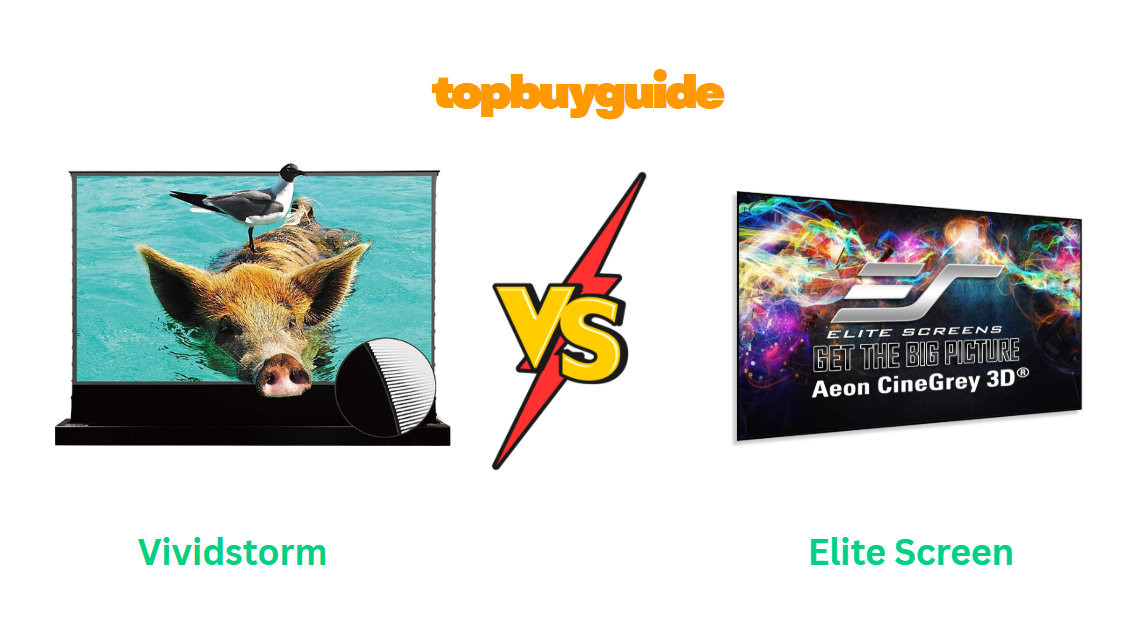
Choosing the right projector screen can make or break your home theater. While both Vividstorm and Elite Screens offer high-quality options, I recommend the Vividstorm Motorized Floor Rising Screen for most users. Its motorized convenience, space-saving design, and superior ambient light rejection for UST projectors provide a premium, hassle-free experience. But is it the right choice for your specific setup? Let’s dive deep into this comparison to find out.
Why Do I Recommend The Vividstorm Motorized Floor Rising Screen?
The Vividstorm screen stands out for its innovative design and user-centric features, making it a superior choice for modern home theaters, especially those using Ultra-Short Throw (UST) projectors. Here’s a breakdown of why it pulls ahead of the Elite Screens Aeon.
- Motorized Convenience: The most significant advantage of the Vividstorm screen is its motorized, floor-rising mechanism. With the push of a button, the screen smoothly rises from its discreet housing, ready for use in seconds. In contrast, the Elite Screens Aeon is a fixed-frame screen that requires permanent wall mounting, which is less flexible and dominates your wall space even when not in use. This makes the Vividstorm ideal for multi-purpose rooms where you don’t want a screen permanently on display.
- Superior UST Projector Compatibility: Vividstorm designs its screen material specifically for Ultra-Short Throw (UST) laser projectors. It features a special optical sawtooth structure that rejects ambient light from above while reflecting the projector’s light from below directly to the viewer. This results in a bright, high-contrast image even in well-lit rooms. While the Elite Screens Aeon CineGrey 3D material also offers ambient light rejection, it is designed for standard-throw projectors, making it less effective at handling the unique angle of light from a UST projector.
- Space-Saving and Unobtrusive Design: When not in use, the Vividstorm screen retracts completely into its sleek aluminum housing, which can be placed on the floor or hidden inside a custom media cabinet. This “hiding” capability is a game-changer for maintaining room aesthetics. The Elite Screens Aeon, being a fixed frame, is always visible and requires dedicated wall space, which might not be practical or desirable in every home.
- Quick and Easy Setup: The Vividstorm screen is essentially a plug-and-play device. You simply place it where you want it, plug in the power cord, and it’s ready to go. There’s no need for drilling holes or complex mounting procedures. The Elite Screens Aeon, on the other hand, requires a more involved assembly process for its 6-piece frame and then needs to be securely mounted to the wall, a task that can take hours and may require more than one person.
- Wrinkle-Free Surface: Thanks to its unique wire tensioning system, the Vividstorm screen boasts a perfectly flat, glass-like surface that is free from wrinkles or curls. This ensures a distortion-free image every time. Although the Elite Screens Aeon also uses a tensioning system with springs, some users report challenges in achieving a perfectly flat surface, and the material can be prone to ripples if not assembled with extreme care.
- Smart Control Options: The Vividstorm screen comes with both IR and RF remotes, but it also includes a wireless USB trigger that can sync the screen’s operation with your projector’s power cycle. Turn on the projector, and the screen rises automatically. The Elite Screens Aeon does not have these smart automation features, as it is a manual, fixed screen.
- Enhanced Eye Comfort: Like all projector screens, the Vividstorm reflects light instead of emitting it like a TV. However, its specialized ALR material is designed to direct light precisely, which can further reduce eye strain during long viewing sessions. This makes it a more comfortable choice for movie marathons or binge-watching your favorite shows.
- Durable Housing: The Vividstorm screen is housed in a heavy-duty, moisture-resistant aluminum case, which protects the delicate screen material from dust, damage, and environmental factors when retracted. The Elite Screens Aeon’s material is permanently exposed, making it more susceptible to dust and potential accidental damage.
Side By Side Comparison Chart: Vividstorm vs Elite Screen
| Feature | VIVIDSTORM Motorized Floor Rising Screen | Elite Screens Aeon CineGrey 3D |
| Mounting Type | Floor-rising (motorized) | Wall Mount (fixed frame) |
| Projector Compatibility | Ultra-Short Throw (UST) Laser Projectors | Standard Throw Projectors |
| Setup Process | Plug-and-play, 1-minute setup | Assembly required, wall mounting |
| Design | Retractable, space-saving | Permanent, edge-free fixed frame |
| Screen Material | UST ALR with optical sawtooth structure | CineGrey 3D CLR/ALR |
| Gain | 0.6 | 1.2 |
| Ambient Light Rejection | 97% | 65% |
| Control | IR & RF Remotes, Smart App, Voice Control | None (fixed screen) |
| Warranty | 2-Year Manufacturer Warranty | 2-Year Manufacturer Warranty (3-Year for ENR-G) |
| Weight | 74.8 lbs | 26 lbs |
What Common Features Can Vividstorm and Elite Screens Do?
Despite their different designs, both the Vividstorm and Elite Screens share a common goal: to deliver a high-quality viewing experience that far surpasses projecting onto a plain wall. They both use advanced screen materials designed to handle ambient light and improve picture quality, making them suitable for more than just dedicated, blacked-out home theaters.
Ambient Light Rejection (ALR) is the star feature of both screens. This technology is engineered to selectively reflect light from the projector back to the audience while absorbing or rejecting light coming from other sources, like overhead lights or windows. The result is a much richer, more vibrant image with deeper black levels and better contrast, even in rooms that aren’t completely dark. This allows you to enjoy a cinematic experience during the day or with the lights on, a feat impossible with standard matte white screens which tend to look washed out.
Both screens are also 4K/8K Ultra HD and Active 3D Ready. This means their surfaces are finely textured to resolve the tiny pixels of high-resolution content without losing detail or creating artifacts like moiré patterns. Whether you’re watching the latest 4K blockbuster or immersing yourself in a 3D movie, both the Vividstorm and Elite Screen are built to deliver a crisp, clear, and detailed picture. This future-proofs your investment, ensuring your screen will be ready for the next generation of video content.
Common Features of Vividstorm vs Elite Screen
| Feature | VIVIDSTORM Motorized Floor Rising Screen | Elite Screens Aeon CineGrey 3D |
| ALR Material | Yes (UST ALR) | Yes (CineGrey 3D) |
| 4K/8K Ready | Yes | Yes |
| Active 3D Ready | Yes | Yes |
| Aspect Ratio | 16:9 | 16:9 |
| Screen Size (Compared) | 120 inch | 120 inch |
A Detailed Comparison Of the Vividstorm vs Elite Screen
When choosing between these two screens, the differences in their design, material, and functionality become critical. Let’s explore these aspects in more detail to help you make an informed decision.
Mounting and Installation
The VIVIDSTORM screen offers unparalleled ease of installation. It’s a floor-rising unit that requires no mounting. You simply place the housing on the floor or a console, plug it in, and it’s ready. This design is perfect for renters or anyone who doesn’t want to drill into their walls. Its motorized mechanism, controlled by remote or smart triggers, adds a layer of modern luxury and convenience. The entire setup can be done in minutes, making it incredibly user-friendly.
In contrast, the Elite Screens Aeon is a fixed-frame screen that requires assembly and permanent wall mounting. The frame comes in six pieces that must be put together, and the screen material is then stretched and attached using a series of springs. While this creates a taut surface, the assembly can be time-consuming and challenging for one person. It requires careful measurement and drilling to mount it securely on the wall, making it a more permanent and labor-intensive installation.
Screen Material and Performance
The screen material is where these two products differ most in their intended use. The VIVIDSTORM uses a specialized UST ALR material with an optical sawtooth structure. This surface is engineered to reject ambient light from above (like ceiling lights) while perfectly reflecting the sharp upward angle of light from an ultra-short-throw projector. With a high 97% ambient light rejection rate and a 0.6 gain, it produces deep black levels and excellent contrast, though it is specifically not compatible with standard or long-throw projectors.
The Elite Screens Aeon features CineGrey 3D material, which is also an angular-reflective ALR screen but is designed for standard-throw projectors. It has a higher gain of 1.2, which makes the image brighter, and a 65% ambient light rejection rate. While effective in moderately lit rooms, it is not optimized for the extreme projection angle of UST projectors and may not control ambient light as effectively in that scenario. For users with standard projectors, however, it offers a great balance of brightness and contrast enhancement.
Design and Aesthetics
The VIVIDSTORM screen is a master of disguise. When not in use, it retracts into a sleek, unobtrusive aluminum housing, freeing up your wall for artwork or just a clean, minimalist look. This space-saving design is a major selling point for multi-purpose living areas where a large, permanent black or grey rectangle on the wall is not desirable. The motorized action adds a “wow” factor that impresses guests and enhances the premium home theater feel.
The Elite Screens Aeon has a very different aesthetic appeal. Its “EDGE FREE” design is meant to look like a giant flat-panel TV. It features an ultra-thin bezel that can be used with or without the included black trim. This creates a very modern, clean look that maximizes the viewing area and blends well into a dedicated media room. However, it is a permanent fixture on your wall, which can dominate the room’s decor.
Versatility and Use Case
Your choice between these two screens largely depends on your projector type and your room. The VIVIDSTORM is the clear winner for anyone with a UST projector. Its specialized material and floor-rising design are tailor-made for this setup, offering the best possible image quality and convenience. Its portability also means you can move it to different rooms if needed, although its weight (74.8 lbs) makes this an infrequent task.
The Elite Screens Aeon is the more versatile option for users with standard or short-throw projectors. Its CineGrey 3D material is designed to work with these projectors to combat ambient light. Being a fixed-frame screen, it’s best suited for dedicated home theaters or media rooms where the screen will be the room’s focal point. It’s a more traditional solution that delivers excellent performance for its intended projector types.
Conclusion
After a thorough comparison, the Vividstorm Motorized Floor Rising Screen is my top recommendation, particularly for the growing number of home theater enthusiasts using UST projectors. Its combination of plug-and-play setup, a motorized space-saving design, and a screen material that brilliantly rejects ambient light makes it a nearly perfect solution. It offers a premium, hassle-free experience and stunning image quality without demanding a dedicated, blacked-out room.
However, if you have a standard-throw projector and a dedicated space, the Elite Screens Aeon CineGrey 3D is an excellent and more budget-friendly choice. It delivers impressive ambient light rejection and a TV-like aesthetic. Ultimately, your projector type and room layout are the deciding factors, but for modern convenience and performance, the Vividstorm screen is a fantastic investment that will elevate your home cinema to the next level.
FAQs
- Which screen is better for a room with lots of windows?
The Vividstorm screen is better for rooms with significant ambient light, especially light coming from the ceiling. Its 97% ALR rating is specifically designed to combat these conditions when paired with a UST projector, providing a much clearer and more vibrant image than the Elite Screen. - Can I use a standard projector with the Vividstorm screen?
No, the Vividstorm UST ALR screen is not compatible with standard or long-throw projectors. The screen’s sawtooth structure is designed to reflect light coming from a sharp angle below. A standard projector would project onto the light-absorbing layer, resulting in a very dark and unwatchable image. - Is the Elite Screens Aeon difficult to assemble?
Assembly can be challenging for one person. It involves putting together a 6-piece frame and attaching the screen material with dozens of springs to create tension. Many users recommend having a second person to help and watching video tutorials, as the process can take a couple of hours. - What does “gain” mean for a projector screen?
Gain is a measure of a screen’s reflectivity. A screen with a 1.0 gain reflects the same amount of light as a standard white magnesium oxide board. The Elite Screen’s 1.2 gain means it reflects 20% more light, making the image appear brighter. The Vividstorm’s 0.6 gain reflects less light, which helps to produce deeper black levels and higher contrast. - Is the motorized mechanism on the Vividstorm screen noisy?
The Vividstorm screen uses a silent tubular motor. While not completely silent, the motor is very quiet and operates smoothly. The sound is generally unobtrusive and is not audible once your movie or show starts playing. - Can I install LED backlighting on the Vividstorm screen?
No, the Vividstorm screen’s housing is not designed for backlighting. However, the Elite Screens Aeon series has an optional LED backlight kit that can be purchased separately to create a glowing effect around the frame, enhancing the viewing ambiance. - Is the Vividstorm screen safe for a home with children?
Yes, the Vividstorm screen has safety features, including a design that allows the power to be turned off once the screen is raised. This prevents accidental operation by children. The heavy housing also makes it very stable on the floor. - Which screen offers a better warranty?
Both screens come with a standard 2-year manufacturer’s warranty. Elite Screens offers an extended 3-year warranty for educational, non-profit, religious, or government organizations through their ENR-G program, which gives it a slight edge in specific purchasing scenarios.

Alex Turner is a dedicated product researcher and reviewer at TopBuyGuide.com, known for his clear, honest, and data-driven insights. He spends countless hours testing, comparing, and analyzing products to help readers make confident and informed buying decisions.