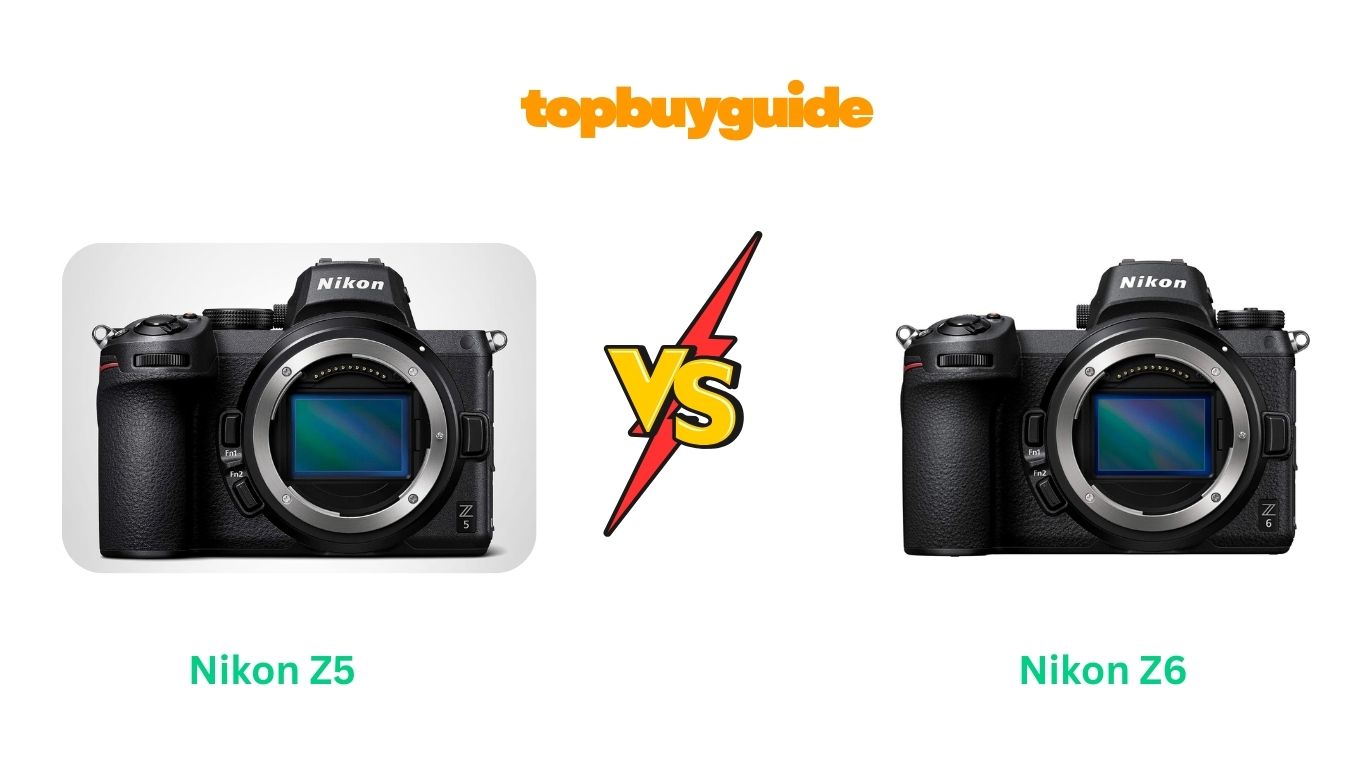
When choosing between the Nikon Z5and Nikon Z6, it’s easy to get lost in the specs — both look similar, but their real-world performance tells a different story. After testing both, I’d confidently recommend the Nikon Z6. It offers better video performance and faster burst shooting, making it ideal for hybrid creators who want stunning stills andcinematic footage.
Keep reading — this in-depth comparison will help you pick the perfect camera for your photography or videography goals.
Why Do I Recommend the Nikon Z6?
The Nikon Z6 stands out as the more powerful and future-ready option between the two. While the Z5 offers excellent image quality for beginners and casual photographers, the Z6 is designed for serious enthusiasts and professionals seeking speed, flexibility, and superior performance.
Here’s why the Nikon Z6 takes the lead:
- 1. Superior Sensor Performance (24.5MP BSI CMOS)
The Nikon Z6 features a 24.5MP backside-illuminated (BSI) sensor, which excels in low-light situations. The BSI design improves light capture, resulting in cleaner, sharper images at high ISOs — a big advantage over the Z5’s 24.3MP standard CMOS sensor. - 2. Faster Continuous Shooting (12 fps vs 4.5 fps)
The Z6 offers an impressive 12 frames per second burst rate, allowing photographers to capture action sequences and sports moments seamlessly. In contrast, the Z5’s 4.5 fps feels limiting for fast-paced subjects like wildlife or motion photography. - 3. Better Video Capabilities (4K 30p Full Readout)
While the Z5 records 4K with a crop, the Z6 delivers full-sensor 4K recording at 30p with no crop. This makes the Z6 perfect for professional videographers or vloggers who want clean, cinematic footage. - 4. More Advanced Autofocus System (273 Points)
The Z6’s 273-point phase-detection AF system covers nearly 90% of the frame, providing accurate subject tracking and eye detection. The Z5 also has 273 points but operates slightly slower, particularly in low light. - 5. Superior ISO Range (100–51,200 vs 100–25,600)
The Z6 offers a broader native ISO range, performing exceptionally in challenging light conditions. You’ll notice significantly less noise in indoor or night photography compared to the Z5. - 6. Faster XQD/CFexpress Memory Card Support
Unlike the Z5’s dual SD card slots, the Z6 uses XQD or CFexpress cards, which are much faster for transferring large RAW files or high-resolution videos. This ensures smoother performance for professional workflows. - 7. 10-Bit N-Log Output for Videographers
The Nikon Z6 can output 10-bit N-Log via HDMI, giving creators more flexibility in post-production color grading — a huge plus for cinematic video editing. The Z5 doesn’t support this advanced feature. - 8. Better Low-Light Autofocus Sensitivity (-3.5 EV)
The Z6 performs noticeably better in dim conditions, locking focus faster and more reliably, while the Z5 occasionally hunts for focus in dark environments. - 9. Higher Quality Build and Handling
Though both cameras share the same magnesium-alloy body, the Z6’s grip feels more balanced with heavier lenses, and its shutter mechanism is rated for more cycles — ideal for long-term professional use.
Side-by-Side Comparison Chart — Nikon Z5 vs Z6
| Feature | Nikon Z5 | Nikon Z6 |
| Sensor Type | 24.3MP Full-Frame CMOS | 24.5MP BSI Full-Frame CMOS |
| Processor | EXPEED 6 | EXPEED 6 |
| Image Stabilization | 5-Axis In-Body | 5-Axis In-Body |
| ISO Range | 100–25,600 | 100–51,200 (expandable to 204,800) |
| Autofocus Points | 273 Hybrid | 273 Hybrid (Enhanced) |
| Burst Shooting | 4.5 fps | 12 fps |
| Video Resolution | 4K 30p (1.7x crop) | 4K 30p (Full-frame readout) |
| Card Slots | Dual SD (UHS-II) | Single XQD/CFexpress |
| Viewfinder | 3.69M-dot EVF | 3.69M-dot EVF |
| LCD Screen | 3.2″ Tilting Touchscreen | 3.2″ Tilting Touchscreen |
| Battery Life | ~470 shots | ~310 shots |
| Body Material | Magnesium Alloy | Magnesium Alloy |
| Weight | 675g | 675g |
| Connectivity | Wi-Fi, Bluetooth | Wi-Fi, Bluetooth |
| Video Output | 8-bit Internal | 10-bit N-Log via HDMI |
| Low-Light AF Sensitivity | -3 EV | -3.5 EV |
| Memory Card Speed | Slower (SD) | Faster (XQD/CFexpress) |
| Price Range (approx.) | More Budget-Friendly | Higher, but Better Value |
What Common Nikon Z5 vs Z6 Can Do
Both the Nikon Z5 and Nikon Z6 share a strong foundation — Nikon’s Z-mount design, advanced image stabilization, and superb build quality. Despite the price difference, both cameras deliver excellent still image performance, intuitive handling, and versatile shooting capabilities that cater to enthusiasts and semi-professionals alike.
Let’s explore their shared strengths in detail:
1. Full-Frame Mirrorless Design
Both the Z5 and Z6 are built around Nikon’s Z-mount system, which features one of the largest mount diameters (55mm) in the industry. This allows for better light capture and superior edge-to-edge sharpness across compatible lenses. Whether you’re shooting landscapes, portraits, or travel photos, both deliver full-frame quality with rich detail and dynamic range.
2. 5-Axis In-Body Image Stabilization (IBIS)
Each camera includes 5-axis sensor-shift image stabilization, compensating for camera shake up to five stops. This is a game changer for handheld photography, especially in low light or when using non-VR lenses. Whether recording video or taking stills, both cameras produce crisp, stable shots.
3. Same EXPEED 6 Image Processor
Both models use Nikon’s EXPEED 6 processor, ensuring fast image processing, beautiful color reproduction, and minimal lag during shooting. The processor also powers advanced noise reduction and color depth, helping maintain smooth tonal transitions in your photos.
4. Dual Control Dials & Premium Ergonomics
The handling of both the Z5 and Z6 is a delight. Their deep grip and dual control dials give a DSLR-like comfort in a compact body. The layout is intuitive, with a dedicated AF joystick, customizable buttons, and weather-sealed construction that withstands outdoor challenges.
5. Sharp EVF and Tilting Touchscreen
Each camera features a 3.69-million-dot electronic viewfinder (EVF) with clear, lag-free display, along with a 3.2-inch tilting touchscreen LCD. This makes framing and reviewing images easy, whether you’re shooting from low or high angles.
6. 5 GHz Wi-Fi & Bluetooth Connectivity
Wireless connectivity is available on both cameras via Wi-Fi and Bluetooth, enabling instant file transfer and remote control through Nikon’s SnapBridge app. You can easily post photos to your smartphone or control the camera remotely — perfect for travel vloggers or social media creators.
7. Solid Build Quality
Both the Nikon Z5 and Z6 feature magnesium alloy bodies with weather sealing that protect against dust and moisture. They’re designed for durability and long-term use — ideal for outdoor and adventure photographers.
8. Lens Compatibility & Expansion
Thanks to the Z-mount system, both cameras can use Nikon’s growing line of Z lenses and older F-mount lenses via the FTZ adapter, offering incredible flexibility in your lens choices.
Common Features of Nikon Z5 vs Z6
| Feature | Nikon Z5 | Nikon Z6 |
| Mount Type | Nikon Z-Mount | Nikon Z-Mount |
| Processor | EXPEED 6 | EXPEED 6 |
| Image Stabilization | 5-Axis IBIS | 5-Axis IBIS |
| EVF Resolution | 3.69M-dot | 3.69M-dot |
| LCD Screen | 3.2” Tilting Touchscreen | 3.2” Tilting Touchscreen |
| Connectivity | Wi-Fi & Bluetooth | Wi-Fi & Bluetooth |
| Body Material | Magnesium Alloy | Magnesium Alloy |
| Weather Sealing | Yes | Yes |
| Mount Adapter Support | FTZ Compatible | FTZ Compatible |
| Audio Input/Output | Mic & Headphone Jack | Mic & Headphone Jack |
| Battery Type | EN-EL15c | EN-EL15b/EN-EL15c Compatible |
| App Support | SnapBridge | SnapBridge |
A Detailed Comparison of the Nikon Z5 vs Z6
Let’s break down how these two cameras perform in real-world scenarios feature by feature.
1. Image Quality
Both the Nikon Z5 and Z6 produce beautiful, sharp, and detailed images. The Z5’s 24.3MP CMOS sensor offers impressive results for most photographers, delivering balanced colors and dynamic range.
However, the Z6’s 24.5MP BSI (backside-illuminated) sensor provides a slight edge in low-light conditions. Thanks to its improved light-gathering efficiency, it produces cleaner files at higher ISO settings, giving the Z6 a noticeable advantage in night or indoor photography.
2. Autofocus Performance
The autofocus system on both cameras uses 273-point hybrid AF, covering nearly the entire frame. For static subjects, both perform excellently.
But in continuous AF or moving subjects, the Z6 shows more consistency and speed. Its enhanced processing and phase-detection sensitivity allow smoother focus tracking — especially useful in sports or wildlife photography where every millisecond counts.
3. Burst Shooting Speed
Speed is where the Z6 truly shines. With a burst rate of 12 fps, it easily outpaces the Z5’s 4.5 fps. If you often shoot action scenes, pets, or fast-moving subjects, the Z6’s speed advantage ensures you never miss the perfect moment.
4. Video Recording
Both cameras support 4K UHD video, but the difference is substantial. The Z5 records 4K at 30p with a 1.7x crop, limiting your field of view. The Z6, on the other hand, captures full-frame 4K video without a crop and supports 10-bit N-Log output for professional color grading. For filmmakers or YouTubers, the Z6 is easily the better pick.
5. ISO Range and Low-Light Performance
The Nikon Z6 covers a broader ISO range — 100–51,200 (expandable to 204,800) — compared to the Z5’s 100–25,600. This means the Z6 can handle darker environments without introducing excessive noise. The Z5 performs well up to ISO 6400, but the Z6 maintains clarity and detail even beyond that.
6. Card Slots and Storage Speed
The Z5 includes dual SD card slots, a welcome feature for wedding or event photographers who want backup storage. The Z6 only has one slot, but it supports XQD and CFexpress cards, which are dramatically faster for 4K video or RAW bursts. So, the choice depends on your workflow: redundancy (Z5) or speed (Z6).
7. Battery Life
Interestingly, the Z5’s battery lasts longer, offering around 470 shots per charge compared to the Z6’s 310. The difference comes from more efficient power usage and the lack of high-speed continuous shooting in the Z5. For travel photographers, that extra endurance may be handy.
8. Handling and Design
Both models are nearly identical in size and weight (about 675g) and share Nikon’s excellent ergonomics. The Z6, however, feels a bit more premium due to internal refinements and slightly better shutter durability, giving it the edge for professional use.
9. Connectivity and Sharing
Both cameras have Wi-Fi and Bluetooth for fast image transfers and remote operation. Using the Nikon SnapBridge app, you can instantly share JPEGs to your smartphone or tablet — perfect for on-the-go creators.
10. Price and Value
The Z5 is the more affordable option, making it great for beginners entering full-frame photography. The Z6, while pricier, provides a more complete toolset that grows with your skill level — making it the better investment in the long run.
Conclusion
If you’re on a tight budget and mainly shoot photos, the Nikon Z5 delivers fantastic full-frame performance at a lower cost. It’s ideal for travel, portraits, and everyday photography.
However, for anyone serious about video, speed, or low-light performance, the Nikon Z6 is the clear winner. Its 12 fps burst rate, full-sensor 4K video, 10-bit N-Log output, and superior low-light handling make it a versatile powerhouse for hybrid creators.
👉 My Recommendation: Go for the Nikon Z6 if you want a camera that can handle both professional photography and cinematic video seamlessly.
FAQs About Nikon Z5 vs Z6
- Is the Nikon Z5 good for beginners?
Yes. The Z5 is a great entry-level full-frame camera with easy controls, high image quality, and dual SD card slots for safe backups. - Does the Nikon Z6 record video without a crop?
Yes. The Z6 records full-frame 4K 30p video, unlike the Z5, which applies a 1.7x crop when shooting 4K. - Which camera has better autofocus?
The Z6 offers faster, more responsive autofocus — especially in low light — thanks to its enhanced phase-detection system. - Can I use my F-mount lenses with these cameras?
Yes. Both support Nikon’s FTZ adapter, which allows you to use F-mount lenses without losing autofocus or metering functionality. - Is the Nikon Z6 worth the extra price?
Absolutely, if you need better video quality, faster burst speeds, and superior low-light performance. It’s a future-proof choice. - Do both cameras have in-body stabilization?
Yes, both feature 5-axis in-body image stabilization (IBIS) for sharper handheld shots and smoother videos. - Which has better battery life?
The Z5 has a slightly better battery life, delivering around 470 shots per charge versus 310 on the Z6. - Which should I buy for professional use?
The Nikon Z6 is the better option for professionals who want speed, video capabilities, and overall versatility.
Would you like me to write the next comparison in the same professional affiliate format (SEO title, meta description, intro, charts, etc.) if you provide the next two product URLs and keyword?

Alex Turner is a dedicated product researcher and reviewer at TopBuyGuide.com, known for his clear, honest, and data-driven insights. He spends countless hours testing, comparing, and analyzing products to help readers make confident and informed buying decisions.