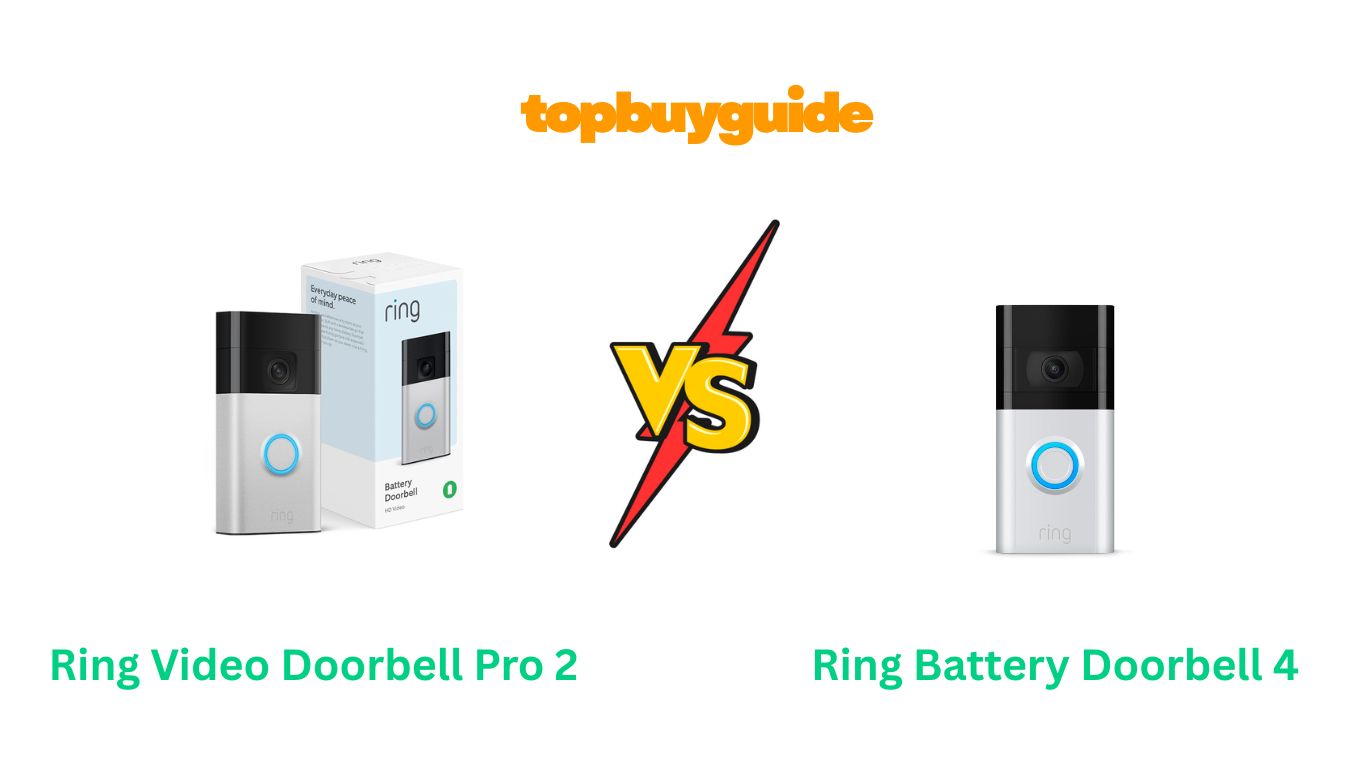
Are you choosing between the Ring Doorbell and Ring Doorbell 3? It can be a tough decision for your home security. While both are excellent choices, I recommend the Ring Doorbell (2024 release). It offers a superior 1440p video resolution and a wider, head-to-toe field of view for a significantly lower price. This makes it a smarter, more cost-effective choice for most homeowners seeking top-notch security without breaking the bank.
Why Do I Recommend The Ring Doorbell (2024 Release)?
When comparing the Ring Doorbell vs Ring Doorbell 3, the newer Ring Doorbell (2024 Release) consistently comes out on top for several key reasons, offering more advanced features at a better price point.
- Superior Video Quality: The Ring Doorbell (2024) captures video in 1440x1440p HD. This is a significant upgrade from the Ring Doorbell 3, which records in 1080p HD. The higher resolution means you get a sharper, more detailed image, making it easier to identify faces and details.
- Wider Field of View: You get a full head-to-toe view with the Ring Doorbell’s 150° horizontal and 150° vertical field of view. In contrast, the Ring Doorbell 3 has a narrower 160° horizontal but only 84° vertical view. The expanded vertical view on the newer model is crucial for seeing packages left on your doorstep.
- Modern Power Source: The Ring Doorbell features a built-in battery that charges via a convenient USB-C port. The Ring Doorbell 3, however, uses an older Quick-Release Battery Pack system. The integrated design of the newer model is sleeker, although it means the entire unit must be detached for charging.
- More Affordable Price: The most compelling reason is the price. The Ring Doorbell (2024) is listed at a significantly lower price (around $49.99) compared to the Ring Doorbell 3, which often sells for over $180. You get better features for a fraction of the cost, making it an incredible value.
- Color Night Vision: Both models offer night vision, but the Ring Doorbell (2024) specifies “Color Night Vision” as a standard feature. This provides clearer, more useful footage in low-light conditions than the standard night vision on the Ring Doorbell 3.
- Enhanced Design: The Ring Doorbell (2024) comes in a sleek, modern design with Satin Nickel and Venetian Bronze color options. While the Ring Doorbell 3 offers interchangeable faceplates, the base unit’s design is from an older generation and looks less integrated.
Side By Side Comparison Chart: Ring Doorbell vs Ring Doorbell 3
| Feature | Ring Doorbell (2024 Release) | Ring Doorbell 3 |
| Video Resolution | 1440x1440p HD | 1080p HD |
| Field of View | 150° Horizontal, 150° Vertical | 160° Horizontal, 84° Vertical |
| Price | Approx. $49.99 | Approx. $188.84 |
| Battery | Built-in rechargeable battery | Removable Quick-Release Battery Pack |
| Charging Port | USB-C | Micro-USB (for battery pack) |
| Wi-Fi Connectivity | 2.4GHz | Dual-band (2.4GHz & 5.0GHz) |
| Night Vision | Color Night Vision | Night Vision |
| Interchangeable Faceplates | No (Solid color body) | Yes (One extra included) |
What Common Features Can Ring Doorbell vs Ring Doorbell 3 Do?
While they have their differences, both the Ring Doorbell (2024 Release) and the Ring Doorbell 3 share a core set of powerful features that form the foundation of the Ring security experience. These commonalities ensure that no matter which you choose, you’re getting a reliable and effective smart doorbell.
Two-Way Talk with Noise Cancellation
One of the most valuable features shared by both doorbells is Two-Way Talk. This allows you to speak directly to anyone at your door through the Ring app on your phone, tablet, or computer. Whether you’re telling the delivery driver where to leave a package or warding off an unwanted visitor, the audio is clear thanks to built-in noise cancellation that helps reduce background sounds. This feature works in real-time, giving you the power to interact from anywhere.
Advanced Motion Detection
Both models are equipped with advanced motion detection capabilities. You can receive instant alerts on your smart device whenever the doorbell detects movement. This feature is highly customizable. You can adjust the sensitivity to reduce false alarms from passing cars or pets, and you can create specific motion zones to monitor only the areas you care about, such as your walkway or porch, while ignoring public sidewalks.
Live View
With Live View, you can check in on your front door at any time, from anywhere. Simply open the Ring app to get an on-demand, real-time video and audio stream. This is perfect for checking on a package you’re expecting or just for the peace of mind of seeing that everything is secure at home while you’re away on vacation or at work.
Power Options
Flexibility in power is a hallmark of both devices. You can run them using their internal batteries for a completely wireless setup, which is great for renters or homes without existing doorbell wiring. Alternatively, both can be hardwired to your existing doorbell system (8-24 VAC). This provides a continuous trickle charge to the battery, so you never have to worry about recharging it.
Ring App Integration and Alexa Compatibility
Both the Ring Doorbell and Ring Doorbell 3 are controlled through the powerful and user-friendly Ring app. From the app, you can view your video history (with a Ring Protect plan), adjust settings, and link other Ring devices. Both are also fully compatible with Amazon Alexa. You can receive announcements on your Echo devices when someone presses the doorbell or motion is detected, and if you have an Echo Show, you can say “Alexa, show the front door” to see a live video feed.
Common Features of Ring Doorbell vs Ring Doorbell 3
| Feature | Ring Doorbell (2024 Release) | Ring Doorbell 3 |
| Two-Way Talk | Yes, with noise cancellation | Yes, with noise cancellation |
| Live View | Yes | Yes |
| Customizable Motion Zones | Yes | Yes |
| Hardwire Option | Yes (8-24 VAC) | Yes (8-24 VAC) |
| Alexa Compatibility | Yes | Yes |
| Ring App Control | Yes | Yes |
| Ring Protect Plan | Required for video recording | Required for video recording |
| Easy Installation | Yes | Yes |
A Detailed Comparison of the Ring Doorbell vs Ring Doorbell 3
Let’s dive deeper into the specific features to see how these two smart doorbells stack up against each other.
Video Quality and Field of View
The Ring Doorbell (2024 Release) offers a significant advantage with its 1440x1440p HD video. This square aspect ratio provides a “head-to-toe” view, capturing a 150° vertical and horizontal field of view. This is incredibly practical, as it allows you to see visitors’ faces clearly while also keeping an eye on packages left on the ground. The higher resolution ensures that details are crisp, which can be crucial for identification.
On the other hand, the Ring Doorbell 3 records in a more traditional 1080p HD resolution with a 160° horizontal and 84° vertical field of view. While the horizontal view is slightly wider, the much narrower vertical view is a notable drawback. It often cuts off the view of the ground directly in front of your door, meaning you might miss seeing a package that has been delivered, defeating one of the primary purposes of a video doorbell for many users.
Wi-Fi Connectivity
Here, the Ring Doorbell 3 has a technical edge with its dual-band Wi-Fi capability, supporting both 2.4GHz and 5.0GHz networks. A 5.0GHz connection can offer faster speeds and less interference, which is beneficial in crowded Wi-Fi environments. This can lead to a more stable connection and quicker loading times for Live View.
The Ring Doorbell (2024 Release) is limited to a 2.4GHz Wi-Fi connection. While 2.4GHz has a longer range than 5.0GHz, it is more susceptible to interference from other household devices. For most homes, a 2.4GHz connection is perfectly adequate, but users with very crowded networks or who place their doorbell far from their router might prefer the flexibility of the dual-band option offered by the Ring Doorbell 3.
Battery and Charging
The Ring Doorbell 3 features a removable Quick-Release Battery Pack. This design is convenient because you can purchase a spare battery, allowing you to swap a dead battery for a fully charged one with no downtime for your camera. The battery is charged via a micro-USB cable.
The newer Ring Doorbell (2024 Release) uses a modern, integrated (non-removable) battery that is recharged via a USB-C port. This means you must remove the entire doorbell unit from its mount to charge it, leaving your front door without surveillance for a few hours. While USB-C is a faster and more modern standard, the lack of a swappable battery is a trade-off for its sleek, integrated design and lower cost.
Conclusion
After a thorough comparison, the Ring Doorbell (2024 Release) is the clear winner for most users. It provides superior video quality (1440p vs. 1080p) and a more practical head-to-toe field of view, which is essential for monitoring package deliveries. Despite being a newer model with better core features, it is priced significantly lower than the Ring Doorbell 3. This makes it an outstanding value. For budget-conscious buyers who want the latest essential tech without paying a premium, the choice is simple.
FAQs
- Is Ring Doorbell 3 better than the regular Ring Doorbell?
No, the newer Ring Doorbell (2024 Release) is generally better than the older Ring Doorbell 3. It offers higher 1440p resolution and a better head-to-toe view for a much lower price. The Ring Doorbell 3’s main advantage is its dual-band Wi-Fi.
- Do both the Ring Doorbell and Ring Doorbell 3 require a subscription?
Yes, both doorbells require a Ring Protect subscription to record, save, and share videos. Without a subscription, you can only access Live View and receive real-time motion alerts, but no footage will be stored for later review.
- What is the main difference in battery between the two models?
The Ring Doorbell 3 has a removable battery pack, allowing you to swap batteries for continuous coverage. The Ring Doorbell (2024 Release) has a built-in, non-removable battery, so the entire unit must be taken down to be recharged via USB-C.
- Can I use my existing doorbell chime with both models?
Yes, both the Ring Doorbell and Ring Doorbell 3 can be hardwired to an existing doorbell system to use your internal chime and keep the battery charged. Both are also compatible with the wireless Ring Chime and Ring Chime Pro.
- Which doorbell is easier to install?
Both doorbells are designed for easy DIY installation and take only a few minutes. Since both can be battery-powered, you don’t need to do any wiring if you don’t want to. The setup process via the Ring app is straightforward for both models.
- Does the Ring Doorbell 3’s dual-band Wi-Fi make a big difference?
It can. If you live in an apartment or an area with many competing Wi-Fi signals, the 5.0GHz option on the Ring Doorbell 3 can provide a more stable connection. For most suburban homes, the 2.4GHz connection on the standard Ring Doorbell is sufficient.

Alex Turner is a dedicated product researcher and reviewer at TopBuyGuide.com, known for his clear, honest, and data-driven insights. He spends countless hours testing, comparing, and analyzing products to help readers make confident and informed buying decisions.