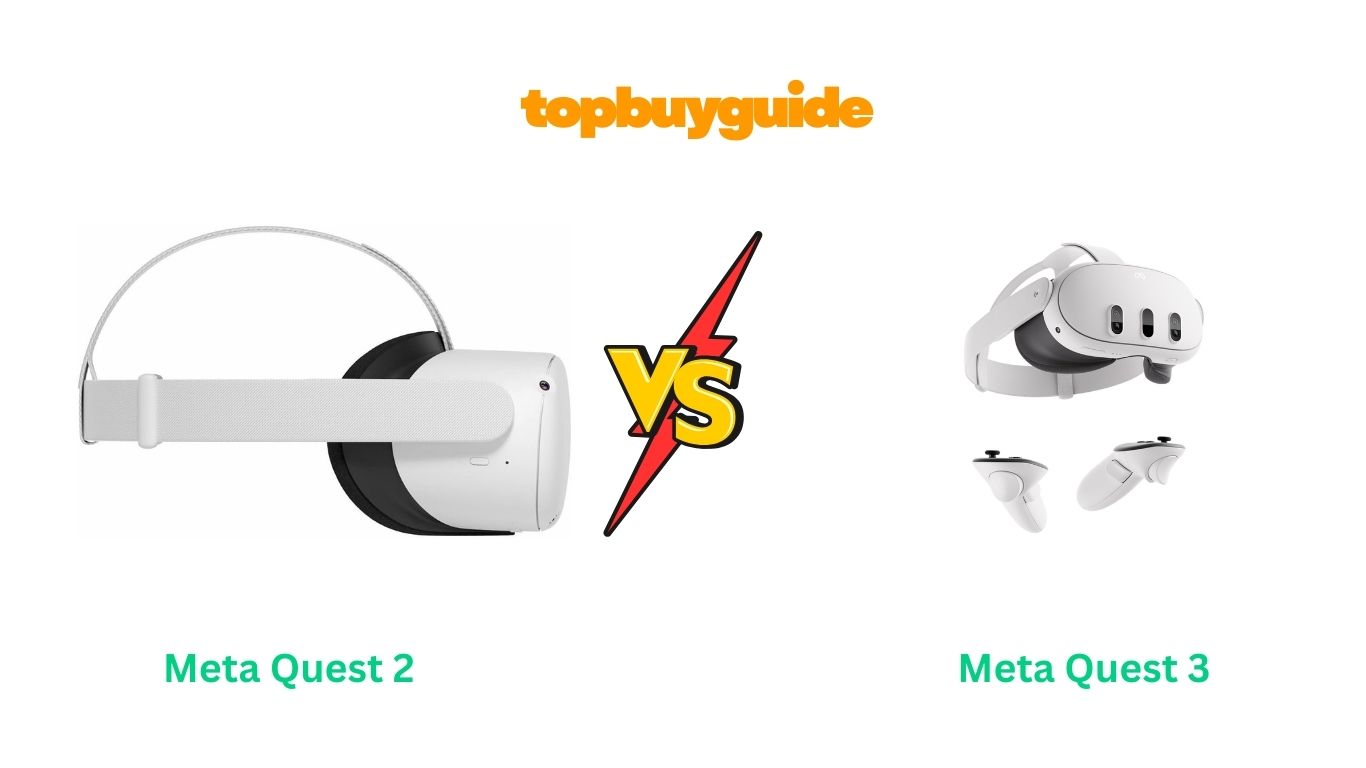
Virtual reality has become a mainstream experience for gaming, social interaction, and immersive media. Among the leading headsets, Meta Quest 2 and Meta Quest 3 are two of the most popular choices. Both provide wireless VR, intuitive controllers, and access to a massive library of VR content.
If you’re looking for cutting-edge visuals, enhanced mixed reality, and future-ready performance, the Meta Quest 3 is the headset to choose. It offers sharper displays, improved tracking, and better overall ergonomics, making it ideal for both gaming and professional VR experiences.
Why Do I Recommend the Meta Quest 3?
The Meta Quest 3 stands out as the superior headset for several reasons:
- Enhanced Display: Meta Quest 3 features higher resolution LCD panels with better color accuracy and contrast, offering a more lifelike VR experience compared to Meta Quest 2’s standard LCD.
- Mixed Reality Capability: With full-color passthrough and advanced sensors, Quest 3 allows for seamless mixed-reality experiences. Meta Quest 2 only supports black-and-white passthrough.
- Improved Comfort: Quest 3 has balanced weight distribution, better face padding, and adjustable straps, allowing longer VR sessions without discomfort, whereas Quest 2 can feel front-heavy during extended play.
- Next-Gen Tracking: Quest 3 comes with more precise inside-out tracking, making movements and interactions smoother, especially in complex VR games or apps.
- High Performance: Powered by next-gen VR processors, Quest 3 handles high-end games, immersive media, and advanced applications more efficiently than Quest 2.
- Updated Controllers: Quest 3’s controllers offer better ergonomics, haptic feedback, and self-tracking for more precise control. Quest 2 controllers are responsive but slightly less advanced.
- Enhanced Audio: Quest 3 provides spatial audio improvements, offering clearer sound directionality and immersive audio experiences. Quest 2 delivers solid audio but lacks some refinements.
- Future-Proof Software: Quest 3 supports newer VR software and mixed-reality applications, ensuring longer support for upcoming VR titles and features.
Transitional Note: While Meta Quest 2 remains a solid, budget-friendly option for casual VR gaming, the Meta Quest 3 gives you a more immersive, high-fidelity, and versatile VR experience.
Side By Side Comparison Chart: Meta Quest 2 vs Meta Quest 3
| Feature | Meta Quest 2 | Meta Quest 3 |
| Display | LCD, 1832 x 1920 per eye | LCD, higher resolution, improved color & brightness |
| Mixed Reality | Black & white passthrough only | Full-color passthrough with advanced sensors |
| Comfort & Ergonomics | Adjustable straps, lighter weight | Better weight distribution, improved padding |
| Tracking | 6DoF inside-out tracking | Enhanced 6DoF inside-out tracking |
| Controllers | Standard touch controllers | Ergonomic, self-tracking, improved haptics |
| Processor | Snapdragon XR2 Gen 1 | Next-gen VR processor (faster & more efficient) |
| Audio | Built-in speakers | Spatial audio improvements |
| Professional & Productivity | Basic VR apps | Supports mixed-reality & productivity apps |
| Accessories & Expandability | Limited official options | Wider accessory support & customization |
| Battery Life | 2–3 hours | 2–3 hours |
| Software & Ecosystem | Meta VR Store & backward compatible | Meta VR Store + next-gen software support |
| Price | Budget-friendly | Premium, higher price point |
Features of Meta Quest 3 vs Meta Quest 2
Meta Quest 3:
- Display: Improved LCD panels with higher resolution and brightness, producing sharper, more vibrant visuals.
- Mixed Reality: Full-color passthrough enables integrating real-world objects into VR, ideal for productivity and mixed-reality games.
- Comfort: Balanced weight distribution and premium face padding reduce fatigue during long VR sessions.
- Performance: Powered by next-gen VR processors, offering smoother gameplay and faster app loading.
- Controllers: Ergonomic controllers with self-tracking and enhanced haptics improve immersion.
- Audio: Upgraded spatial audio provides a more immersive listening experience.
- Software & Future Proofing: Compatible with next-gen VR apps, ensuring long-term usability.
Meta Quest 2:
- Display: LCD panels offer clear visuals, suitable for casual gaming and entertainment but less vibrant than Quest 3.
- Mixed Reality: Limited to black-and-white passthrough for basic environmental awareness.
- Comfort: Lightweight but can feel front-heavy during long sessions.
- Performance: Snapdragon XR2 Gen 1 processor handles most VR apps efficiently but may struggle with next-gen content.
- Controllers: Standard touch controllers are solid for gaming but lack advanced haptics.
- Audio: Built-in speakers provide decent sound, but spatial fidelity is lower.
- Software & Ecosystem: Supports wide range of VR games and apps, primarily gaming-focused.
Great! Here’s Part 2 of the “Meta Quest 2 vs Meta Quest 3” article, covering common features, detailed comparisons, conclusion, and FAQs to complete the full review.
What Common Quest 2 vs Quest 3 Can Do?
Despite the hardware differences, both Meta Quest 2 and Meta Quest 3 offer several common VR capabilities that make them strong contenders:
- Wireless VR Freedom: Both headsets allow untethered VR experiences, letting users move around freely without cables, perfect for gaming, fitness, or exploration.
- Inside-Out 6DoF Tracking: Both headsets provide 6 degrees of freedom tracking, allowing natural movement in virtual environments without external sensors.
- Hand Tracking: Both support hand tracking, enabling natural gestures for navigation and interaction without controllers.
- Touch Controllers: Both devices come with ergonomic controllers for precise input and interaction with VR games and apps.
- IPD Adjustment: Both allow Interpupillary Distance (IPD) adjustment, reducing eye strain and ensuring comfortable viewing for different users.
- Extensive VR Library: Both headsets access the Meta VR Store, with a large selection of games, apps, and educational experiences.
- Quick Setup: Both are designed for plug-and-play simplicity, getting you into VR quickly.
- Portability: Lightweight designs make both headsets easy to carry and store, whether at home or on the go.
- Multiplayer & Social VR: Both headsets support social VR features, allowing interaction with friends in virtual spaces.
Common Features of Meta Quest 2 vs Meta Quest 3
| Feature | Meta Quest 2 | Meta Quest 3 |
| Wireless Capability | Yes | Yes |
| Tracking | 6DoF inside-out | 6DoF inside-out |
| Hand Tracking | Yes | Yes |
| Controllers | Touch controllers | Touch controllers |
| IPD Adjustment | Yes | Yes |
| VR Library Access | Meta VR Store + apps | Meta VR Store + apps |
| Quick Setup | Yes | Yes |
| Portability | Lightweight | Lightweight |
| Multiplayer & Social VR | Yes | Yes |
| Battery Life | 2–3 hours | 2–3 hours |
A Detailed Comparison of Meta Quest 2 vs Meta Quest 3
1. Display & Visual Quality
Meta Quest 3 features higher-resolution LCD panels with improved brightness and color accuracy, producing sharper, more immersive visuals. Textures, environments, and game details appear more lifelike, enhancing both gaming and mixed reality experiences.
Meta Quest 2 has standard LCD panels with 1832 x 1920 per eye resolution. While visuals are clear and adequate for gaming, colors are less vibrant, and blacks are not as deep, limiting immersion compared to Quest 3.
2. Mixed Reality Capabilities
Meta Quest 3 supports full-color passthrough, allowing users to see real-world objects seamlessly integrated into VR. This makes it ideal for productivity apps, design, and mixed-reality games.
Meta Quest 2 only offers black-and-white passthrough, suitable for basic environmental awareness but limited for professional or advanced MR applications.
3. Comfort & Ergonomics
Meta Quest 3 is designed with better weight distribution, premium padding, and adjustable straps, reducing fatigue during long VR sessions. It is ideal for extended gaming or professional use.
Meta Quest 2 is lightweight and portable, but its simpler strap design can make it front-heavy during prolonged sessions, which may cause discomfort.
4. Controllers & Tracking
Meta Quest 3 comes with ergonomic, self-tracking controllers that offer enhanced haptic feedback and precision, improving immersion and responsiveness in VR games and apps.
Meta Quest 2 has standard touch controllers that work well for casual gaming but lack the advanced tracking and refined haptics of Quest 3.
5. Processor & Performance
Meta Quest 3 runs on next-generation VR processors, delivering smoother gameplay, faster load times, and better handling of high-end games and applications.
Meta Quest 2 uses Snapdragon XR2 Gen 1, sufficient for most casual VR gaming but slightly less powerful for advanced VR experiences or demanding mixed-reality apps.
6. Audio Experience
Meta Quest 3 provides enhanced spatial audio, making sound more directional and immersive for gaming, entertainment, and VR experiences.
Meta Quest 2 has solid built-in audio, but lacks some of the spatial refinements of Quest 3, reducing auditory immersion slightly.
7. Software & Ecosystem
Meta Quest 3 supports next-gen VR applications and productivity tools, ensuring compatibility with future VR content and mixed-reality software.
Meta Quest 2 primarily focuses on gaming and entertainment, though it still has access to Meta’s VR library. It is less versatile for professional or mixed-reality applications.
8. Battery Life & Charging
Both devices provide 2–3 hours of active VR use, depending on usage. Quest 3 supports fast USB-C charging and slightly improved efficiency with next-gen processors, whereas Quest 2 may need a longer recharge after extended sessions.
Conclusion
While Meta Quest 2 remains a reliable, budget-friendly VR headset, the Meta Quest 3 is the clear winner for those who want better visuals, advanced mixed-reality capabilities, ergonomic comfort, and future-proof performance.
Meta Quest 3 is perfect for serious gamers, mixed-reality enthusiasts, and professionals, offering superior display, improved controllers, next-gen processing power, and premium comfort.
For anyone looking to invest in the ultimate VR experience, the Meta Quest 3 is highly recommended. Click the link to grab it today and step into the most immersive virtual reality experience yet.
FAQs: Meta Quest 2 vs Meta Quest 3
- Which headset offers better visuals?
Meta Quest 3 has higher-resolution LCD panels with better brightness and color accuracy, producing more vibrant and immersive visuals than Meta Quest 2. - Can I use both headsets for mixed-reality experiences?
Yes, but Quest 3 supports full-color passthrough, while Quest 2 offers only black-and-white passthrough. - Which headset is more comfortable for long VR sessions?
Quest 3 is more comfortable due to better weight distribution and premium padding, making it ideal for extended use. - Are the controllers different?
Yes, Quest 3 has self-tracking, ergonomic controllers with advanced haptics, while Quest 2 uses standard touch controllers. - Can both headsets access the same VR library?
Yes, both have access to the Meta VR Store, including games, educational apps, and entertainment titles. - What is the battery life of these headsets?
Both offer 2–3 hours of active VR use, depending on the applications and settings used. - Which headset is better for casual gamers?
Quest 2 is a budget-friendly option for casual VR gaming. Quest 3 is better for users seeking high-end performance and future-proof features. - Can both headsets be used for professional or work applications?
Quest 3 is better suited for professional VR applications, mixed-reality, and design tools, while Quest 2 is primarily for gaming and entertainment.

Alex Turner is a dedicated product researcher and reviewer at TopBuyGuide.com, known for his clear, honest, and data-driven insights. He spends countless hours testing, comparing, and analyzing products to help readers make confident and informed buying decisions.