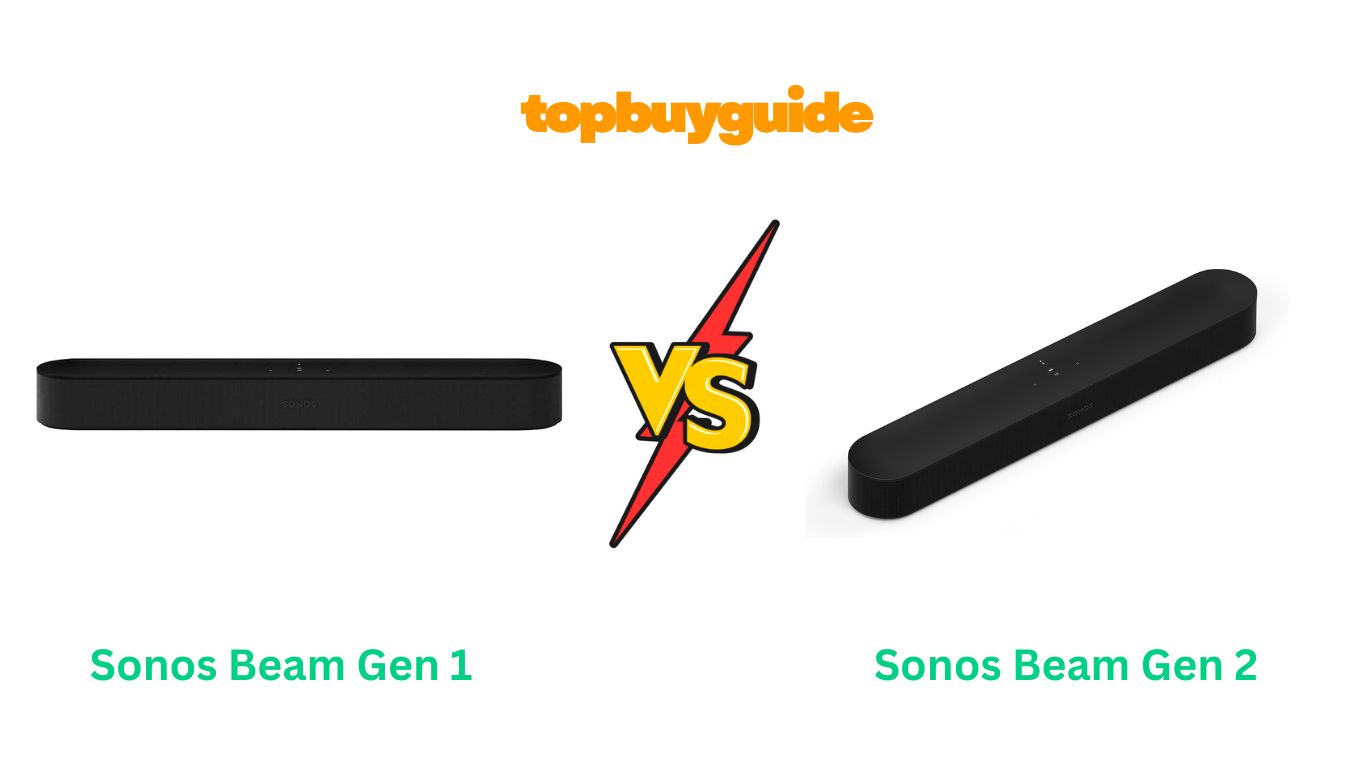
Deciding between the Sonos Beam Gen 1 and Gen 2 challenges buyers seeking compact premium soundbars. Both deliver impressive audio in small packages, yet the Gen 2 introduces significant technological advances. I recommend the Sonos Beam Gen 2 for most users wanting future-proof home theater experiences. The Gen 2 offers Dolby Atmos support and HDMI eARC connectivity for immersive three-dimensional sound. These critical upgrades make the Gen 2 worth the additional investment for serious entertainment enthusiasts.
Why Do I Recommend The Sonos Beam Gen 2?
The Sonos Beam Gen 2 stands out as the superior choice for several compelling reasons:
- Revolutionary Dolby Atmos Support: The Gen 2 delivers immersive three-dimensional audio through advanced psychoacoustic processing and virtual height channels. This technology creates overhead sound effects without requiring physical upward-firing drivers in the compact chassis. Conversely, the Gen 1 only supports Dolby Digital 5.1, which lacks any height dimension capabilities.
- Advanced 40% Faster Processor: The Gen 2 features significantly upgraded CPU power enabling complex audio processing for Atmos content. This faster processor allows real-time manipulation of sound positioning, timing, and frequency for spatial audio. The Gen 1’s slower processor cannot handle the computational demands required for height virtualization.
- Enhanced Five-Channel Array Configuration: The Gen 2 utilizes five separate audio processing arrays compared to the Gen 1’s three-array system. Two additional arrays specifically handle surround and height channels for Dolby Atmos content effectively. The Gen 1’s limited three-channel configuration cannot deliver the same spatial audio experience at all.
- HDMI eARC Connectivity Upgrade: The Gen 2 supports HDMI eARC for higher bandwidth audio transmission up to 38 Mbps speeds. This enhanced connection allows uncompressed eight-channel 24-bit/192kHz audio streams and lossless Dolby Atmos formats. The Gen 1 only offers HDMI-ARC with significantly lower bandwidth, limiting audio quality potential dramatically.
- Improved Polycarbonate Grille Design: The Gen 2 features a precisely perforated polycarbonate grille that’s more durable and easier to clean. This premium grille design matches the flagship Sonos Arc aesthetic for cohesive multi-room setups. The Gen 1 uses fabric covering which collects dust and appears less premium overall.
- Superior Vocal and Dialogue Clarity: The Gen 2 delivers noticeably clearer dialogue reproduction through optimized center channel tuning and processing. Oscar-winning sound engineers fine-tuned the Gen 2 specifically to ensure every word remains perfectly intelligible. While the Gen 1 sounds good, the Gen 2’s vocal clarity represents a meaningful upgrade.
- DTS Digital Surround Decoding: The Gen 2 added DTS digital surround sound support through firmware updates after launch. This expanded codec support provides better compatibility with various media sources and streaming services. The Gen 1 lacks DTS decoding entirely, limiting playback compatibility with certain content sources unfortunately.
- Apple Spatial Audio Music Support: The Gen 2 supports Apple spatial audio tracks through Apple Music via the Sonos app. This feature delivers immersive music experiences from Apple’s growing spatial audio catalog for subscribers. The Gen 1 cannot play spatial audio music content from any streaming service whatsoever.
Side By Side Comparison Chart – Sonos Beam Gen 1 vs Gen 2
| Feature | Sonos Beam Gen 1 | Sonos Beam Gen 2 |
| Dolby Atmos Support | No | Yes (virtual height) |
| Audio Processing Arrays | 3 arrays | 5 arrays |
| Processor Speed | Standard | 40% faster CPU |
| HDMI Connectivity | HDMI-ARC only | HDMI-ARC + eARC |
| Maximum Bandwidth | Lower (ARC) | 38 Mbps (eARC) |
| Supported Audio Formats | Dolby Digital, Dolby Digital 5.1 | Atmos, Dolby TrueHD, Dolby Digital Plus |
| DTS Decoding | No | Yes (Digital Surround) |
| Uncompressed Audio | No | Yes (24-bit/192kHz) |
| Grille Material | Woven fabric | Perforated polycarbonate |
| Apple Spatial Audio Music | No | Yes (via Apple Music) |
| Dolby Atmos Music | No | Yes (Amazon Music HD) |
| NFC Quick Setup | No | Yes |
| Center Channel Tuning | Standard | Enhanced (Oscar engineers) |
| Height Channel Processing | Not available | HRTF psychoacoustic tech |
| Launch Price | $399 / £399 / AU$599 | $449 / £449 / AU$699 |
| Current Availability | Discontinued | Currently available |
| Firmware Updates | Limited | Ongoing (DTS added) |
What Common Features Do Sonos Beam Gen 1 and Gen 2 Share?
Identical Physical Dimensions and Design
Both soundbars measure exactly 25.6 inches wide, 3.9 inches deep, and 2.3 inches tall. This compact footprint fits perfectly in front of TVs without blocking screens or remote sensors. The curved, pill-shaped design maintains Sonos’s signature minimalist aesthetic beautifully throughout both generations. Both models weigh approximately 6 pounds, making wall mounting easy with optional brackets sold separately. The low-profile design allows placement on furniture or shelves without dominating your entertainment center visually. Neither soundbar requires extensive space planning compared to traditional multi-speaker surround sound systems significantly.
Capacitive Touch Control Panel
Both the Gen 1 and Gen 2 feature identical touch-sensitive controls on the top surface. These capacitive controls handle play/pause, track skip, volume adjustment, and microphone mute functions intuitively. The touch panel responds instantly to deliberate finger taps and swipes for quick adjustments. LED indicators on both models provide visual feedback for connection status, mute status, and errors. The consistent control layout means muscle memory transfers perfectly if upgrading from Gen 1 to Gen 2. Neither soundbar includes physical buttons, maintaining a clean and seamless appearance across the entire surface.
Comprehensive Smart Voice Assistant Support
Both generations support Amazon Alexa and Google Assistant for hands-free voice control of entertainment and smart home. The five far-field microphone array uses advanced beamforming and echo cancellation for accurate voice recognition. Users can play music, check weather, set timers, control smart devices, and adjust soundbar settings vocally. Both models allow microphone disabling through physical touch controls or app settings for privacy protection. Voice commands work from across large rooms, recognizing natural speech patterns without requiring shouting. Neither soundbar forces users to choose one assistant permanently; you can switch between them easily.
Sonos TruePlay Room Calibration Technology
Both soundbars include TruePlay automatic room tuning that optimizes sound for your specific listening environment. This technology uses your iPhone’s microphone to measure room acoustics and adjust audio output accordingly. TruePlay compensates for furniture placement, room dimensions, and acoustic reflections to maximize sound quality automatically. The calibration process takes just minutes, walking you through different listening positions systematically. Both models sound significantly better after TruePlay tuning compared to default factory settings consistently. Android users can still enjoy both soundbars but miss TruePlay’s automatic optimization features unfortunately.
Speech Enhancement and Night Sound Modes
Both generations offer Speech Enhancement mode accessible through the Sonos app for improved dialogue clarity. This feature boosts center channel frequencies, ensuring every spoken word cuts through background music and effects. Night Sound mode reduces loud effects and enhances quiet sounds, perfect for late-night viewing without disturbing others. Both audio enhancements work independently and can be toggled on or off based on content. The features prove especially valuable for dialogue-heavy dramas, news broadcasts, and podcasts with quiet speakers. Neither mode requires complex configuration; simple app toggles activate or deactivate them instantly.
Seamless Sonos Multi-Room Ecosystem Integration
Both soundbars integrate perfectly with the broader Sonos multi-room audio ecosystem for synchronized playback. You can group either Beam with other Sonos speakers throughout your home for whole-house audio. Both models support wireless surround sound expansion using compatible Sonos speakers as rear channels. Adding a Sonos Sub enhances bass response dramatically for theater-quality low-frequency impact on both generations. The Sonos app manages all speaker groupings, volume levels, and audio sources from one intuitive interface. Both soundbars can play different content simultaneously or sync with other rooms based on preferences.
Apple AirPlay 2 Wireless Streaming
Both the Gen 1 and Gen 2 support Apple AirPlay 2 for wireless audio streaming from iOS devices. AirPlay 2 enables high-quality audio transmission from iPhones, iPads, and Macs to either soundbar seamlessly. Users can stream music, podcasts, audiobooks, and other audio content directly without Bluetooth pairing hassles. AirPlay 2 also allows Siri voice commands through your Apple device to control playback remotely. Both soundbars maintain stable AirPlay connections throughout your home without dropouts or quality degradation. The technology works independently of the Sonos app, providing multiple control method options conveniently.
Comprehensive Music Streaming Service Support
Both generations access virtually all major music streaming services through the Sonos app seamlessly. Supported services include Spotify, Apple Music, Amazon Music, Tidal, Deezer, Pandora, and dozens more. Users can search, browse, and play content from multiple services within the unified Sonos interface. Both soundbars save favorite playlists, radio stations, and albums for quick access without navigating apps. The integration eliminates switching between different service apps, creating a cohesive music listening experience consistently. Neither soundbar requires separate app installations beyond the main Sonos control application for full functionality.
Common Features of Sonos Beam Gen 1 vs Gen 2
| Feature | Sonos Beam Gen 1 | Sonos Beam Gen 2 |
| Dimensions (W x D x H) | 25.6″ x 3.9″ x 2.3″ | 25.6″ x 3.9″ x 2.3″ |
| Weight | 6.2 lbs (2.8 kg) | 6.2 lbs (2.8 kg) |
| Driver Configuration | 4 mid-woofers + 1 tweeter + 3 radiators | 4 mid-woofers + 1 tweeter + 3 radiators |
| Class-D Amplifiers | ✓ Yes (5 amplifiers) | ✓ Yes (5 amplifiers) |
| Capacitive Touch Controls | ✓ Yes | ✓ Yes |
| Microphone Mute | ✓ Yes (physical + app) | ✓ Yes (physical + app) |
| Amazon Alexa Support | ✓ Yes (built-in) | ✓ Yes (built-in) |
| Google Assistant Support | ✓ Yes (built-in) | ✓ Yes (built-in) |
| Apple Siri (AirPlay) | ✓ Yes (via device) | ✓ Yes (via device) |
| Five Far-Field Microphones | ✓ Yes | ✓ Yes |
| TruePlay Room Calibration | ✓ Yes (iOS only) | ✓ Yes (iOS only) |
| Speech Enhancement | ✓ Yes | ✓ Yes |
| Night Sound Mode | ✓ Yes | ✓ Yes |
| Loudness Feature | ✓ Yes | ✓ Yes |
| Bass & Treble Adjustment | ✓ Yes (via app) | ✓ Yes (via app) |
| HDMI Connection | ✓ Yes (ARC) | ✓ Yes (ARC + eARC) |
| Optical Audio Adapter | ✓ Included | ✓ Included |
| Ethernet Port | ✓ Yes | ✓ Yes |
| WiFi Connectivity | ✓ 802.11b/g/n/ac | ✓ 802.11b/g/n/ac |
| Apple AirPlay 2 | ✓ Yes | ✓ Yes |
| Spotify Connect | ✓ Yes | ✓ Yes |
| Sonos App Control | ✓ Yes | ✓ Yes |
| Multi-Room Audio | ✓ Yes | ✓ Yes |
| Wireless Surround Support | ✓ Yes (2 speakers) | ✓ Yes (2 speakers) |
| Sonos Sub Compatible | ✓ Yes | ✓ Yes |
| Wall Mount Socket | ✓ Yes (0.5 inch) | ✓ Yes (0.5 inch) |
| Color Options | Black, White | Black, White |
| LED Status Indicators | ✓ Yes | ✓ Yes |
A Detailed Comparison Of the Sonos Beam Gen 1 vs Gen 2
Dolby Atmos and Surround Sound Capabilities
The Beam Gen 2 delivers virtual Dolby Atmos through advanced psychoacoustic processing without physical upward-firing drivers. The 40% faster CPU enables real-time audio manipulation using HRTF technology to create phantom height channels. Two dedicated processing arrays handle overhead and surround sound positioning, moving specific sounds throughout the soundstage. While not matching true Atmos systems with height speakers, the Gen 2 creates convincing spatial depth.
The Beam Gen 1 maxes out at Dolby Digital 5.1 surround sound without any height dimension. Its three-array configuration lacks the processing channels necessary for Atmos content handling or vertical audio. The Gen 1 delivers excellent front-facing soundstage width but cannot reproduce overhead effects like helicopters flying. For flat-plane surround sound, the Gen 1 performs admirably, but lacks modern immersive audio capabilities.
HDMI Connectivity and Audio Format Support
The Beam Gen 2 features HDMI eARC support providing substantially higher bandwidth up to 38 Mbps. This enhanced connection enables uncompressed eight-channel 24-bit/192kHz audio streams and lossless Dolby TrueHD/Atmos formats. The eARC implementation future-proofs the soundbar for evolving high-resolution audio standards and streaming services. Users with compatible TVs experience noticeably better audio quality from premium streaming sources consistently.
The Beam Gen 1 includes HDMI-ARC connectivity with more limited bandwidth compared to eARC specifications. While HDMI-ARC handles Dolby Digital effectively, it cannot transmit uncompressed multi-channel audio or lossless formats. The Gen 1 remains compatible with most modern TVs but misses enhanced audio quality potential. For compressed streaming audio, the difference remains minimal, but audiophiles notice limitations with high-quality sources.
Processing Power and Audio Array Configuration
The Beam Gen 2’s upgraded processor runs 40% faster, enabling sophisticated real-time audio processing for spatial effects. Five separate processing arrays handle center, left, right, surround, and height channels independently and simultaneously. This computational power allows dynamic sound positioning that responds to content instantaneously without audible processing delays. The enhanced arrays create wider soundstage and more precise audio localization throughout the listening area.
The Beam Gen 1 uses a less powerful processor with three audio processing arrays total. These arrays handle front left, center, and right channels without dedicated surround or height processing. The Gen 1’s processor proves sufficient for standard surround sound but lacks headroom for advanced features. While the Gen 1 sounds excellent for its era, the processing limitations prevent future feature additions.
Grille Design and Build Quality
The Beam Gen 2 features a precisely perforated polycarbonate grille with thousands of microscopic holes replacing fabric. This durable plastic construction resists wear, stays cleaner longer, and maintains appearance over years of use. The polycarbonate design matches the premium Sonos Arc aesthetic, creating visual cohesion in multi-speaker setups. Users can simply wipe dust away without worrying about fabric deterioration or staining over time.
The Beam Gen 1 uses woven fabric covering stretched around its curved exterior for a soft look. While attractive initially, fabric collects dust, may stain, and can show wear with heavy use. The textile covering requires more careful cleaning to maintain appearance compared to hard plastic materials. Some users prefer the fabric’s softer, warmer aesthetic despite practical maintenance considerations with the material choice.
Music Playback Capabilities
The Beam Gen 2 supports Apple spatial audio music tracks through Apple Music integration via Sonos app. Dolby Atmos Music from Amazon Music HD plays with full three-dimensional processing for immersive listening. The enhanced processor handles complex music mixing with greater dynamic range and detail compared to Gen 1. Music enthusiasts appreciate the Gen 2’s refined treble, warmer mid-range, and controlled bass response significantly.
The Beam Gen 1 delivers excellent stereo music playback through all supported streaming services effectively. However, it cannot play spatial audio or Atmos music formats from any streaming platform. The Gen 1’s tuning emphasizes balanced frequency response suitable for various music genres competently. While music sounds very good, the Gen 1 lacks the Gen 2’s enhanced clarity and dimensionality.
Firmware Update Support and Future Features
The Beam Gen 2 receives ongoing firmware updates adding new features like DTS Digital Surround decoding. Sonos continues developing enhancements leveraging the Gen 2’s faster processor and expanded capabilities regularly. Recent updates improved center channel clarity, added codec support, and enhanced smart home integrations. The Gen 2’s architecture allows Sonos to add features impossible on older hardware limitations.
The Beam Gen 1 receives maintenance updates but cannot receive major feature additions due to processing constraints. The slower processor and limited arrays prevent implementation of newer audio technologies retroactively. While the Gen 1 remains fully functional, it won’t benefit from advanced features requiring Gen 2 hardware. Users seeking future-proofing should strongly consider the Gen 2 over the discontinued Gen 1 model.
NFC Quick Setup Technology
The Beam Gen 2 includes an NFC chip positioned left of the control panel for tap-to-setup functionality. Android users can simply tap their NFC-enabled phone to the soundbar to initiate pairing instantly. This streamlined setup process eliminates manual app navigation for initial configuration on compatible devices. The NFC implementation reflects Sonos’s commitment to user-friendly setup experiences across all platforms equally.
The Beam Gen 1 lacks NFC technology, requiring traditional app-based setup through WiFi connection procedures. Users must manually connect to the soundbar through the Sonos app during initial configuration. While still straightforward, the Gen 1 setup takes slightly longer without NFC tap-to-pair convenience. iOS users see minimal difference since Apple devices don’t utilize NFC for soundbar pairing.
Conclusion
The Sonos Beam Gen 2 represents the definitive choice for compact premium soundbar excellence and future-proofing. Dolby Atmos support delivers three-dimensional audio experiences impossible with the Gen 1’s flat surround sound. The 40% faster processor and five-array configuration enable sophisticated spatial audio processing and ongoing feature additions. HDMI eARC connectivity ensures compatibility with the highest-quality lossless audio formats from streaming services. Enhanced dialogue clarity, Apple spatial audio music support, and DTS decoding provide comprehensive format compatibility. While the Gen 1 remains capable, the Gen 2’s technological advances justify choosing it for the ultimate compact home theater experience.
Frequently Asked Questions
Q: Is the Sonos Beam Gen 2 worth upgrading from Gen 1?
Yes, if you value Dolby Atmos and future-proofing, the Gen 2 upgrade makes sense. The virtual height channels, enhanced processor, and eARC connectivity provide meaningful improvements over Gen 1. However, if you’re satisfied with Gen 1’s performance and lack Atmos content, the upgrade isn’t urgent. Consider your content sources and audio format priorities before upgrading.
Q: Does the Beam Gen 2 really deliver Dolby Atmos without height speakers?
Yes, but with limitations compared to soundbars with dedicated upward-firing drivers. The Gen 2 uses psychoacoustic processing to create virtual height channels that simulate overhead sound. While not matching physical height speakers, the Gen 2 delivers noticeably more spatial depth than standard surround. Expectations should be realistic regarding “true” overhead sound reproduction capabilities.
Q: Can I use the Beam Gen 1 with newer TVs?
Yes, the Beam Gen 1 works perfectly with modern TVs via HDMI-ARC or optical connection. However, you won’t access Dolby Atmos content or eARC’s enhanced audio quality features. The Gen 1 remains fully compatible for Dolby Digital 5.1 content from any TV. Consider the Gen 2 only if you specifically want Atmos support capability.
Q: Which Beam model sounds better for music streaming?
The Beam Gen 2 delivers noticeably better music reproduction with warmer treble, richer mid-range, and wider soundstage. Spatial audio music from Apple Music and Amazon Music HD provides immersive listening experiences. However, the Gen 1 still sounds excellent for stereo music playback from streaming services. Music enthusiasts will appreciate the Gen 2’s sonic refinements and enhanced dynamic range significantly.
Q: Do both Beams work with Google Assistant and Alexa?
Yes, both Gen 1 and Gen 2 support Amazon Alexa and Google Assistant voice control. You can choose either assistant but must select only one at a time. The five-microphone array on both models provides excellent voice recognition from across rooms. Voice control features remain identical between generations for smart home and playback control.
Q: Can I add surround speakers to the Beam Gen 1?
Yes, the Beam Gen 1 supports wireless surround speakers just like the Gen 2. You can add two Sonos One, Era 100, or other compatible speakers as rear channels. A Sonos Sub can also be added for enhanced bass on either generation. The multi-room expansion capabilities remain identical between Gen 1 and Gen 2 models.
Q: Does the Gen 2’s Dolby Atmos work with all streaming services?
The Gen 2 plays Dolby Atmos from any source that provides it, including Netflix, Disney+, Apple TV+, and others. Your TV must support and pass through Atmos via HDMI-ARC or eARC to the soundbar. The source content must be encoded in Atmos for height processing to activate. Standard stereo and 5.1 content plays normally without Atmos processing enabled.
Q: Is TruePlay calibration necessary for both Beam models?
TruePlay significantly improves sound quality on both Gen 1 and Gen 2 by optimizing for your room. While not absolutely necessary, both soundbars perform noticeably better after TruePlay tuning completes. Unfortunately, TruePlay requires iOS devices; Android users cannot access this calibration feature. Without TruePlay, both Beams still sound good but may not reach their full potential.

Alex Turner is a dedicated product researcher and reviewer at TopBuyGuide.com, known for his clear, honest, and data-driven insights. He spends countless hours testing, comparing, and analyzing products to help readers make confident and informed buying decisions.